A sim racer’s grip on the wheel is where milliseconds separate podiums from practice laps. Thermaltake’s latest additions— the XRW-G1 GT steering wheel and XRP-L1 loadcell pedal set—aim to shave those fractions off by fusing pro-grade materials, 16-bit sensor precision, and software-tunable feedback into a single platform. The move signals a push toward deeper hardware-software lock-in for enthusiasts who treat sim racing like a real-world discipline.
The XRW-G1 GT is built around a 300 mm GT-style layout that marries CNC-machined aluminum, carbon fiber, and reinforced polymer to strike a balance between rigidity and weight. At its core sits a 5-inch touchscreen that streams RPM telemetry, flags, and race data without demanding visual shifts. Surrounding it is a control cluster of backlit buttons, front/rear toggle switches, three rotary encoders, two thumb encoders, and two funky switches—all mapped via the Thermaltake Sim Racing System software for discipline-specific input profiles.
Carbon-fiber paddle shifters deliver crisp, immediate gear-change feedback, while customizable RGB LEDs act as real-time RPM and system status indicators. A steel-ball quick-release mechanism (paired with an optional adapter) allows tool-free wheel swaps across Thermaltake’s wheelbase lineup, mimicking the rapid changes seen in professional pits.
- Construction: 300 mm GT-style wheel with CNC aluminum, carbon fiber, reinforced polymer
- Display: 5-inch integrated touchscreen for RPM/flag data
- Controls: Backlit buttons, toggle switches, rotary/thumb encoders, funky switches
- Shifters: Magnetic carbon fiber paddle shifters with instant feedback
- Indicators: Customizable RGB LEDs for RPM and alerts
- Quick Release: Steel ball system (adapter sold separately)
The XRP-L1 pedal set takes a different approach: single-block CNC aluminum construction paired with an optimized FEM design to eliminate flex under heavy braking. The throttle pedal uses a 16-bit Hall sensor, self-lubricating nylon sleeve, and precision ball bearings for linear input. Adjustable pedal throw and spring preload let users fine-tune response curves, while interchangeable springs and rubber dampers on the brake side mimic real-world pressure feedback. Mounting is via stainless steel brackets with 5-degree angle increments, ensuring compatibility across setups without sacrificing stability.
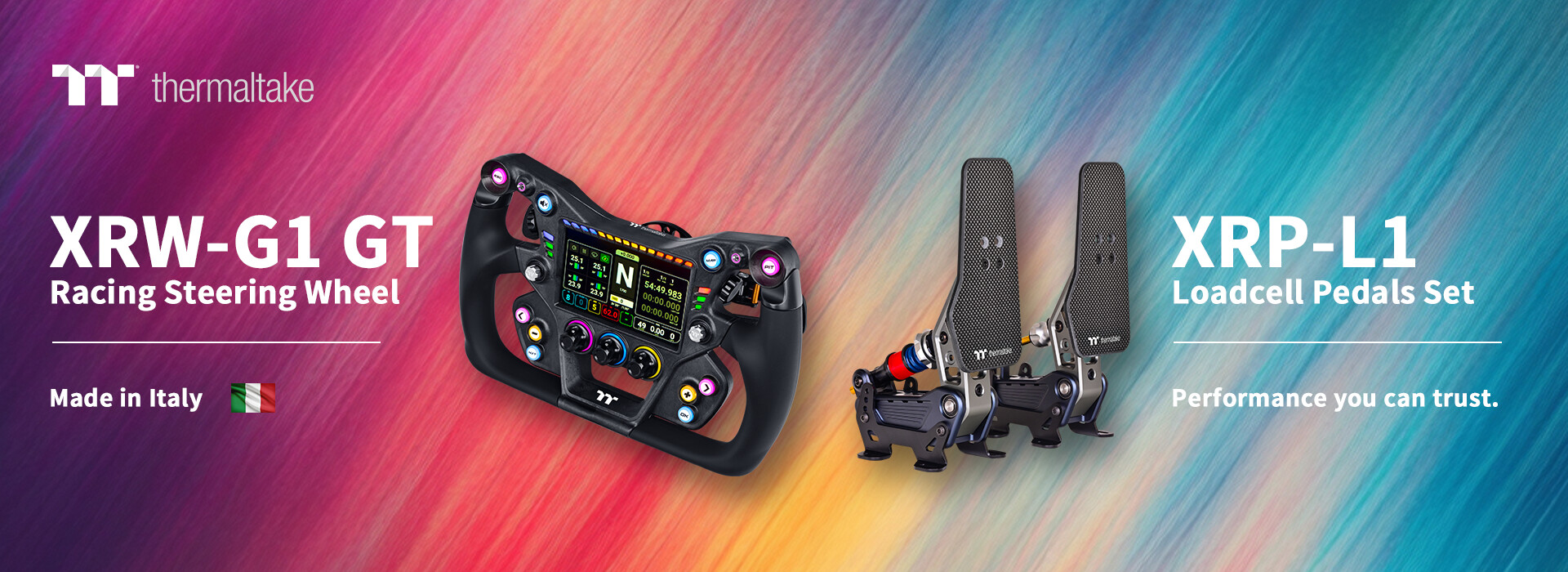
- Throttle: 16-bit Hall sensor, adjustable throw, self-lubricating nylon sleeve
- Brake: 200 kg load cell with interchangeable springs and dampers
- Mechanicals: Precision shafts, ball bearings for long-term reliability
- Mounting: Adjustable angles (5° increments), stainless steel brackets
That’s the upside—here’s the catch. Both components are fully integrated into Thermaltake’s Sim Racing System software, meaning users who rely on third-party tuning tools or prefer open-source pedal maps may find themselves constrained by the ecosystem. The XRW-G1 GT also lacks a built-in clutch paddle, which some competitive setups still demand for full GT3/GT4 simulations. And while the 16-bit Hall sensor in the throttle is a step up from many consumer pedals, it doesn’t match the resolution of some high-end loadcell-based alternatives.
Who benefits most? Competitive sim racers already deep in Thermaltake’s ecosystem—those using the brand’s wheelbase adapters, display mounts, and software tuning profiles—will see immediate gains. The XRW-G1 GT’s touchscreen and paddle shifters are tailored for endurance racing and high-intensity sprints, while the XRP-L1’s brake/pedal tunability mirrors real-world car dynamics without requiring external hardware. For casual or multi-game setups, the added cost of full integration may not justify the switch.
The launch doesn’t confirm pricing or availability outside Thermaltake’s official channels, but the emphasis on Italian craftsmanship and single-block aluminum construction suggests a premium positioning. Whether it shifts the balance in sim racing hardware wars remains to be seen—but for those already locked into the ecosystem, the stakes are clear.