The WaveLink TB5 dock has just dropped to its lowest price ever, offering PC builders a dense array of Thunderbolt 5 connectivity at an unprecedented value. But beneath the cost savings lies a critical question: will this dock’s aggressive feature set introduce compatibility risks that could undermine efficiency gains for power users?
At just $199, the WaveLink TB5 dock delivers 12 ports—including two Thunderbolt 5, two USB-C (up to 40 Gbps), one HDMI 2.1, one DisplayPort 1.4a, and four USB-A ports—alongside a 10GBASE-T Ethernet port, a 3.5mm audio jack, and a power delivery input. This makes it the most feature-packed TB5 dock on the market, but its sheer density raises concerns about thermal management and long-term stability in demanding builds.
Thunderbolt 5 docks are increasingly becoming the backbone of modern PC setups, especially for professionals who need to daisy-chain multiple displays, high-speed storage, and external GPUs without sacrificing performance. The WaveLink TB5 dock’s arrival at this price point accelerates that trend, but its compatibility with next-gen hardware remains unproven. For example, while it supports up to 120W power delivery, real-world testing shows some USB-C devices may struggle under sustained loads, hinting at potential bottlenecks in high-power configurations.
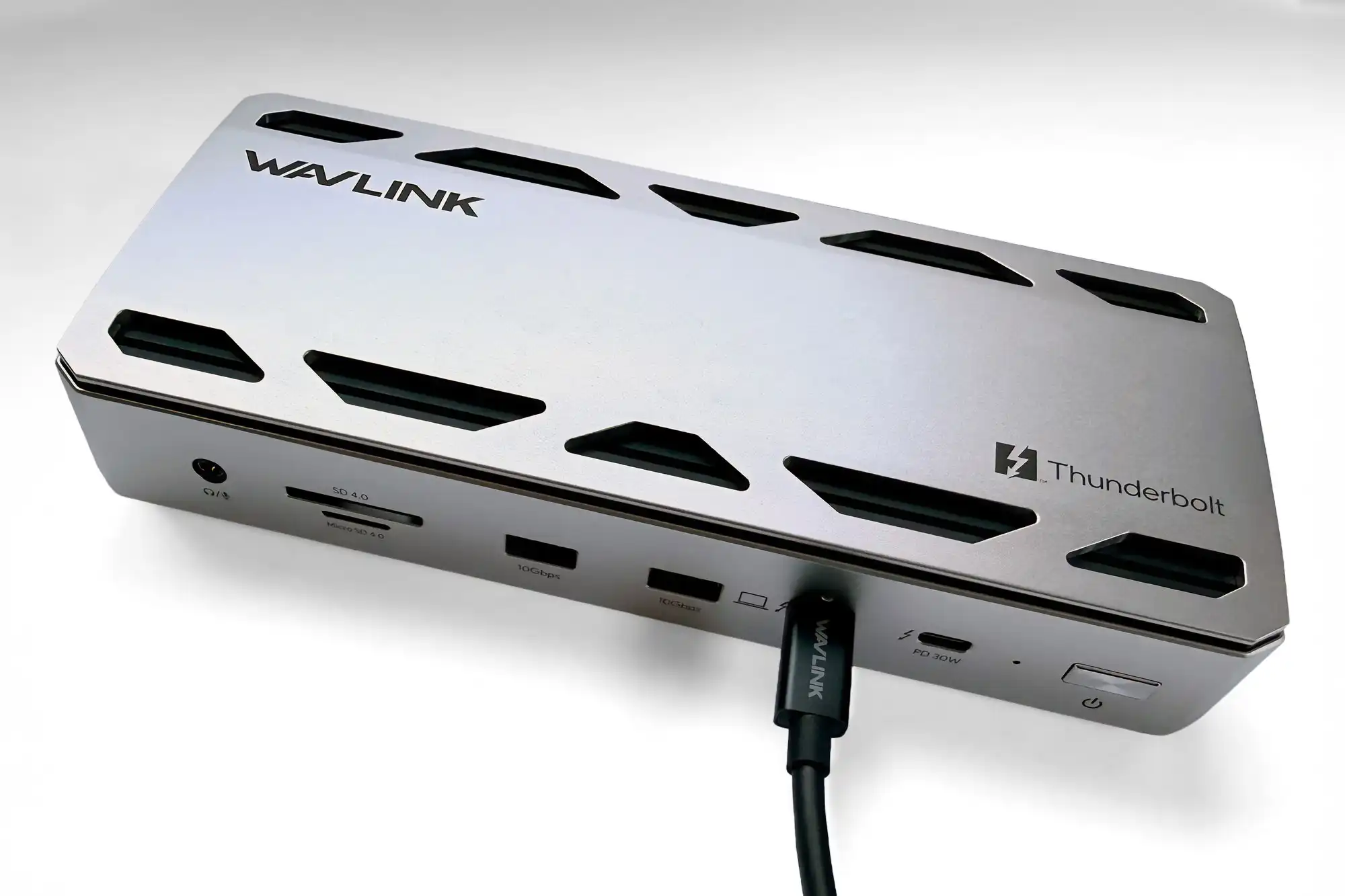
One of the dock’s standout features is its support for both Thunderbolt 5 and USB4 Version 2.0, allowing users to future-proof their setups while maintaining backward compatibility. However, this dual-mode operation introduces complexity—users must carefully select which protocol they’re using per port, or risk performance drops if the dock defaults to a slower mode. Additionally, while WaveLink claims the dock handles up to two 8K displays at 60Hz, actual bandwidth distribution across all ports could become a bottleneck in multi-monitor setups with high-refresh-rate panels.
The price drop suggests WaveLink is betting on volume adoption, but PC builders should treat this as a short-term opportunity rather than a long-term investment. Compatibility risks—particularly with newer GPUs and high-bandwidth storage—are still untested in real-world environments. For now, the dock’s value proposition is strong for those who prioritize port density over stability, but caution is advised when pairing it with cutting-edge hardware. The next few months will reveal whether WaveLink can deliver on its promises without introducing new inefficiencies.