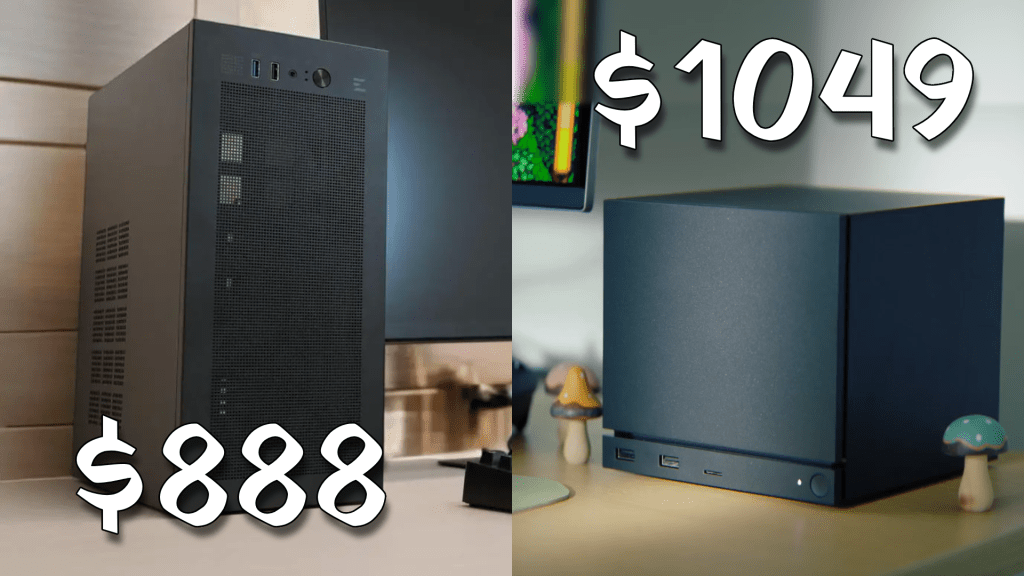
A $900 gaming PC can be a hard sell. Valve’s Steam Machine—built to blur the line between console and desktop—lands at that price point with the promise of next-gen power without the usual desktop clutter. But for those willing to roll their own, an alternative emerges: a DIY build that shaves nearly $150 off the official cost while delivering comparable performance. The catch? It requires more effort, a deeper understanding of hardware, and a willingness to accept some compromises in design and convenience.
The question isn’t just about saving money anymore. In an era where pre-built gaming rigs are becoming more competitive on price and features, the DIY path is no longer about raw savings—it’s about control, customization, and whether the effort translates into tangible benefits. For power users who treat their gaming setup like a precision instrument, that trade-off can still be worthwhile.
What changed in 2017?
In previous generations, building your own Steam Machine was often a necessity rather than a choice. Valve’s original hardware, released in 2015, was expensive and lacked the flexibility of a traditional desktop build. Fast-forward two years, and the landscape has shifted. The new Steam Machine, now powered by an Intel Core i7-6700K processor, 16 GB of DDR4 RAM, and a 2 TB SSD, represents Valve’s attempt to refine its vision: a console-like form factor with desktop-level performance.
- Processor: Intel Core i7-6700K (Quad-Core, 4.0 GHz base, up to 4.2 GHz Turbo)
- RAM: 16 GB DDR4 (2133 MHz)
- Storage: 2 TB SSD
- Graphics: NVIDIA GeForce GTX 970 (4 GB GDDR5)
The DIY alternative, however, doesn’t just match this spec sheet—it often exceeds it. A custom build can include the same i7-6700K or even a more powerful variant like the i7-6800K, paired with 32 GB of RAM and a faster GTX 1070 or RTX 2060 in some configurations. The result? A machine that isn’t just cheaper but also more future-proof.
Reality check: Is the performance gap real?
On paper, the differences are clear. But in practice, the story is more nuanced. Benchmarks show that a DIY build with a GTX 1070 can outperform the Steam Machine’s GTX 970 by roughly 20-25% in gaming benchmarks. However, those gains come with caveats. The Steam Machine’s closed design ensures better thermal management and noise suppression, while a DIY build might require careful case selection to avoid overheating or excessive fan noise.
For power users, the real advantage lies elsewhere: customization. Swapping out components for future upgrades, adding more storage, or even overclocking are options that Valve’s hardware doesn’t support. But those perks come with a cost—literal and figurative. The DIY path demands time, patience, and a willingness to troubleshoot hardware issues that pre-built systems often avoid.
Who benefits most?
The $150 savings is meaningful but not revolutionary. What’s truly transformative is the ability to tailor every aspect of the build to specific needs—whether it’s prioritizing cooling for overclocking, optimizing airflow for silent operation, or future-proofing for next-gen GPUs. For those who see their gaming rig as an extension of their workflow—not just a device but a tool—the DIY route still holds weight.
Yet the gap is narrowing. Pre-built systems are becoming more modular, and Valve’s SteamOS has matured significantly since its early days. The question for 2017 isn’t whether to build or buy—it’s how much control you’re willing to sacrifice for convenience. For power users who value precision over plug-and-play simplicity, the DIY path remains a viable alternative. But the premium on performance is shrinking, and the lines between console-like elegance and desktop flexibility are blurring faster than ever.