China’s LineShine supercomputer has emerged as a game-changer in high-performance computing (HPC), achieving a sustained performance of 2.198 ExaFLOPS in double-precision computing. This milestone, verified by independent benchmarks, positions it as the first system to exceed 2 ExaFLOPS without relying on GPU acceleration, signaling a significant shift in HPC design paradigms.
The LineShine’s theoretical peak performance of 2.736 ExaFLOPS suggests an impressive sustained efficiency near 80%, outpacing competitors like the U.S.-based Frontier and El Capitan. Unlike many modern AI-focused systems that prioritize 8-bit precision, the LineShine maintains a strong focus on traditional FP64 performance, making it particularly suited for scientific simulations such as climate modeling and fluid dynamics.
The supercomputer’s architecture is built around 13.79 million ARMv9 cores distributed across 20,480 nodes. Each node houses two LX2 CPUs, each featuring 304 cores with 32 GB of HBM memory. The system scales to 256 GB of DDR5 per CPU, though details on the exact memory type remain unconfirmed.
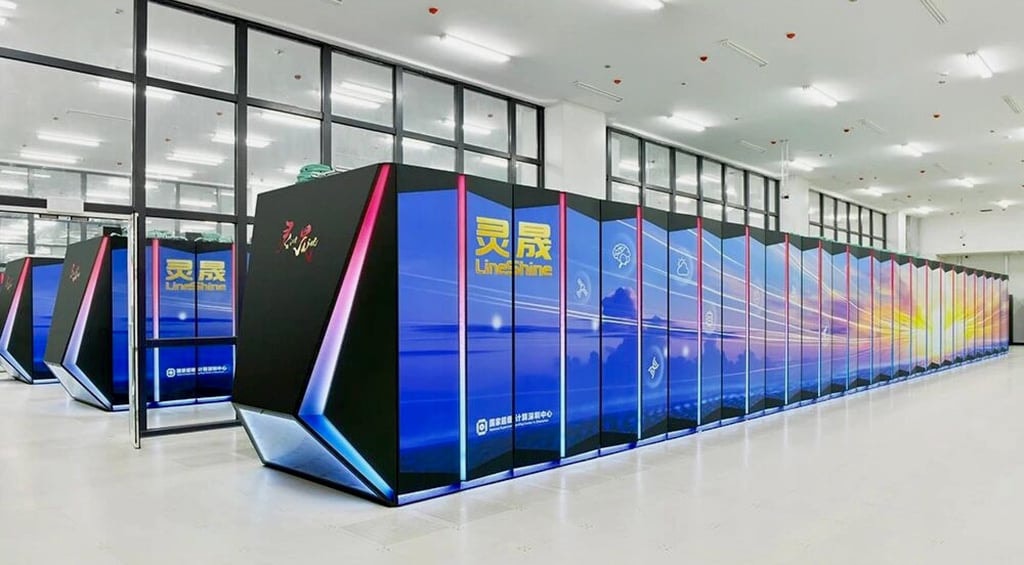
- Compute: 13.79 million ARMv9 cores (CPU-only, no GPU acceleration)
- Peak Performance: 2.736 ExaFLOPS (sustained: 2.198 ExaFLOPS)
- Memory: 32 GB HBM per CPU, 256 GB DDR5 per CPU
- Clock Speed: 1.55 GHz per core
- Power Efficiency: 52.07 GigaFLOPS/Watt at 42.2 MW
The LineShine’s power efficiency, measured at 52.07 GigaFLOPS per watt, is a notable achievement, especially given its CPU-only design. This efficiency nearly doubles that of Japan’s Fugaku supercomputer, which once dominated the HPC landscape with a similar approach.
For small businesses or research institutions considering upgrades, the LineShine’s architecture presents both opportunities and challenges. Its CPU-centric design is well-suited for workloads requiring precise FP64 calculations but may lack flexibility for AI training tasks due to the absence of GPU acceleration. The high memory bandwidth of 256 GB DDR5 per CPU is a standout feature, though thermal constraints and exact memory specifications remain unclear.
One lingering question is whether the LineShine’s performance will translate into real-world applications beyond benchmark tests. While its position on the TOP500 list is confirmed, long-term stability and software optimization will determine the sustainability of this CPU-only exascale computing approach. For now, the LineShine stands as a testament to China’s leadership in HPC, but its broader impact on the industry remains to be seen.