A small business owner preparing to render complex 3D models for a client suddenly finds themselves staring at a critical choice: upgrade their workstation GPU or delay the project entirely. The Intel Arc Pro B65, now available in U.S. retail channels, promises performance tailored for professional workloads but comes with a price that mirrors its high-end siblings—leaving some to wonder if the tradeoffs are worth it.
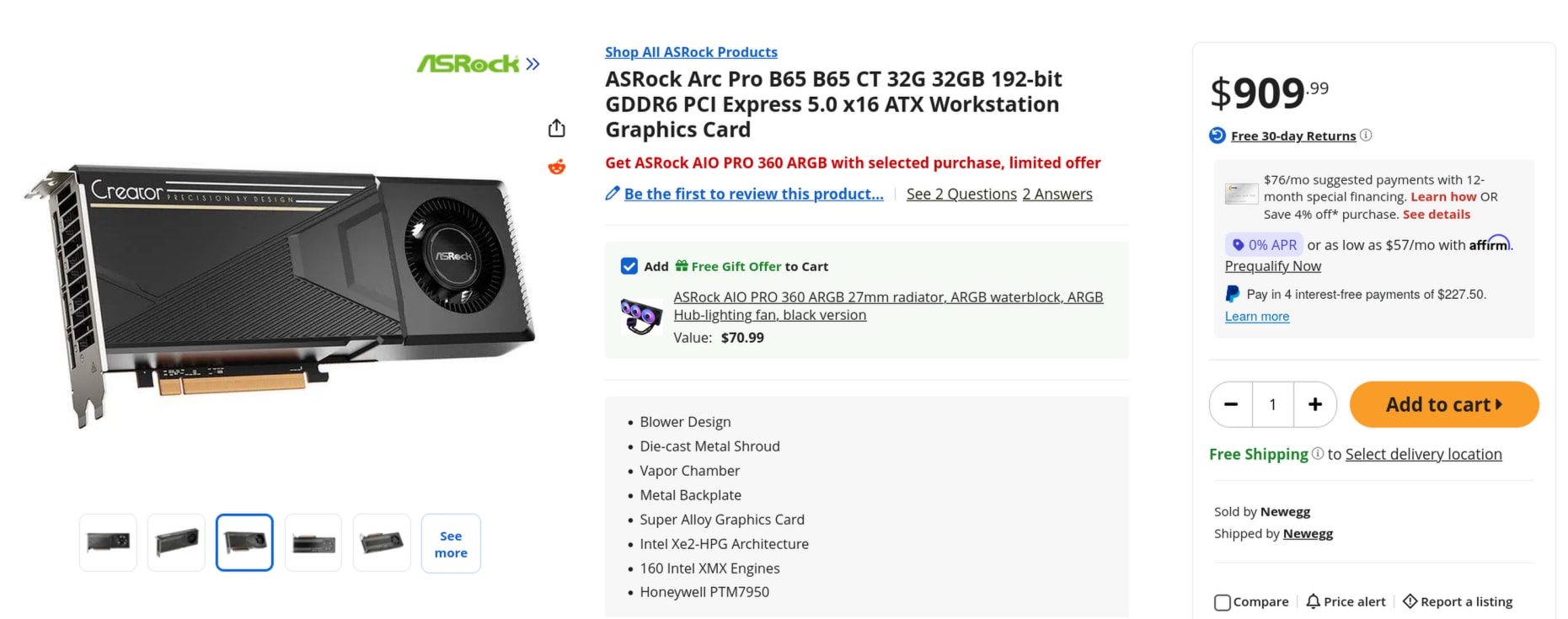
The B65 is not just another entry in Intel’s Arc Pro lineup; it’s a workstation-grade GPU designed for tasks that demand both raw power and reliability. With 20 Xe cores and 32 GB of VRAM, it positions itself between the more affordable B60 (which shares its core count but cuts VRAM to 20 GB) and the flagship B70 (which bumps up to 32 Xe cores while retaining the same memory capacity). The question for potential buyers isn’t just about performance—it’s about whether this configuration justifies a $910 price tag in an era where DRAM shortages continue to squeeze margins.
For enthusiasts, the B65’s specifications are worth dissecting. It shares the same core architecture as its siblings but strikes a balance that may appeal to users who need substantial VRAM without the full Xe-core count of higher-tier models. The 32 GB of memory is particularly notable, as it addresses the growing demands of AI-driven workloads and large-scale data processing—areas where even mid-range workstations are increasingly pushing boundaries.
Key Specifications
- Model: Intel Arc Pro B65 (ASRock variant)
- Xe Cores: 20
- VRAM: 32 GB (ECC support implied)
- Price: $910
- Comparison:
- Intel Arc Pro B70: 32 Xe cores, 32 GB VRAM, $999.99
- Intel Arc Pro B60: 20 Xe cores, 20 GB VRAM, $660 (estimated)
The price discrepancy between the B65 and its siblings is striking. While the B70’s additional Xe cores might justify a $90 premium for users who can leverage them, the B65’s $250 markup over the B60—despite sharing the same core count—hints at the broader market pressures shaping GPU pricing today. DRAM shortages, in particular, have made memory capacity a decisive factor in cost, leaving little room for negotiation even as demand remains strong.
For everyday users, particularly small businesses or freelancers, the B65’s value proposition hinges on workload specificity. If your tasks involve rendering high-resolution 3D models, processing large datasets, or running AI-driven applications, the extra 12 GB of VRAM over the B60 could be a game-changer—provided the price doesn’t become a bottleneck. However, those working with less demanding workloads may find the B70’s additional Xe cores offer better long-term scalability without stretching budgets further.
A Closer Look at Tradeoffs
The B65’s placement in Intel’s lineup reflects a deliberate engineering tradeoff: balancing core count and memory capacity to serve a niche but critical segment of the market. While it doesn’t match the raw performance of the B70, its 32 GB of VRAM makes it a strong contender for tasks where memory bandwidth is as important as compute power. This could be particularly appealing for industries like architecture or product design, where large files are the norm.
Looking ahead, the B65’s availability raises questions about the broader GPU market. Will prices stabilize as DRAM shortages ease, or will manufacturers continue to pass on costs to consumers? For now, the B65 stands as a benchmark—one that challenges buyers to weigh performance against price in an era where both are increasingly uncertain.