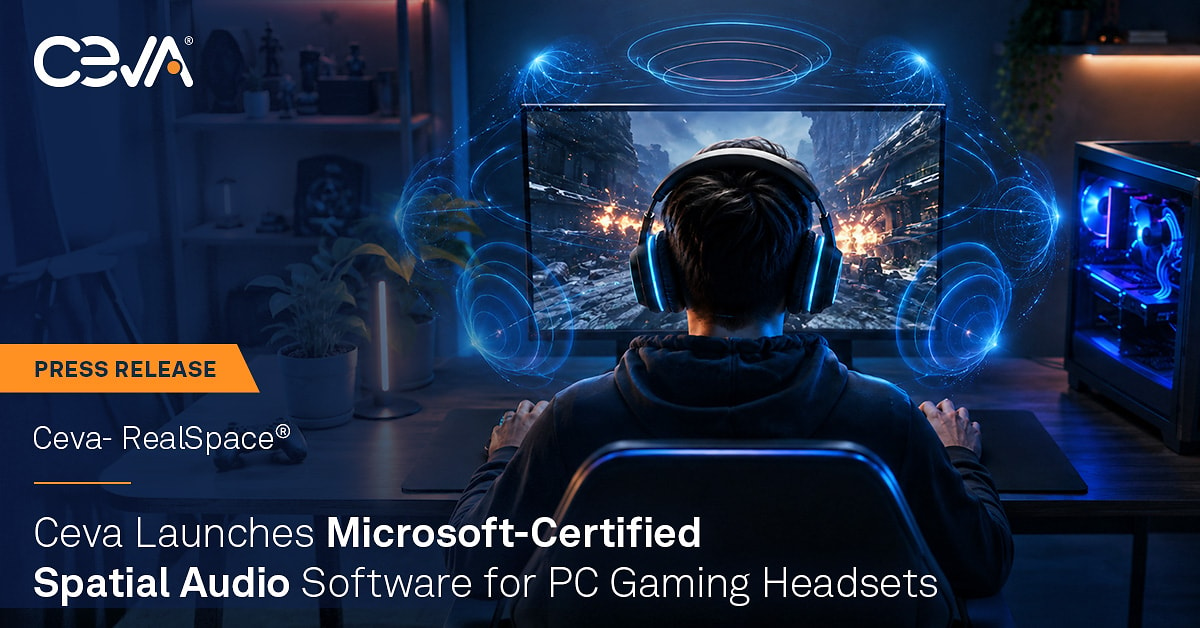
Gaming headset manufacturers are gaining a powerful yet flexible way to deliver premium spatial audio without the usual constraints of cost or complexity. The RealSpace Elevate solution from Ceva introduces a Microsoft-certified Windows Audio Processing Object (APO) that enables OEMs to craft unique, high-performance sound experiences tailored to their hardware.
Unlike generic OS-level solutions or third-party applications, this APO offers deep customization over user interfaces, branding elements, and audio presets—all while maintaining precise sound localization critical for competitive gaming. It supports both entertainment content and gaming scenarios, where accurate spatial cues can be a decisive factor in performance.
Technical Overview
- Core Capability: 7.1 multichannel spatial rendering with natural externalization
- Customization: Full control over UI, branding, and audio profiles for competitive/casual modes
- Platform Integration: Seamless deployment via Windows APO architecture, ensuring compatibility across all supported systems
The solution builds on Ceva’s established RealSpace engine but refines it specifically for headset manufacturers. It eliminates the need for proprietary software stacks that often lead to fragmentation or performance compromises, instead providing a ready-to-deploy tool that balances speed with precision.
Market Impact
Spatial audio has become a key differentiator in premium headsets, but OEMs have historically faced significant barriers—high development costs, time-consuming implementation, and the risk of incompatible user experiences. RealSpace Elevate addresses these challenges by offering a production-ready APO that maintains performance while allowing manufacturers to tailor sound profiles to their product identity.
Industry observers suggest this approach will accelerate innovation in the gaming headset market, where demand for unique audio signatures is increasing. By avoiding the limitations of generic solutions or third-party apps, OEMs can now focus on refining user experiences without sacrificing control over branding or functionality.
Future Outlook
The solution is designed to work across Windows PCs, ensuring broad compatibility while preserving OEM ownership of the audio experience. While exact pricing and licensing terms are undisclosed, its availability signals a shift toward more cohesive, hardware-optimized spatial audio in gaming peripherals—one that prioritizes both performance and differentiation without compromising cost efficiency.