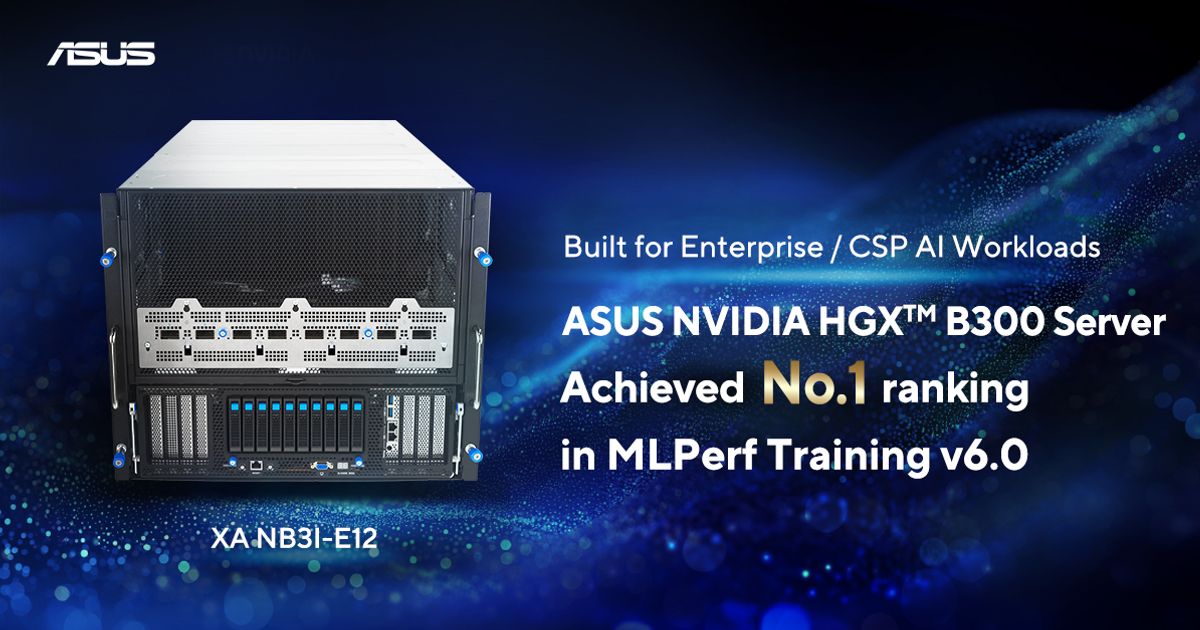
The ASUS HGX B300 server has emerged as a benchmark leader in AI training efficiency, achieving top marks across multiple MLPerf tests. This positions the platform as a critical asset for organizations scaling large-scale machine learning workloads, where performance and resource optimization are paramount.
training demands have surged with the rise of complex models, pushing data centers to balance computational power with energy efficiency. The HGX B300 addresses this by integrating NVIDIA’s latest GPU architecture into a server designed for high availability and supply chain stability—a key differentiator in today’s constrained market.
Performance and Practicality
The HGX B300 outperforms competitors in training tasks, including image classification and language modeling. Its ability to handle large datasets with minimal latency makes it particularly suited for enterprises transitioning from prototyping to production AI systems. Unlike previous generations, the server’s design prioritizes both raw performance and operational scalability, which is essential as teams move beyond research to real-world deployment.
Industry Implications
- Supply Chain Stability: The HGX B300’s reliance on NVIDIA’s established GPU ecosystem reduces dependency on volatile component markets, a strategic advantage for long-term planning.
- Energy Efficiency: While not the sole focus of its benchmarks, the server’s architecture suggests improvements in power consumption per training cycle—a critical factor as data centers face increasing pressure to lower operational costs.
The HGX B300’s success underscores a broader trend: AI workloads are no longer just about raw compute but also about how that compute is packaged, deployed, and sustained. For organizations investing in AI infrastructure, this server represents a practical leap forward—one that balances performance with the realities of today’s data center ecosystems.