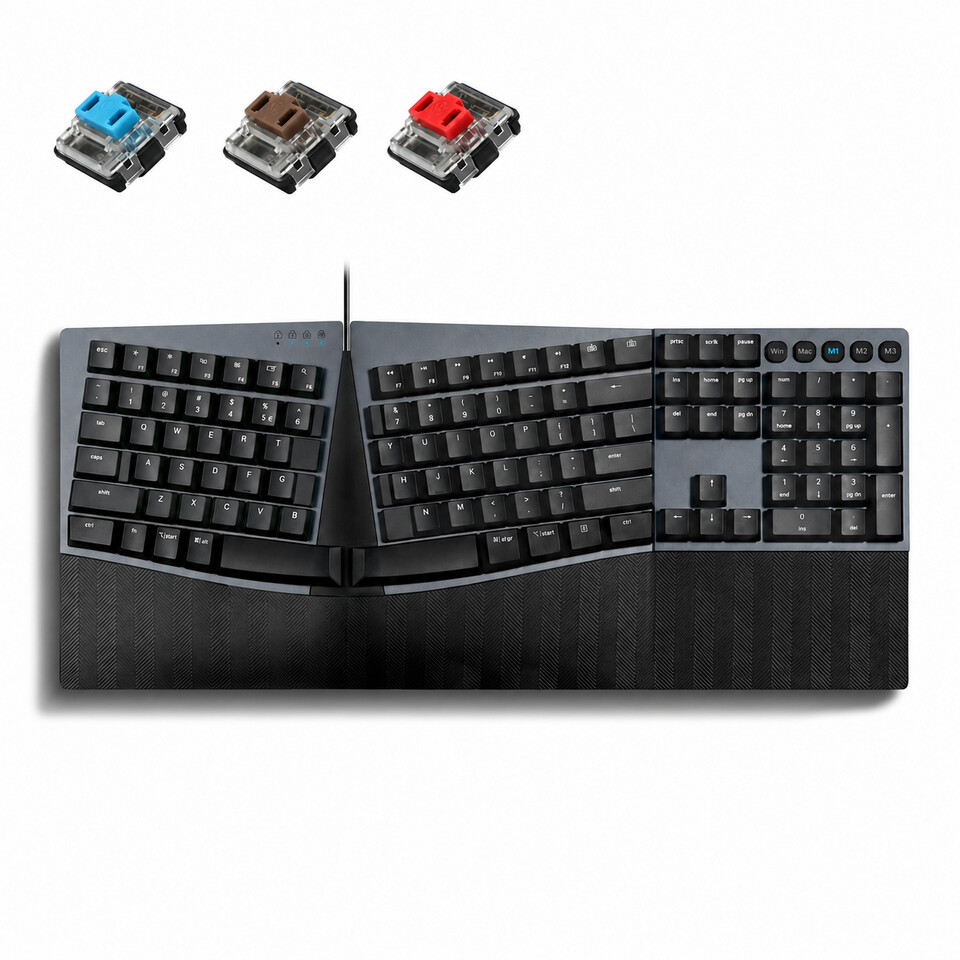
The Periboard-535 II represents a significant evolution in office keyboard design, moving beyond the conventional full-size layout to prioritize biomechanical efficiency. By splitting the keyboard and curving it to match natural hand positioning, Perixx has addressed a critical gap in workplace ergonomics—one that becomes increasingly relevant as sedentary work patterns extend. The integrated palm rest further reduces wrist strain, making it particularly suitable for professionals who spend long hours typing, from software developers to content creators.
Noise reduction is another key focus of the Periboard-535 II. While blue switches provide the familiar clicky feedback, brown and red variants offer tactile or linear responses with significantly lower audio output. This addresses a persistent challenge in shared office environments, where keyboard acoustics can become a distraction or compliance issue under noise regulations. The inclusion of N-key rollover (NKRO) support ensures flawless keystroke registration without requiring additional software, a practical consideration for IT departments managing fleet deployments.
Key Specifications and Industry Positioning
- Design: Split, curved full-size layout with integrated palm rest; adjustable negative tilt angles (0°, -4°, -7°)
- Switch Options: Blue (clicky), Brown (tactile quiet), Red (linear quiet)
- Performance Features: N-key rollover for error-free keystroke registration across all keys; web-based macro and key remapping without software dependencies
- Connectivity: Wired USB with cross-platform compatibility (Windows, macOS, Linux)
- Pricing: Blue variant priced at $84.99; Brown and Red variants at $89.99
The adjustable tilt angles strike a balance between ergonomic customization and desk space efficiency. While negative tilts are common in ergonomic keyboards, the 0°, -4°, and -7° increments allow for precise adjustments without sacrificing desk real estate—a consideration that could influence purchasing decisions in environments where both individual comfort and collaborative workflows matter.
The Periboard-535 II also reflects broader industry trends. As remote and hybrid work models persist, the demand for peripherals that mitigate long-term physical discomfort has grown. While competitors have largely focused on either performance or aesthetics, Perixx’s emphasis on ergonomics without compromising mechanical precision positions it as a potential disruptor in the mid-tier keyboard segment. The web-based macro system, accessible from any browser, further aligns with modern IT infrastructure, where centralized management and minimal software requirements are preferred.
Long-Term Considerations for Adoption
Despite its immediate appeal, questions remain about durability. Mechanical keyboards often exhibit varying lifespans depending on switch quality and build materials—a factor that could delay widespread corporate adoption if reliability concerns persist. However, the Periboard-535 II’s design suggests a focus on both short-term comfort and long-term usability, which may offset skepticism over time.
Implications for the Industry
The keyboard’s launch signals a potential shift toward ergonomics as a standard feature rather than a niche offering. If other manufacturers follow suit, we could see a broader redefinition of what constitutes an 'office-grade' peripheral—one that prioritizes not just functionality but also user well-being. This would likely accelerate the phase-out of traditional flat keyboards in favor of designs that adapt to human anatomy rather than the reverse.
For Perixx, the challenge will be balancing innovation with practicality. The Periboard-535 II’s pricing and feature set suggest it targets both individual consumers and small-to-medium businesses, where budget constraints often dictate purchasing decisions. Whether it can maintain this balance while competing with established brands remains to be seen, but its introduction sets a new benchmark for what ergonomic keyboards can achieve without sacrificing performance.