The Cougar MX600 MAX doesn’t just add features to an existing concept—it rethinks how a PC case should function. Traditional designs force users to choose between unrestricted airflow and cable clutter, often relying on fixed mesh panels or limited adjustments. The MX600 MAX breaks this mold with a magnetic floor that replaces screws entirely, allowing components like PSU shrouds or 2.5-inch drive bays to be mounted without tools. This isn’t just convenience; it’s a shift toward modularity in case design, where every element can adapt to the builder’s needs rather than the other way around.
The magnetic floor is the centerpiece of this approach. Beneath its surface lies a grid of neodymium magnets strong enough to hold accessories securely while leaving the underside unobstructed. Cougar’s proprietary cable organizers snap onto these magnets, keeping wires tidy without blocking airflow—something that’s rarely achieved in high-performance cases. Even the mesh panels are removable and can be repositioned independently of the frame, giving builders precise control over ventilation zones.
- Mesh panels are fully detachable and can be adjusted to focus cooling where it’s needed most.
- The magnetic floor eliminates screws for cable management, PSU shrouds, and 2.5-inch drives.
- Supports 240 mm fans on the top, front, and rear without interference from case components.
Performance-wise, the MX600 MAX doesn’t skimp. It maintains a mid-tower footprint but extends its depth to accommodate larger GPUs and coolers while keeping internal space organized. One side of the dual-chamber design is dedicated to GPU and CPU cooler airflow, while the other remains open for additional 2.5-inch drives or extra fans—flexibility that’s uncommon in this form factor.
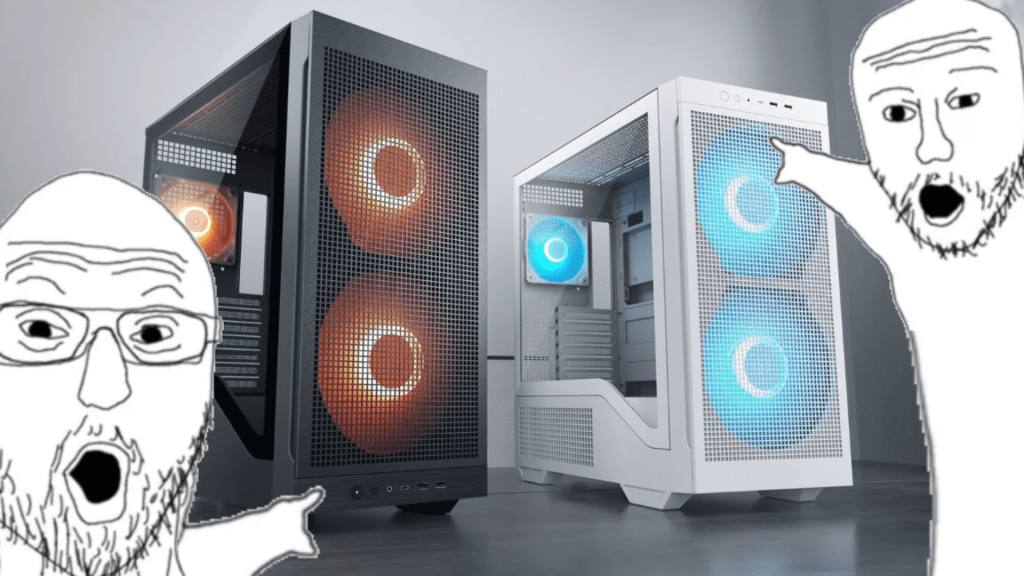
How does it stack up against established alternatives? Most premium cases still rely on fixed mesh panels with minimal adjustments, often using sliding mechanisms for cable access rather than a full magnetic system. Competitors like the Lian Li PC-O11 Dynamic or Fractal Design Meshify C offer tool-less drive bays and adjustable ventilation, but none match the MX600 MAX’s level of modularity in both structure and airflow management. The difference isn’t just theoretical; it’s a tangible shift that could influence future case designs if adopted widely.
For enthusiasts who prioritize clean builds without sacrificing cooling, this approach could become the new benchmark. Traditional cases force compromises—either leaving cables visible for airflow or restricting ventilation to maintain tidiness. The MX600 MAX attempts to resolve this conflict entirely, though its long-term success hinges on two factors: the durability of the magnetic system under daily use and whether Cougar expands compatibility with third-party accessories. If it meets both conditions, other manufacturers may follow suit.
Pricing aligns with premium mid-tower cases, so buyers must decide if the magnetic floor’s convenience justifies the cost over more conventional designs—especially for those who rarely change cable layouts or components. The system is still in its early stages, meaning real-world durability tests are pending. If it proves reliable, this could push the industry toward more modular, adaptable case designs.
Right now, the MX600 MAX is a high-risk, high-reward proposition. It’s not just another case with better cable management; it’s an experiment that, if successful, could redefine what PC cases are capable of. Whether it becomes a niche curiosity or a category-defining product remains to be seen—but it’s certainly a design worth observing closely.