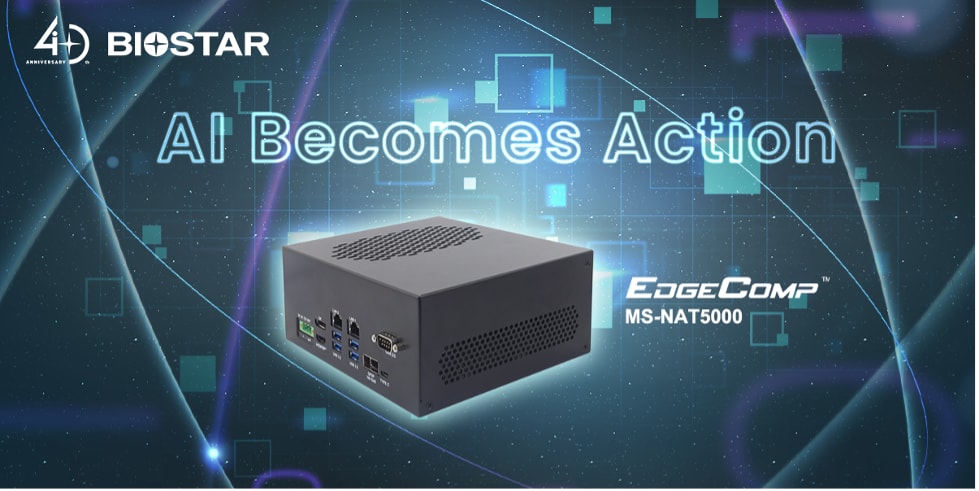
The EdgeComp MS-NAT5000 from Biostar is a compact powerhouse designed for edge AI, but its engineering tradeoffs reveal the challenges of balancing raw performance with real-world usability. By integrating NVIDIA’s Jetson Thor T5000 module—capable of 2,070 TFLOPS of FP4 AI processing—the system aims to bring generative AI and sensor-driven intelligence closer to the source than ever before. However, whether that promise translates into practical value depends on how it handles workload isolation, thermal constraints, and industrial connectivity.
At its core, the MS-NAT5000 is built for environments where latency matters: smart factories, autonomous machines, or real-time visual inspection systems. It pairs 128 GB of LPDDR5X memory with a 14-core Arm CPU, delivering the muscle needed for LLM, VLM, and multimodal AI tasks at the edge. But the tradeoff is clear—this level of performance demands careful thermal management and power efficiency, which may not yet be fully optimized for mass adoption.
Performance vs. Practicality: The Edge AI Dilemma
The system’s 1x QSFP28 (breakout to 4 x 25GbE) and dual 5GbE LAN ports are designed for high-bandwidth sensor workflows, but the real bottleneck could be how it handles workload isolation. Supporting navigation, vision processing, and language-based interactions simultaneously means system integrators will need to fine-tune software stacks to avoid bottlenecks—a challenge that isn’t fully addressed in the current spec sheet.
- 2,070 TFLOPS FP4 AI performance (NVIDIA Blackwell architecture)
- 128 GB LPDDR5X memory, 16 GB DDR5 (unified or separate? Not yet confirmed)
- 14-core Arm CPU for general workloads
- Industrial-grade expansion: M.2 slots for storage, 4G/5G/Wi-Fi, and CAN FD interfaces
The MS-NAT5000 also includes optional SATA III with SSD hot-swap trays and a wide DC input range (12–36V), making it adaptable to rugged environments. But for PC builders or system integrators, the lack of clarity on whether DDR5 is unified or separate from LPDDR5X raises questions about memory bandwidth bottlenecks—a critical factor in AI workloads.
Competitive Lens: Where It Stands
Compared to other edge AI solutions, the MS-NAT5000 positions itself as a high-performance alternative, but it’s not without competition. NVIDIA’s own Jetson platforms and AMD’s ROCm-based offerings already dominate the space. The question is whether Biostar can differentiate itself by focusing on industrial-grade reliability and connectivity—features that matter more in smart manufacturing than raw TFLOPS alone.
Looking ahead, the MS-NAT5000 could set a new benchmark for edge AI systems if it delivers on its promises of low-latency processing and workload isolation. But for now, buyers will need to weigh the benefits against potential thermal and power challenges—especially in environments where efficiency isn’t just preferred but required.