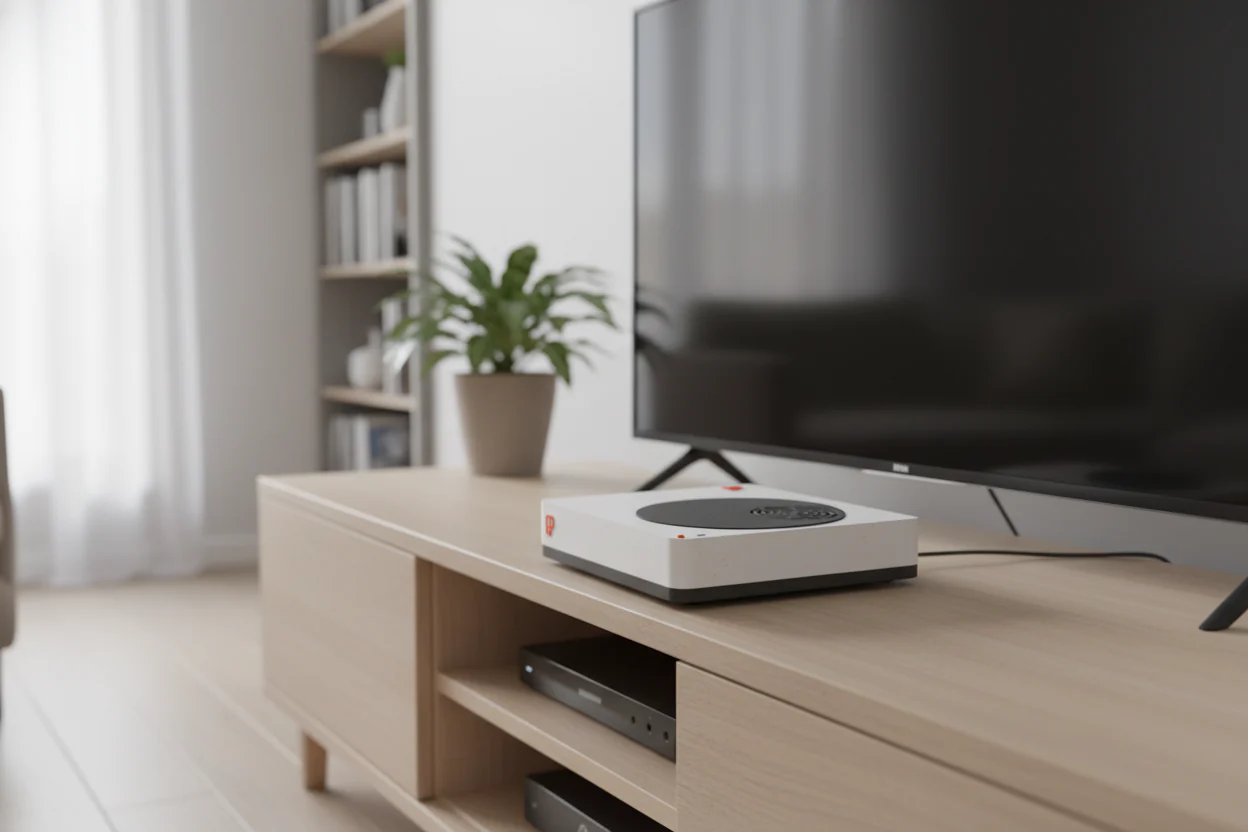
The ASUS ExpertCenter PN55 is not just another mini PC. It’s a deliberate attempt to cram workstation-level horsepower into a form factor small enough for tight desks or rack-mounted setups, all while keeping costs in check for IT teams that demand more than a thin client can offer.
At its core, the PN55 runs on AMD’s Ryzen 7 8620U processor—part of the AI 400 series—paired with up to 128GB of DDR5-6400 RAM and 4TB of NVMe storage. It skips traditional displays in favor of a single HDMI 2.1 port, but its real strength lies in I/O flexibility: four USB-C ports (two with Thunderbolt 4), two DisplayPorts, an M.2 socket for expansion, and dual gigabit Ethernet. This configuration is designed to serve as a headless compute node or a lightweight workstation, depending on how it’s deployed.
The AI 400 series in a tiny chassis
AMD’s Ryzen 7 8620U brings the Zen 4 core architecture and RDNA 3.5 graphics to the PN55, but without the full complement of iGPU features seen on desktop parts. It’s clocked at up to 4.1GHz and supports AV1 hardware encoding—a detail that matters for media transcoding or low-latency video streaming in enterprise setups. The chip is paired with up to 128GB of DDR5-6400 RAM, a capacity more commonly associated with desktop workstations than mini PCs.
Storage options are equally generous: the PN55 supports a single M.2 2280 NVMe SSD slot (PCIe Gen 4), which can hold up to 4TB of data. This isn’t a platform for storage-heavy workloads, but it’s more than enough for IT teams running virtual desktops or lightweight file servers where raw compute is the bottleneck.

Key specs
- Processor: AMD Ryzen 7 8620U (Zen 4 core, RDNA 3.5 iGPU)
- Base/Boost clocks: 1.9GHz / 4.1GHz
- TDP: 25W
- RAM: Up to 128GB DDR5-6400 (soldered, no upgrade path)
- Storage: M.2 2280 PCIe Gen 4 NVMe (up to 4TB)
- Display output: HDMI 2.1, two DisplayPorts
- I/O ports:
- Four USB-C (two with Thunderbolt 4)
- Two DisplayPorts
- One M.2 socket (PCIe Gen 4)
- Dual gigabit Ethernet (Intel I211-AT)
- 3.5mm jack, microSD slot
- Power: 90W adapter (100V–240V)
- Operating system: Windows 11 Pro pre-installed
- Certifications: FCC, CE, RoHS
The PN55’s design is a study in tradeoffs. On one hand, it delivers workstation-grade performance in a chassis that measures just 200 x 183 x 45mm—small enough to fit behind most monitors or stack neatly in a rack. The absence of built-in displays or Wi-Fi (it relies on Ethernet) is not an oversight but a deliberate choice for IT teams prioritizing security and stability over convenience.
On the other hand, some compromises are unavoidable. The RAM is soldered to the motherboard, meaning no future upgrades beyond the initial configuration. The single M.2 slot rules out redundancy or multi-drive setups, which could be a dealbreaker for teams running high-availability workloads. And while the Thunderbolt 4 ports enable high-bandwidth peripherals, they’re not as flexible as a full desktop in terms of daisy-chaining or external GPU support.
For IT teams looking to deploy a compact, low-power workstation or AI inference node without breaking the bank, the PN55 offers a compelling balance. It’s not a replacement for high-end desktops, but it fills a niche where space is limited and performance needs are moderate. The real question isn’t whether it can do the job—it clearly can—but whether its constraints will prove frustrating over time.