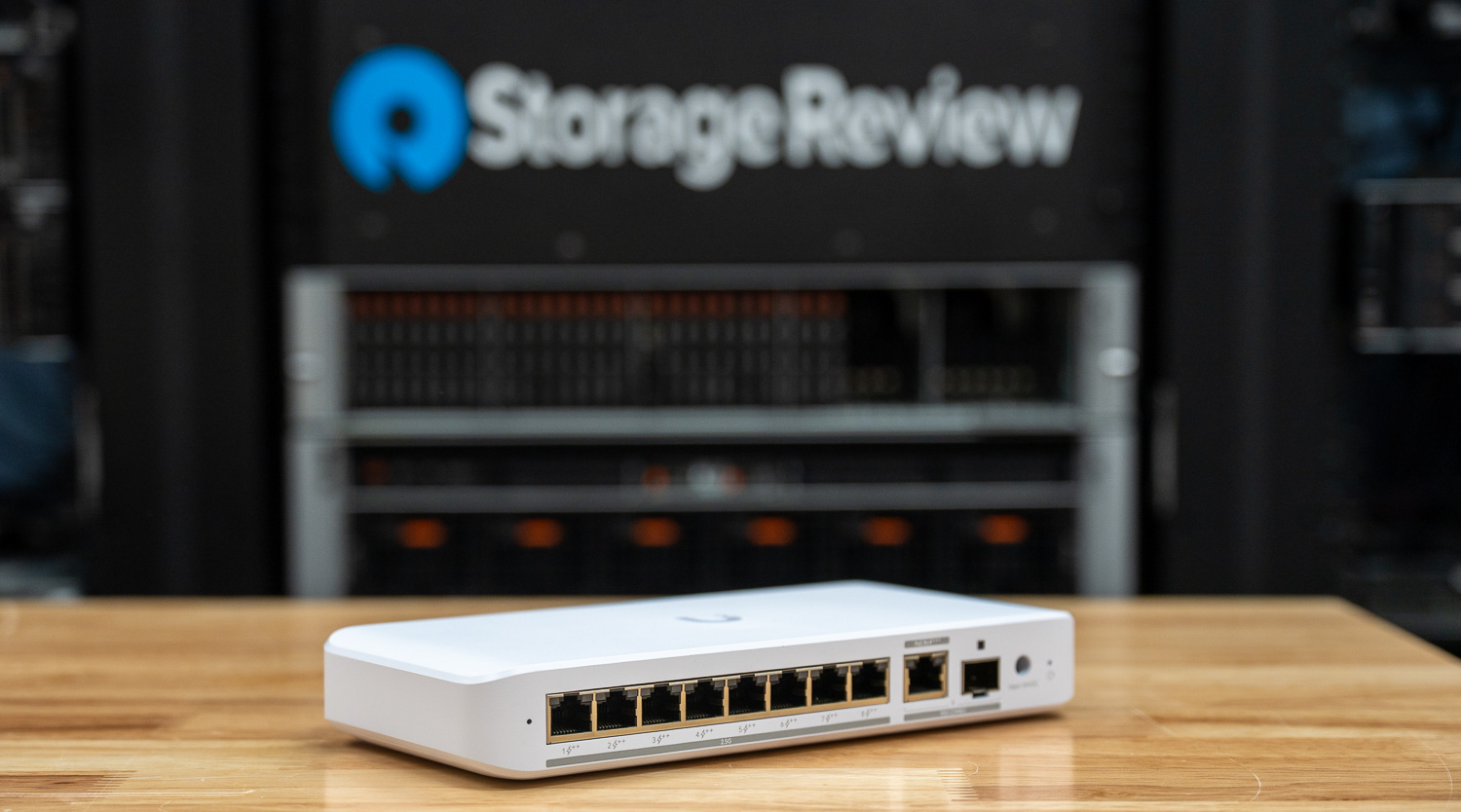
Ubiquiti UniFi Switch Flex 2.5G 8 PoE Review: The Edge Switch That Does It All for $199 by Conor Houser on March 18, 2026 Enterprise ◇ Networking As surveillance systems, enterprise WiFi deployments, and IoT infrastructure continue to evolve, network bandwidth demands are steadily increasing. Devices such as high-resolution security cameras, WiFi 7 access points, and industrial IoT sensors frequently require multi-gigabit connectivity and reliable power delivery. The UniFi Switch Flex 2.5G 8 PoE (USW-Flex-2.5G-8-PoE), available for $199.00 on the Ubiquiti Store, is designed specifically to address this challenge. Acting as a compact edge or “leaf” switch, it extends high-speed connectivity and Power over Ethernet (PoE) capabilities to remote clusters of devices while maintaining a simple uplink back to the core network. Rather than requiring each device to run a direct cable back to the central rack, this switch enables localized distribution of both data and power. This architecture is particularly valuable in surveillance deployments, office expansions, warehouses, and outdoor installations where devices may be physically grouped but located far from the primary switching infrastructure. By combining multi-gigabit ports with a flexible power input design, the Flex 2.5G 8 PoE provides a versatile solution for environments that need both performance and deployment flexibility. One of the most distinctive aspects of the switch is its adaptable power architecture. The device can operate entirely on a high-wattage PoE+++ uplink supplied by a larger upstream switch, or draw power from a dedicated external AC adapter when additional PoE output capacity is required. This flexibility allows administrators to tailor installations based on available power sources and total PoE budget requirements. Specification USW-Flex-2.5G-8-PoE Specifications Overview Dimensions 212.9 × 99.4 × 33.5 mm (8.4 × 3.9 × 1.3 in) Weight 567 g (20 oz) Enclosure Material Polycarbonate Mount Material Polycarbonate Form Factor Compact desktop, wall mount, DIN rail, or magnetic mounting Networking & PoE 2.5 GbE RJ45 Ports 8 (All PoE++) — 2.5G / 1G / 100M / 10M 10 GbE RJ45 Port 1 (PoE+++ Input) — 10G / 5G / 2.5G / 1G / 100M 10G SFP+ Port 1 (10G / 1G) Maximum PoE Output Up to PoE++ (64W per port) Total PoE Availability PoE+++ Input: 76W PoE++ Input: 46W PoE+ Input: 16W 210W AC Adapter: 196W Performance Switching Capacity 60 Gbps Total Non-Blocking Throughput 30 Gbps Forwarding Rate 45 Mpps Supported VLANs 256 MAC Address Table Size 4,000 Hardware & Power Power Method (1) AC/DC Adapter (optional)(1) PoE+++ Max Power Consumption 14W (excluding PoE output) with PoE input, 17W (excluding PoE output) with AC adapter input, 210W maximum, including PoE output Operating Temperature -20 to 45°C (-4 to 113°F) Operating Humidity 10–90% non-condensing Build and Design The Flex 2.5G 8 PoE features a compact polycarbonate chassis measuring just 8.4 × 3.9 × 1.3 inches. This small form factor is intentional and reflects the switch’s intended role as a remote distribution point rather than a rack-mounted core device. Its lightweight construction allows it to be easily mounted in locations where traditional rack equipment would be impractical, such as inside media cabinets, under desks, in network boxes, or in outdoor enclosures. Despite its small footprint, the switch is engineered for high-density connectivity. The panel houses eight 2.5GbE RJ45 ports designed for downstream devices, each capable of delivering PoE++ power. These ports support multiple Ethernet speeds, including 10 Mbps, 100 Mbps, 1 Gbps, and 2.5 Gbps, ensuring compatibility with both legacy equipment and modern multi-gigabit hardware. For uplink connectivity, the switch includes a versatile 10-gigabit combo interface consisting of both a 10G SFP+ slot and a 10GbE RJ45 port. This design allows administrators to choose between fiber and copper uplinks based on the network infrastructure. The presence of a 10GbE backhaul is particularly important because it ensures that aggregated traffic from multiple 2.5GbE devices does not overwhelm the uplink. Additional interface features include a system LED that provides quick status information and a recessed reset button located near the power input. These simple diagnostic tools allow administrators to quickly identify operational issues or restore the device during troubleshooting. Power Architecture One of the defining features of the Flex 2.5G 8 PoE is its adaptable PoE power budget. Unlike traditional switches with fixed internal power supplies, this model can operate under multiple power scenarios depending on its power source. In environments where running a new electrical circuit is impractical, the switch can be powered directly through its 10GbE RJ45 uplink using PoE+++ (90W). When supplied with this high-power PoE input, the switch redistributes approximately 76W of usable power across its downstream ports. This configuration enables a fully cable-simplified installation in which both data and power are delivered via a single Ethernet connection from the upstream switch. For deployments requiring greater power capacity, administrators can connect the optional 210W external AC adapter ($79.00, available on the Ubiquiti Store). This dramatically increases the available PoE budget to approximately 196W, allowing the switch to power more high-consumption devices simultaneously. In high-density installations with multiple access points or advanced surveillance cameras, this expanded power budget becomes essential. Management & Layer 2 Features Managing the Flex 2.5G 8 PoE integrates smoothly with the UniFi Network application (requiring Version 9.0.114 or later). Despite its edge-deployment focus, it retains a robust suite of Layer 2 features. Administrators can leverage Jumbo Frames to maximize throughput for large file transfers, while Spanning Tree Protocols (STP & RSTP) provide essential loop protection. Additional traffic management tools, such as port isolation, storm control, and egress rate limiting, give network engineers granular control over how data behaves before it travels back across the 10GbE uplink. Use Case: Surveillance A common deployment scenario for the Flex 2.5G 8 PoE is as a remote hub for surveillance infrastructure. Instead of routing each camera cable individually back to the central rack, administrators can deploy this switch near the camera cluster. A single 10GbE fiber or copper connection then links the remote switch back to the main network. This approach significantly reduces cabling complexity while maintaining high network performance. Cameras can be powered directly by the switch while their video streams are aggregated and transmitted back to the recording server over the high-speed uplink. Camera Type Average Power Draw Example 76W Budget (PoE+++) Example 196W Budget (AC) G5 Turret Ultra ~4W Up to 8 cameras (32W total) Up to 8 cameras G5 Pro ~10W Up to 7 cameras (70W total) Up to 8 cameras G5 PTZ ~14W Up to 5 cameras Up to 8 cameras G4 PTZ ~43W 1 camera Up to 4 cameras As these examples illustrate, power availability can significantly impact deployment capacity. For standard camera arrays such as the G5 Turret or G5 Bullet models, the PoE+++-powered configuration provides more than enough power for a full cluster. However, installations involving high-draw devices such as PTZ cameras benefit greatly from the larger AC-powered PoE budget. Use Case: Creative Workspaces and Video Editing Beyond surveillance, the shift to 2.5GbE is a massive quality-of-life upgrade for creative workflows. When performing heavy video editing, standard Gigabit Ethernet quickly becomes a severe bottleneck. The Flex 2.5G 8 PoE serves as an excellent local studio switch for connecting a high-speed multi-bay storage enclosure or NAS directly to editing workstations. Leveraging the 10GbE uplink to the core network and 2.5GbE to the machines ensures smooth timeline playback and...