Samsung’s latest OLED monitors are breaking a long-standing rule: durability doesn’t have to mean sacrificing the deep blacks and high contrast that define premium panels.
The new line, codenamed QuantumBlack, is built with an anti-glare surface and a reinforced front layer designed to resist scratches. This marks a significant departure from previous OLED monitors, which often relied on glass surfaces for optimal image quality but left them vulnerable to everyday wear in office environments.
Key specifications include
- A 34-inch screen with a 21:9 aspect ratio and 178-degree viewing angles.
- Support for HDR10+ and a peak brightness of 600 nits, maintaining Samsung’s reputation for high dynamic range performance.
- An anti-glare coating that reduces reflections while preserving color accuracy within a ±2 delta-E range.
The reinforced front layer is said to be up to three times more resistant to scratches than standard OLED panels. While Samsung hasn’t disclosed long-term durability metrics—such as how it holds up after thousands of hours in high-traffic settings—the focus on surface protection suggests a deliberate effort to address one of the biggest pain points for enterprise buyers.
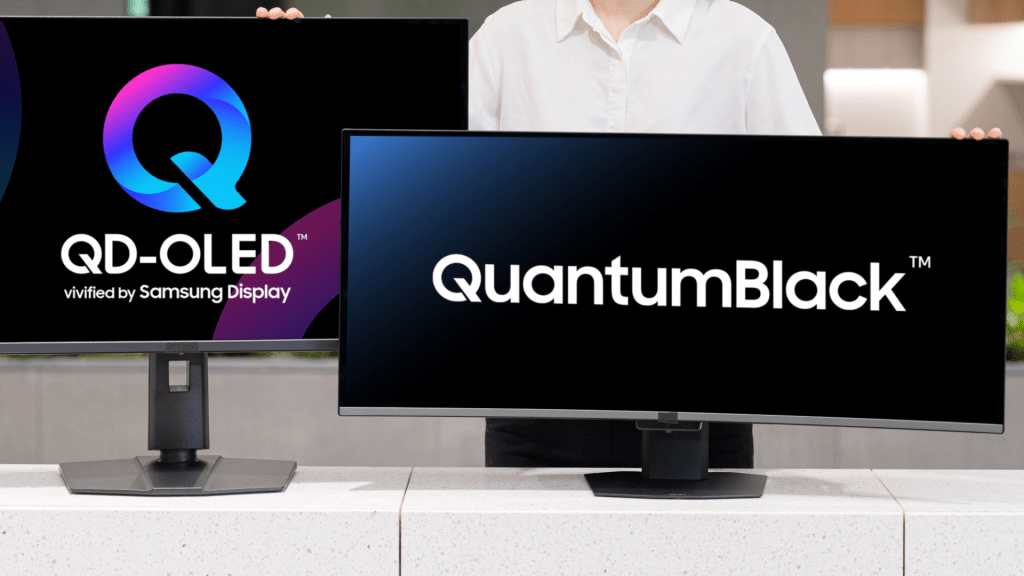
This shift comes at a time when OLED monitors are increasingly competing with traditional LCD and mini-LED displays. The new panels aim to differentiate themselves not just through image quality, but also through practical considerations like glare resistance and longevity—factors that matter more in professional settings than in home entertainment. For businesses, the tradeoff has long been choosing between the vibrant colors and perfect blacks of OLED and the sturdier, often brighter surfaces of LCD or mini-LED. QuantumBlack attempts to eliminate that choice.
The implications for enterprise buyers are clear: if Samsung can deliver on its durability claims without compromising performance, these monitors could become a default option for design studios, video editing suites, and corporate workstations where screen life is measured in years rather than months. However, real-world testing will be needed to confirm whether the anti-glare and scratch-resistant features hold up under prolonged use.
For now, Samsung has confirmed the availability of these panels starting this quarter, with pricing expected to align with its mid-to-high-end OLED monitor lineup. Whether they become a standard in enterprise environments remains an open question—but one thing is certain: the conversation around monitor durability just got more complicated.