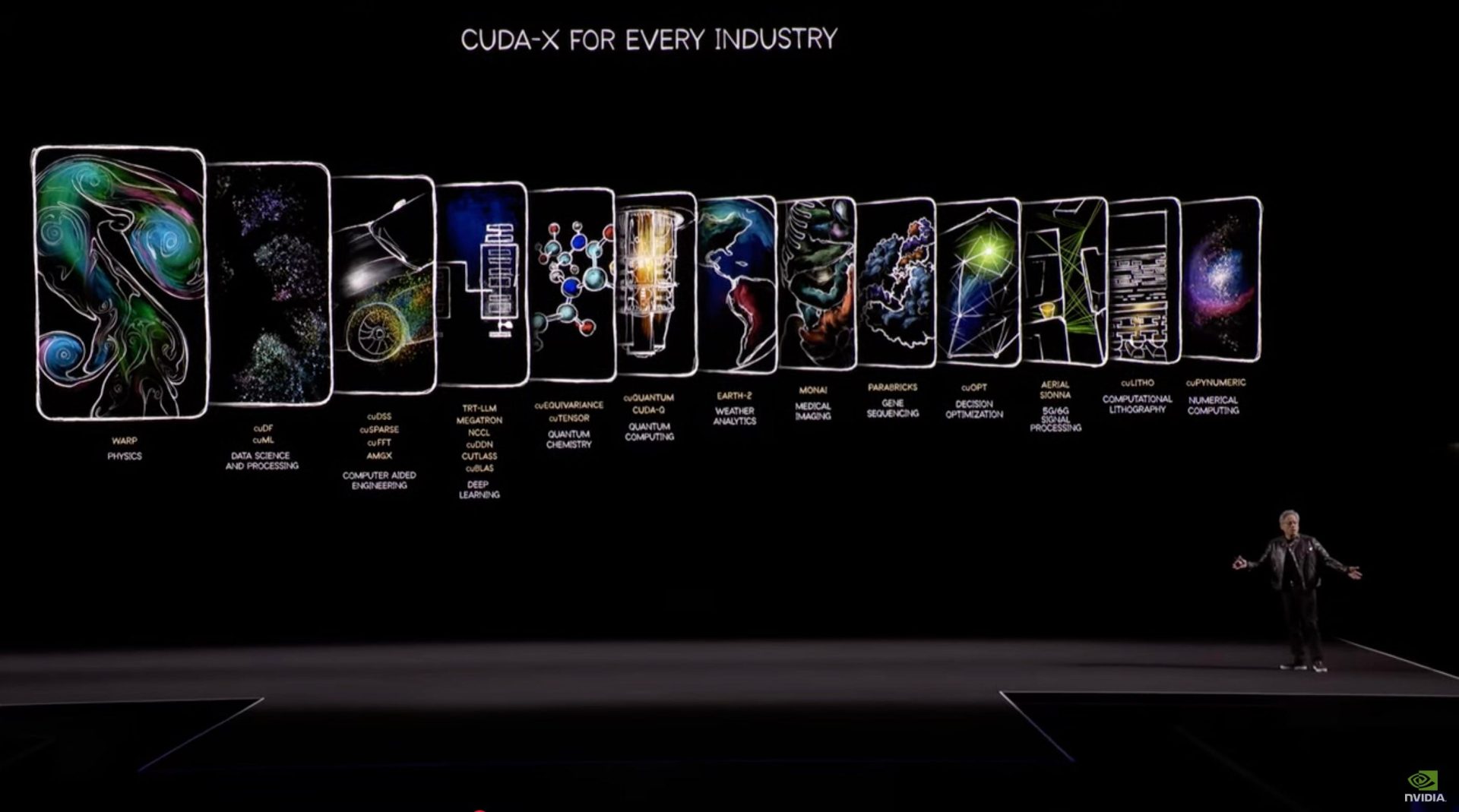
Industry Report NVIDIA CEO Reveals How The Company Survived an “Existential Threat” After Forcing CUDA On Gaming GPUs; Now, It’s Their Biggest Moat Muhammad Zuhair • at EDT Add on Google Image NVIDIA NVIDIA's CEO recalls a pretty interesting moment with the launch of CUDA on GeForce GPUs, saying that it was a bet that could've cost Jensen his company. NVIDIA's CEO Expresses His Gratitude To GeForce Being the Driving Force Behind CUDA It's actually astonishing to see how vital a resource CUDA has become for NVIDIA and its enterprise business, given that, according to Jensen, a framework laid down in 2006 is now the company's biggest reason for dominating the AI race. However, according to Jensen Huang's appearance on the Lex Fridman podcast, CUDA was a major bet for NVIDIA at launch, driven by the goal of not being known as a 'GPU company' but as a complete computing platform provider. Jensen wanted to dominate every workload, rather than becoming a 'specialist' company. Related Story President Trump Assembles an AI ‘Dream Team’ to Advise America’s Future, With Jensen Huang and Lisa Su Among Them The better computing company we become, the worse we became as a specialist. The more of a specialist, the less capacity we have to do overall computing. The company has to find that really narrow path, step by step by step, to expand our aperture of computing but not give up on the most important specialization that we had. - NVIDIA's CEO Jensen talks about how the idea of CUDA, or rather programmable GPUs, surfaced, and how programmable pixel shaders, with the goal of making GPUs practical beyond 3D graphics workloads, helped make that happen. With pixel shaders, NVIDIA envisioned a world where programmability moved beyond the confines of general-purpose CPUs into a new medium. The introduction of pixel shaders was NVIDIA's entrance into the "world of computing", according to how Jensen puts it, but even after it, coding on the GPU wasn't as precise as what other means could achieve. To sort that out, Jensen said that support for FP32 computation within programmable shaders was another massive breakthrough, allowing NVIDIA to break into a market where researchers and experts were considering GPUs for compute-intensive workloads. It was the reason why all of the people who were working on stream processors and other types of dataflow processors discovered us. Here's what's more interesting with CUDA, which is that after NVIDIA achieved programmability with GPUs, they had to pursue this innovation further, but back then, Team Green had a customer base that focused on rendering gaming titles, so there were 'zero' expectations of a return coming from making GPUs programmable through CUDA. Since Jensen & Co. knew that installing CUDA on GeForce GPUs immediately wouldn't yield any financial results, it was a costly bet for them, one that had signifcantly ramped up costs while gross margins shrank. It cost the company enormous amounts of our profits and we couldn't afford it at the time. But we did it anyways because we wanted to be a computing company. We increased our cost by 50% and we were a 35% gross margin company. Our market cap went down to like one and a half billion dollars. What's more interesting is that the CUDA bet took a whole decade to play out, and the patience of both Jensen and the development team in maintaining the software stack without seeing practical results is one of the reasons why CUDA has now evolved into the entity it is today. Jensen is still grateful to GeForce for being the driving force behind CUDA and its software ecosystem. You could imagine that someday this would go into workstations and it would go into supercomputers and in those segments maybe we can capture more margin. So you could reason your way into being able to afford this. I always say that NVIDIA is the house that GeForce built — because it was GeForce that took CUDA out to everybody. Follow on Google to get more of our news coverage in your feeds. Further Reading NVIDIA’s True Power Lies in Its Infrastructure, but There’s an Overlooked Dimension to Its Grip: Jensen’s ‘Web of Alliances’ NVIDIA CEO Doesn’t Believe in “Succession Plans,” Says He Operates in a Way That Doesn’t Make His Company a One-Man Show NVIDIA’s Vera Rubin Racks Are the Costliest to Date, but AI Giants Are Willing to Pay Anything to Avoid Becoming the Next Yahoo Middle East Conflict Could Trigger a ‘Black Swan’ For Chips, Pushing the Industry Into a Period That Could Be Devastating for AI Read all on NVIDIA CEO Reveals How The Company Survived an “Existential Threat” After Forcing CUDA On Gaming GPUs; Now, It’s Their Biggest Moat