For those who remember the RTX 40 series, the jump to NVIDIA’s RTX 50 lineup feels like moving from a high-performance sedan to a hypercar—more power, more efficiency, but also significantly higher expectations. GIGABYTE’s latest AORUS Infinity cards, based on the RTX 5080 and RTX 5070 Ti, push these boundaries further with aggressive clock speeds, dual-flow cooling, and a design that blurs the line between functionality and statement-making aesthetics.
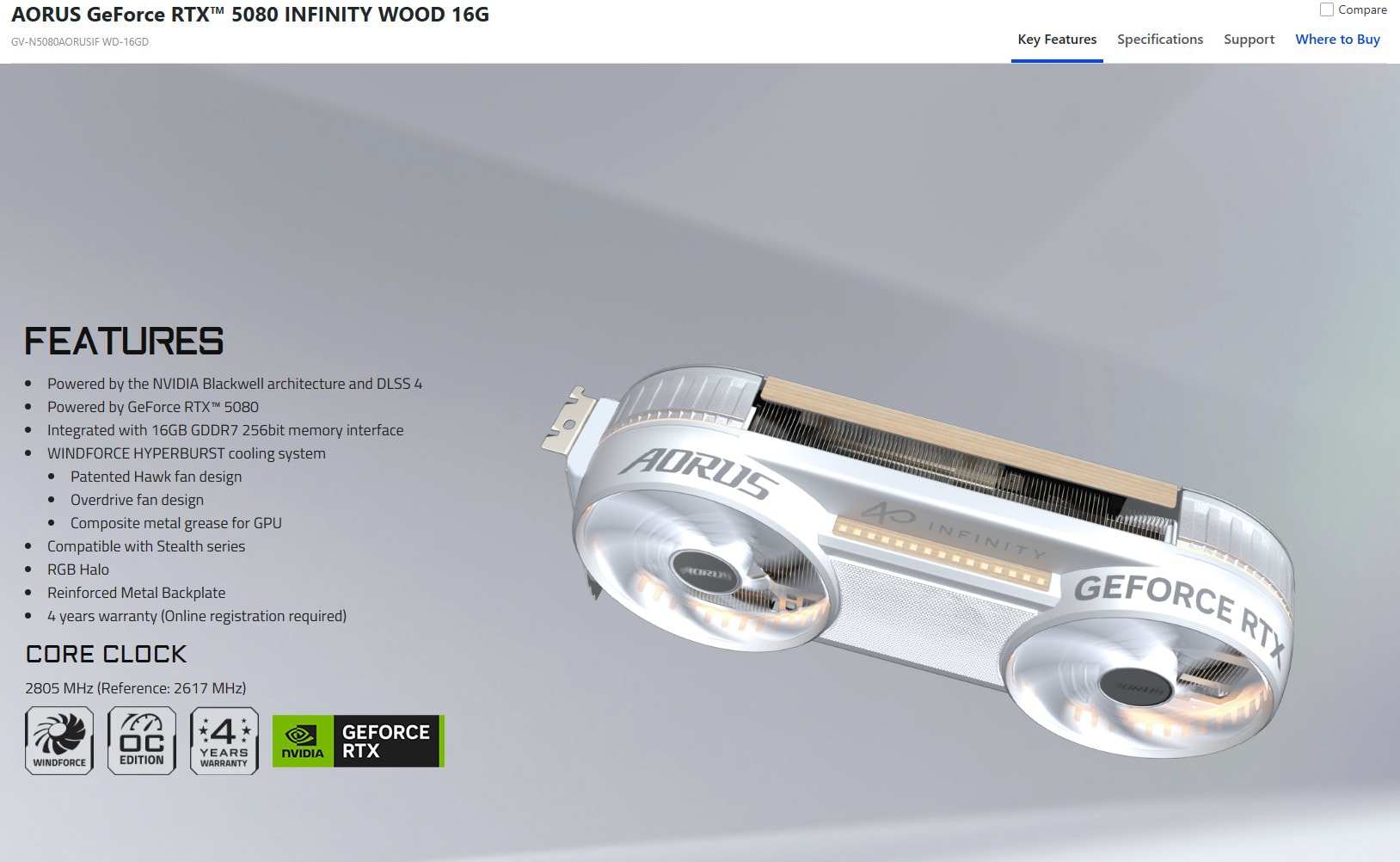
The most striking addition is the RTX 5080 AORUS Infinity Wood, which introduces a matte-white and beige wood trim to its cooler shroud. This isn’t just a cosmetic change; it’s designed to complement GIGABYTE’s Aero Wood series motherboards, creating a cohesive ecosystem for enthusiasts who prioritize both performance and visual harmony in their builds.
Performance-wise, the RTX 5080 AORUS Infinity Wood leads with a factory overclock of 2805 MHz, outpacing NVIDIA’s reference clock by a significant margin. The standard RTX 5080 AORUS Infinity follows suit with identical clock speeds but adopts a more utilitarian design, closely mirroring the RTX 5090’s aesthetic while being lighter and more compact. Meanwhile, the RTX 5070 Ti AORUS Infinity offers a slightly slower GPU core (2670 MHz) but remains a strong contender for users who need high-end performance without the premium price tag of the 5080.
Key Specifications
- RTX 5080 AORUS Infinity Wood:
- Core Clock: 2805 MHz (Factory Overclock)
- Memory: GDDR7, 16 GB
- Cooling: WindForce Hyperburst with dual flow-through design and composite metal TIM
- Design: Matte-white and beige wood trim, compatible with Aero Wood motherboards
- RTX 5080 AORUS Infinity:
- Core Clock: 2805 MHz (Factory Overclock)
- Memory: GDDR7, 16 GB
- Cooling: WindForce Hyperburst with dual flow-through design and composite metal TIM
- Design: Similar to RTX 5090 AORUS Infinity but lighter and more compact
- RTX 5070 Ti AORUS Infinity:
- Core Clock: 2670 MHz (Factory Overclock)
- Memory: GDDR7, 16 GB
- Cooling: WindForce Hyperburst with dual flow-through design and composite metal TIM
- Design: Identical to RTX 5080 but based on the slower GB203 silicon
The WindForce Hyperburst cooling solution is a standout feature, employing thick axial airflow fans, fan overdrive mode, and a composite metal thermal interface material (TIM) for improved heat dissipation. This design is particularly appealing to users who run their GPUs at high loads for extended periods, such as content creators or AI researchers.
For everyday users, the decision to upgrade hinges on two key factors: necessity and budget. The RTX 5080’s performance leap over its predecessor is substantial, but the price may not justify it unless you’re working with demanding workloads like real-time ray tracing, high-resolution rendering, or AI-driven applications. The RTX 5070 Ti, while slightly less powerful, offers a more accessible entry point for those who need a boost without breaking the bank.
One question lingers: how long will these cards remain relevant in an era where memory prices are volatile and supply chains continue to fluctuate? While GIGABYTE’s engineering seems to address performance and cooling with precision, the real-world impact of these upgrades—especially for non-gaming workloads—remains to be seen. For now, the AORUS Infinity series represents a bold step forward in GPU design, but whether it translates to tangible benefits for all users is still an open question.