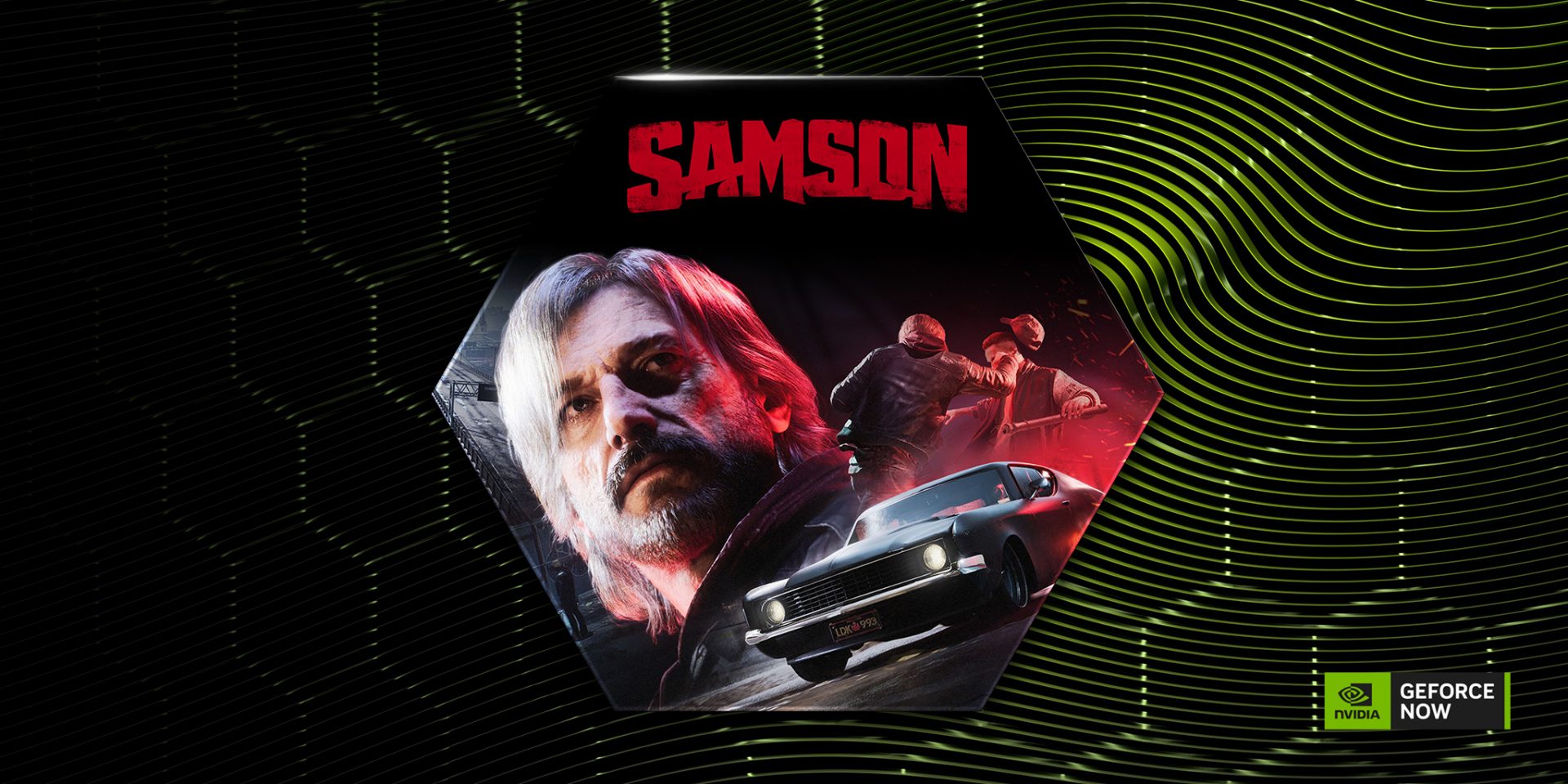
NVIDIA's GeForce NOW has quietly added two of the most technically intensive games in its roster, signaling a shift toward high-performance play. 'Samson' and 'Morbid: The Second Omen' join the service, both requiring significant GPU power to deliver smooth experiences at high resolutions.
These additions mark a departure from GeForce NOW's usual focus on accessibility. While the platform has long supported a mix of casual and demanding titles, the inclusion of games like 'Samson'—a real-time destruction sandbox with heavy physics calculations—and 'Morbid,' known for its intricate AI-driven environments, suggests NVIDIA is doubling down on power users who expect near-native performance from cloud gaming.
Key Specs: The New Demands
- Game: Samson
- Engine: Custom (real-time destruction physics)
- Recommended GPU: NVIDIA RTX 3080 or better for 4K/120fps
- Memory: 16GB GDDR6X or higher
- Storage: Not applicable (cloud-based)
- Game: Morbid: The Second Omen
- Engine: Unreal Engine 5 with Nanite/Lumen
- Recommended GPU: NVIDIA RTX 4090 for full ray-traced performance
- Memory: 24GB GDDR6X or higher (for advanced lighting effects)
The hardware requirements here are not just about raw power—they reflect a new era of game development where even cloud gaming must keep pace with desktop-level performance. 'Samson,' for instance, demands a GPU capable of handling complex destruction physics in real time, while 'Morbid' pushes the boundaries of Unreal Engine 5's Nanite and Lumen features, requiring top-tier GPUs to render its sprawling, AI-generated environments smoothly.
Why It Matters: The Cloud vs. Desktop Divide
GeForce NOW has historically been a bridge between accessibility and performance, but these new titles blur that line. Power users who once relied on high-end desktop setups for demanding games now have an alternative—cloud gaming that matches (or nearly matches) local hardware capabilities. The tradeoff? Latency remains a factor, though NVIDIA's infrastructure is optimized to minimize it for high-refresh-rate play.
For developers, this shift means cloud gaming must evolve beyond being a secondary option. If GeForce NOW can sustain performance parity with desktop setups, it could redefine how power users approach gaming—no longer as an 'either/or' scenario but as a seamless experience where hardware limitations no longer dictate playstyle.
The Caveats: Latency and Bandwidth
- High-speed internet (50 Mbps+ recommended for 4K)
- Low-latency connections required for competitive play (NVIDIA's 'Ultra' setting adds input lag)
- Not all regions have access to the highest-tier GPUs in GeForce NOW's cloud
Of course, no cloud gaming solution is without its challenges. Latency remains a critical factor, especially for competitive or fast-paced titles. While NVIDIA's 'Ultra' setting aims to minimize input lag, it still falls short of true local hardware performance. Bandwidth also plays a role—50 Mbps is the baseline recommendation, but real-world conditions can vary significantly.
Additionally, not all regions have equitable access to GeForce NOW's highest-tier GPUs. While the service offers a global footprint, the distribution of top-end hardware (like RTX 4090 instances) is uneven. This means power users in some markets may still find themselves limited by regional availability rather than raw performance.
A New Benchmark for Cloud Gaming
With 'Samson' and 'Morbid: The Second Omen,' GeForce NOW isn't just adding games—it's setting a new benchmark for what cloud gaming can achieve. These titles represent the upper echelon of current game development, where real-time physics, AI-driven environments, and ray tracing are no longer optional but expected.
The question now is whether this shift will stick. If NVIDIA continues to prioritize high-performance titles while addressing latency and regional hardware distribution, cloud gaming could become the default for power users. But if the tradeoffs outweigh the benefits, it may remain a niche option—one that's powerful but not yet perfect.
For now, GeForce NOW has taken a bold step forward. Whether it's enough to close the gap with desktop remains to be seen.