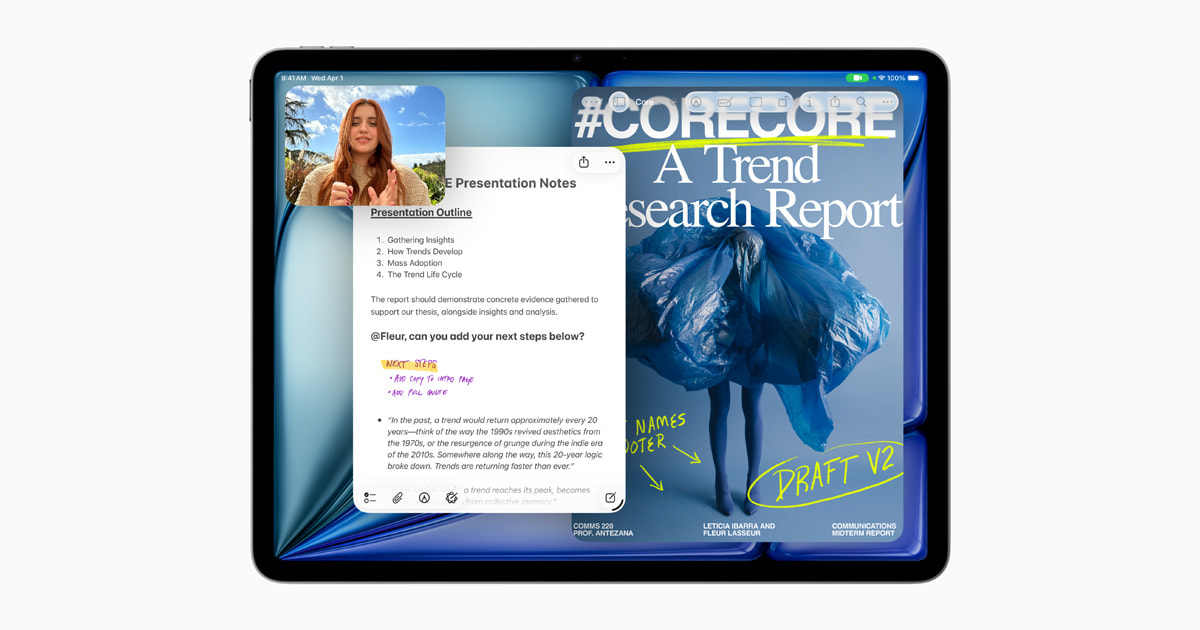
The balance between performance gains and cost stability has shifted once again with the introduction of the iPad Air, now powered by Apple’s M4 chip. IT teams evaluating mobile solutions face a clear tradeoff: significant computational improvements—up to 2.3 times faster than the previous generation—without an increase in the starting price point. This positions the device as a compelling option for workloads demanding both raw power and efficiency, particularly in AI-driven environments.
At the heart of this iteration is the M4 chip, which brings notable advancements in CPU and GPU performance while expanding system memory to 12GB. The 9-core GPU supports second-generation hardware-accelerated mesh shading and ray tracing, a feature that enhances both professional rendering tasks and gaming experiences on the platform. For IT professionals managing mobile fleets, this means more consistent performance across diverse workloads without sacrificing battery life or connectivity reliability.
Key specs
- Chipset: M4 (8-core CPU, 9-core GPU)
- Memory: 12GB unified system memory (50% more than previous generation)
- Memory bandwidth: 120GB/s
- Neural Engine: 16-core, 3x faster than M1
- Connectivity: N1 chip (Wi-Fi 7 support), C1X modem for cellular models
- Display sizes: 11-inch and 13-inch variants
- Storage options: 128GB, 256GB, 512GB, 1TB
- Pricing (starting): $599 for 11-inch Wi-Fi model; $799 for 13-inch Wi-Fi model
The M4 chip’s improvements extend beyond raw speed. Unified memory bandwidth increases to 120GB/s, a critical factor for AI workloads where faster data processing translates directly into productivity gains. The 16-core Neural Engine, three times faster than its M1 counterpart, is particularly notable for on-device AI tasks—such as real-time image analysis or natural language processing—without relying heavily on cloud resources.
For IT teams, the inclusion of Apple’s N1 connectivity chip introduces support for Wi-Fi 7, a standard that promises improved throughput and reliability in dense wireless environments. Cellular models benefit from the C1X modem, which delivers up to 50% faster data performance while reducing energy consumption by 30%. These features address growing concerns around connectivity stability in hybrid work settings, where seamless transitions between networks are essential.
Use-case focus: AI and mobile efficiency
The new iPad Air is designed with workload-specific efficiency in mind. The 12GB of unified memory allows for smoother multitasking when running multiple AI-driven applications simultaneously, a common requirement for developers and data analysts. The device’s ability to handle tasks like video compositing in Pixelmator Pro or professional-grade rendering in Final Cut Pro—with over four times faster ray tracing performance compared to the M1 model—makes it a viable alternative to traditional desktop setups for on-the-go professionals.
For IT administrators, the device’s support for advanced accessories like the Apple Pencil Pro and Magic Keyboard further expands its utility. The Pencil Pro, with features like Find My integration, simplifies asset tracking in shared environments, while the Magic Keyboard provides a full laptop-like experience with a built-in trackpad and function row—ideal for users who need both portability and productivity.
The starting price of $599 for the 11-inch model remains unchanged, making it an attractive option for budget-conscious organizations looking to upgrade without significant cost increases. However, the lack of confirmation on global availability timelines leaves some uncertainty for IT teams planning large-scale deployments.
In summary, the iPad Air with M4 represents a meaningful step forward in mobile computing efficiency, particularly for AI-driven workflows and connectivity-heavy environments. Its combination of performance improvements, memory optimizations, and advanced connectivity features makes it a strong candidate for IT teams prioritizing both power and cost-effectiveness.