Intel’s Wildcat Lake processors mark a shift in the company’s mid-range chip strategy, emphasizing power efficiency over raw performance. Part of the Core 300 series, these chips are built for edge and industrial environments where thermal constraints dictate design choices.
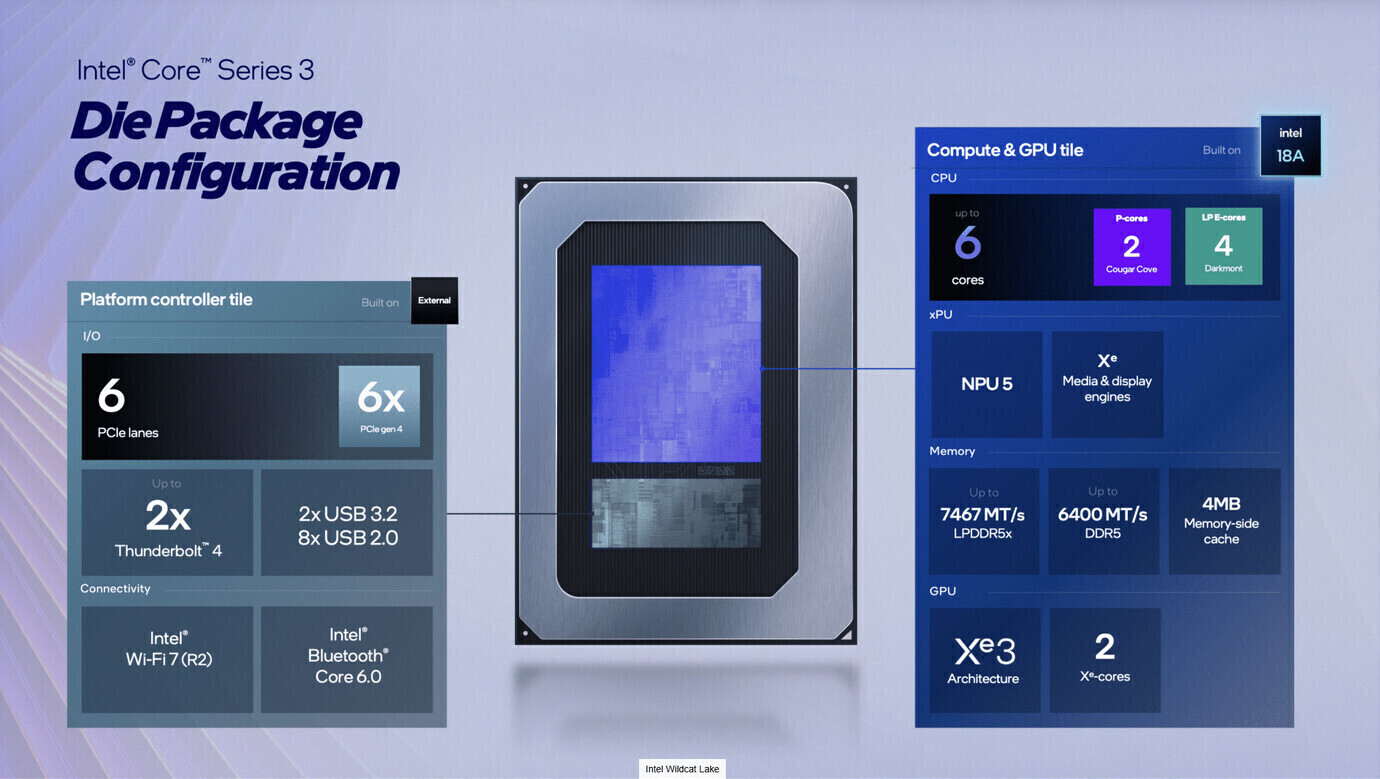
The architecture combines two high-performance Cougar Cove P-cores with four low-power efficiency cores, eliminating the Darkmont E-cores found in previous generations. This configuration aims to balance single-threaded performance with energy consumption, making it suitable for devices where heat management is critical.
Key Specifications
- Core Layout: 2P+4LPE (no E-cores)
- Cache: Uniform 6 MB L3 cache across all models
- Boost Clocks: Range from 4.3 GHz to 4.8 GHz, depending on the SKU
- NPU Performance: Estimated between 15 and 17 TOPS, targeting lightweight AI inference tasks
- Graphics: Xe3-based iGPU without dedicated vPro support
- TDP Range: 15–35 W, optimized for low-power operation
The absence of E-cores suggests a focus on efficiency over multithreaded performance. This trade-off aligns with the growing demand for power-constrained devices in industrial automation and IoT, though it may limit performance in tasks requiring heavy parallel processing.
Performance and Applications
Wildcat Lake’s NPU is designed for niche AI workloads, such as edge inference or lightweight automation. The Core 3 304, featuring a single P-core and reduced graphics unit, stands out as a budget-friendly option, potentially appealing to cost-sensitive industrial designs.
SIPP certification, which ensures platform stability over long lifecycles, is confirmed for the Core 7 360 and Core 5 330 but not all models. This could influence buyers who prioritize longevity over performance.
Comparison to Ultra Series
Unlike Intel’s Ultra series, Wildcat Lake does not include enterprise features like vPro support. This reinforces its positioning as a non-enterprise solution, though it shares architectural similarities with the Core Ultra 300 lineup.
The processors also feature LPDDR5X memory support and an integrated NPU capable of handling on-device AI tasks without relying on external accelerators. The TDP range of 15–35 W further underscores their suitability for battery-powered or heat-sensitive applications.