Intel has entered the high-end workstation market with the Xeon 600 series, a platform designed to blur the line between client and server-grade processing. Unlike traditional desktop CPUs optimized for gaming or light productivity, these chips prioritize sustained multithreading, massive memory capacity, and PCIe 5.0 expansion—making them ideal for AI development, large-scale simulations, and memory-intensive workflows.
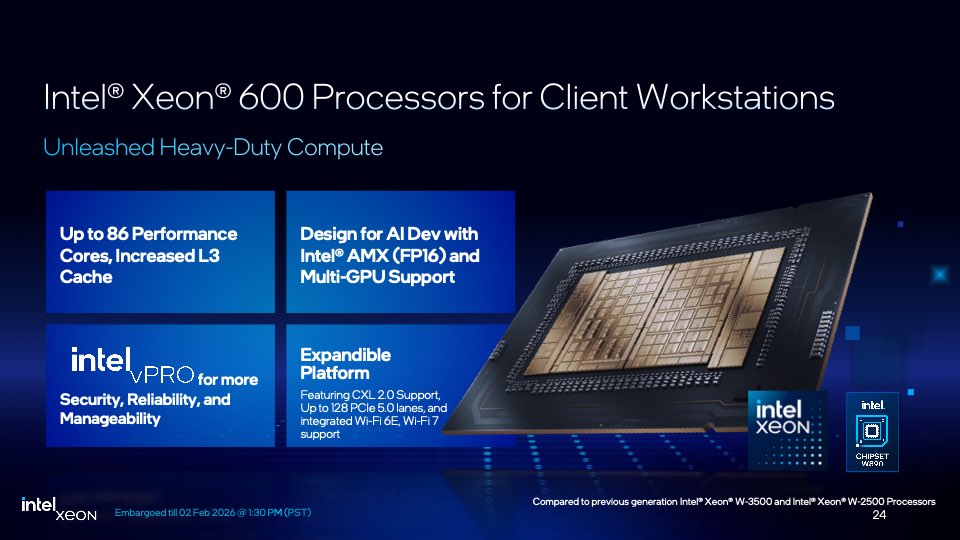
The Xeon 600 lineup replaces Intel’s Xeon W-3500 series, offering up to 86 performance cores, 336MB of L3 cache, and support for eight DDR5 memory channels with speeds up to 8000 MT/s via MRDIMM. This isn’t about raw clock speeds; it’s about handling workloads where more cores, more cache, and more memory bandwidth directly translate to faster results.
For IT administrators managing workstation fleets, the platform introduces Intel vPro technology, remote manageability, and hardware-based security features—critical for environments where uptime, compliance, and centralized control are priorities.
Key specs at a glance
- Top-tier model (698X): 86 P-cores, 336MB L3 cache, 350W TDP, $7,699
- Mid-range (678X): 48 P-cores, 192MB L3 cache, 300W TDP, $3,749
- Budget entry (634): 12 P-cores, 48MB L3 cache, 150W TDP, $499
- Memory: Up to 8 DDR5 channels, 4TB max capacity, 8000 MT/s MRDIMM support
- PCIe 5.0: Up to 128 lanes for multi-GPU, NVMe storage, and accelerators
- AI acceleration: Intel AMX (int8, bfloat16, FP16) for CPU-based inference
- Security: Intel vPro with total memory encryption, remote management
- Socket: LGA 4710-2, paired with W890 chipset
- Availability: Late March 2026
The Xeon 600’s memory and I/O capabilities set it apart from mainstream workstation CPUs. While a typical desktop CPU might max out at 128GB of DDR5-6400, the Xeon 600 can handle 4TB—critical for rendering massive 3D scenes, running large-scale physics simulations, or processing datasets that exceed RAM limits. The 128 PCIe 5.0 lanes allow for configurations with four GPUs, multiple NVMe SSDs, and FPGA accelerators, making it a viable alternative to server-class setups for professionals who need flexibility without the overhead of a data center.
Intel claims up to 61% improvement in multi-threaded performance over the Xeon W-3500 series, with gains most noticeable in AI training, financial modeling, and energy simulation workloads. Single-thread performance improvements are modest (around 9%), reinforcing that this is a platform for parallel workloads, not latency-sensitive tasks.
Who benefits—and who doesn’t?
This CPU is not for gamers or lightly threaded applications. Instead, it targets
- AI researchers running CPU-based inference or preprocessing
- Engineers running finite element analysis (FEA) or computational fluid dynamics (CFD)
- Media professionals working with large datasets or photorealistic rendering
- Financial analysts processing complex models
- IT teams managing high-performance workstations in regulated environments
For admins, the Intel vPro integration means features like remote BIOS updates, disk encryption, and hardware-based security—useful in industries where data protection is non-negotiable. The W890 chipset adds support for modern networking (Wi-Fi 7, 2.5GbE), though these are typically handled by motherboard vendors rather than Intel.
Pricing reflects the platform’s specialization. The top-tier 698X starts at $7,699, while the entry-level 634 is $499—a steep drop but still targeting professionals, not consumers. The mid-range models (e.g., 678X at $3,749) offer a balance between core count and cost, making them viable for smaller teams or solo users with demanding workloads.
As workstations increasingly handle hybrid CPU/GPU/AI workloads, Intel’s Xeon 600 positions itself as a long-term foundation—one that can scale with future accelerators and memory demands without requiring a full server migration.