The Intel Arc Pro B770 isn't just another GPU—it's a complete reimagining of how professionals engage with their tools. Unlike traditional discrete graphics cards, the B770 is designed from the ground up for AI-augmented workflows, where raw compute power meets intelligent acceleration to streamline complex tasks that once bogged down even the most powerful workstations.
This isn't about brute-force performance metrics alone. The 32 GB GDDR6 memory configuration, paired with Intel's Xe2 architecture, creates a foundation for handling massive datasets with efficiency. For media professionals, this translates to near-instantaneous AV1 encoding and decoding cycles that could redefine post-production timelines. Engineers see similar benefits in simulation workloads where hardware acceleration can shave hours—or even days—off project completion times.
But the B770's real innovation lies in its ecosystem approach. It's not a one-size-fits-all solution but rather a component that needs to be thoughtfully integrated into modern professional computing environments. This means considering it within the context of multi-GPU setups, AI-optimized workstations, and even server configurations where density and thermal management become critical factors.
- The blower cooling configuration makes it ideal for single-unit workstations where airflow isn't a concern
- Passive cooling options open up possibilities for high-density compute environments where traditional GPUs would overheat
- Full compatibility with Intel's oneAPI development framework ensures smooth integration with existing software stacks
For those already operating within Intel's ecosystem, the transition promises to be seamless. The B770 builds on established platform support for professional applications while introducing new capabilities that leverage Intel's hardware-software optimization. However, for organizations using non-Intel platforms, the decision becomes more complex—requiring careful evaluation of whether this represents a strategic upgrade path or a premature shift in infrastructure.
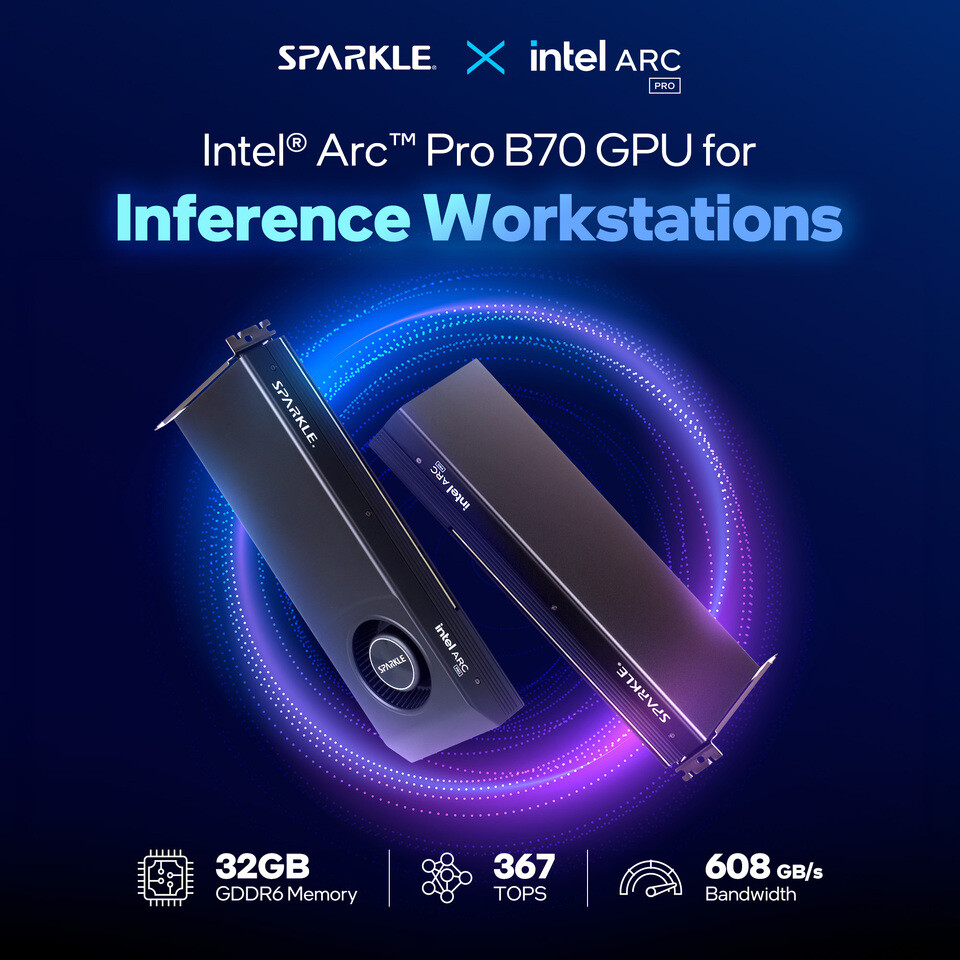
Practical deployment considerations extend beyond just performance metrics. The B770's 32 GB GDDR6 memory, while impressive on paper, serves specific use cases where large frame buffers and extended precision calculations are necessary. This includes advanced visualization tasks, certain AI training scenarios, and high-resolution rendering pipelines that benefit from the additional memory capacity.
Looking ahead, the B770 signals Intel's commitment to professional computing markets where performance demands continue to grow exponentially. Its arrival coincides with increasing industry focus on AI acceleration at the edge, suggesting this GPU could play a significant role in shaping how professionals approach complex workloads in the coming years.
The challenge for potential adopters isn't just about evaluating the B770's specifications—it's about assessing whether their current workflows are ready to leverage these capabilities. For organizations already invested in AI-augmented processes, this GPU represents a natural evolution of existing infrastructure. For others, it may serve as a catalyst for rethinking how they structure their computing environments to take full advantage of emerging professional graphics technologies.
As with any high-end professional component, the B770 won't be a plug-and-play solution. It requires thoughtful integration into existing systems, careful consideration of power requirements, and an understanding of how it fits within broader AI computing strategies. But for those willing to make that investment, it offers a compelling vision of what professional computing could look like in the near future—where hardware acceleration isn't just about speed, but about intelligent workflow optimization that transforms how work actually gets done.