The tradeoff is clear: more VRAM means less memory stress for AI workloads, but it also means higher costs and larger power draw. The Intel Arc Pro B70 series from Maxsun delivers exactly that—32 GB of ECC memory, designed to handle large-scale AI models without breaking a sweat.
This isn’t just an upgrade over the previous B60 series; it’s a rethinking of how professional GPUs interact with software. Intel’s Arc Pro platform has evolved beyond raw performance metrics, focusing on efficiency in dynamic quantization and multi-GPU scaling. The result? A card that doesn’t just push more numbers but does so with less system overhead—a practical benefit for teams balancing budgets and ambition.
What sets the B70 apart is its memory bandwidth: 608 GB/s, paired with PCIe 5.0 support to minimize latency in multi-GPU setups. That’s not just about speed; it’s about reducing the friction in parallel computing environments, where every nanosecond of data exchange matters.
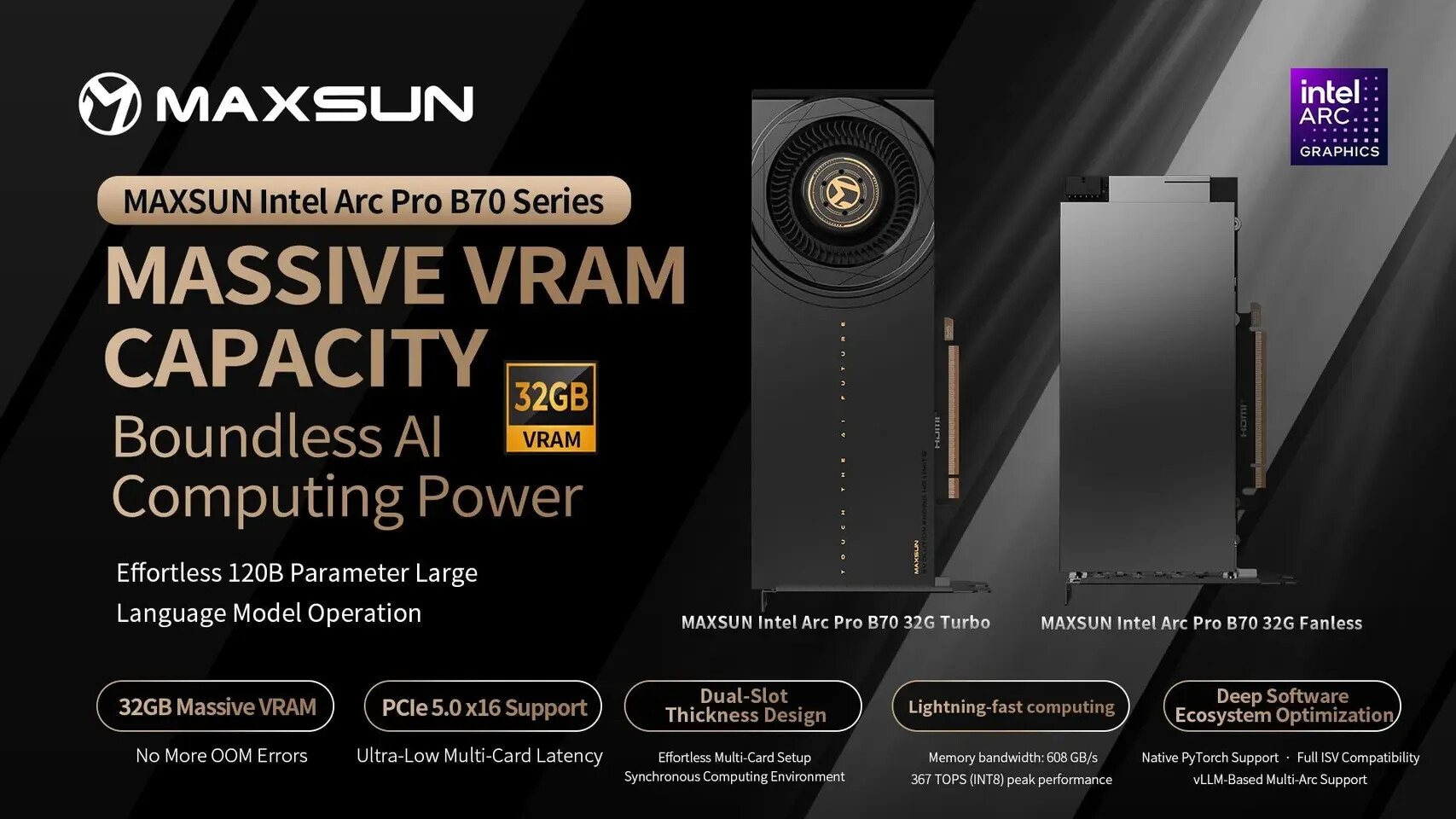
- AI Compute Power: Up to 367 TOPS (INT8), targeting inference and rendering tasks with near-linear scaling.
- Memory Optimization: Environment variables trim dynamic quantization memory use, lowering system requirements without sacrificing performance.
- Multi-GPU Scaling: Dual-slot design and PCIe 5.0 reduce latency in clusters, making high-density deployments feasible for workstations and servers alike.
The software ecosystem is just as critical. Native PyTorch support, ISV certifications, and vLLM-based Multi-Arc optimization ensure stability across professional applications. Docker containerization further streamlines deployment, turning complex setups into a single command—no tinkering required.
But the B70 isn’t just for AI. It supports 3× DisplayPort 2.1 + HDMI 2.1a, delivering uncompressed visuals for multi-display configurations where pixel-perfect clarity is non-negotiable. Two form factors—Turbo Edition (with a triple thermal solution) and Fanless Edition (for server environments)—cover the spectrum from high-load desktops to silent data centers.
Where things stand now: The B70’s 32 GB VRAM is a bold step forward, but its real value hinges on how well it balances raw power with efficiency. For buyers, the question isn’t just whether they need this much memory—it’s whether the ecosystem and optimization can keep pace with the hardware’s capabilities. For now, the B70 proves that in professional computing, VRAM is no longer a bottleneck; it’s the foundation.