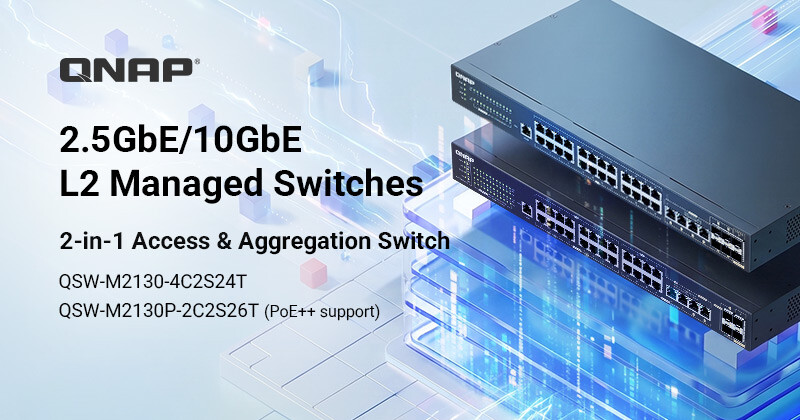
A fresh approach to office networking has arrived with a unified switch series that merges access and aggregation into one chassis, removing the need for layered switch deployments while delivering enough PoE++ power—375 W—to sustain next-generation Wi-Fi 7 access points alongside 4K IP cameras. The result is a single device capable of both connecting desktops and uplinking to core infrastructure, with no loss in performance or management simplicity.
Key specifications
- Port configuration: 24 × 2.5 GbE RJ45 (non-PoE) or 26 × 2.5 GbE RJ45 (PoE++); 4 × 10 GbE Combo (RJ45/SFP+) or a PoE++ variant with an additional 2 × 10 GbE RJ45 ports.
- Uplink options: Standard 2 × 10 GbE SFP+ on both models; optional per-port power of 90 W or 45 W for high-demand devices.
- Total power budget: 375 W (PoE++ model only).
The switch’s design also includes multi-gigabit combo ports that dynamically shift between copper and SFP+ uplinks, allowing IT teams to adjust bandwidth on the fly without hardware swaps. Standard L2 features—LACP for link aggregation, QoS for traffic prioritization, VLAN segmentation, and IGMP snooping to filter multicast streams—remain consistent across both models.
What the upgrades mean
For organizations transitioning from 1 Gbps networks, adopting 2.5 GbE now future-proofs against bandwidth-heavy devices such as 4K cameras or Wi-Fi 7 access points that require sustained multi-gigabit throughput. The PoE++ model takes this further by eliminating the need for separate power injectors on high-wattage APs, reducing cable clutter and operational costs.
Who it suits
The unified switch series is tailored for small-to-mid-sized offices and multi-floor environments where network sprawl has become a bottleneck. It addresses the need for scalable yet simple infrastructure, enabling businesses to manage both desktop connectivity and wireless backbones from a single management interface without sacrificing performance or security.
Security measures include ACLs for access control, DoS attack prevention, and RSTP to prevent network loops, ensuring resilience against malicious traffic. Both models are manufactured in Taiwan, maintaining the brand’s reputation for durability and reliability.