Gaming PCs have never been more expensive, and the latest price surge in DDR5 memory is forcing builders to make painful tradeoffs. Just six months ago, a 32GB DDR5-6000 kit with 30-cycle CAS latency could be found for under $90—plenty for even budget-conscious Ryzen systems. Today, that same configuration costs $480, with premium brands like Corsair or G.Skill pushing prices even higher. The alternative? Brands like PUSkill now offer 32GB DDR5-4800 kits for $300, cutting bandwidth by 20% and increasing latency by 56%. But does it matter?
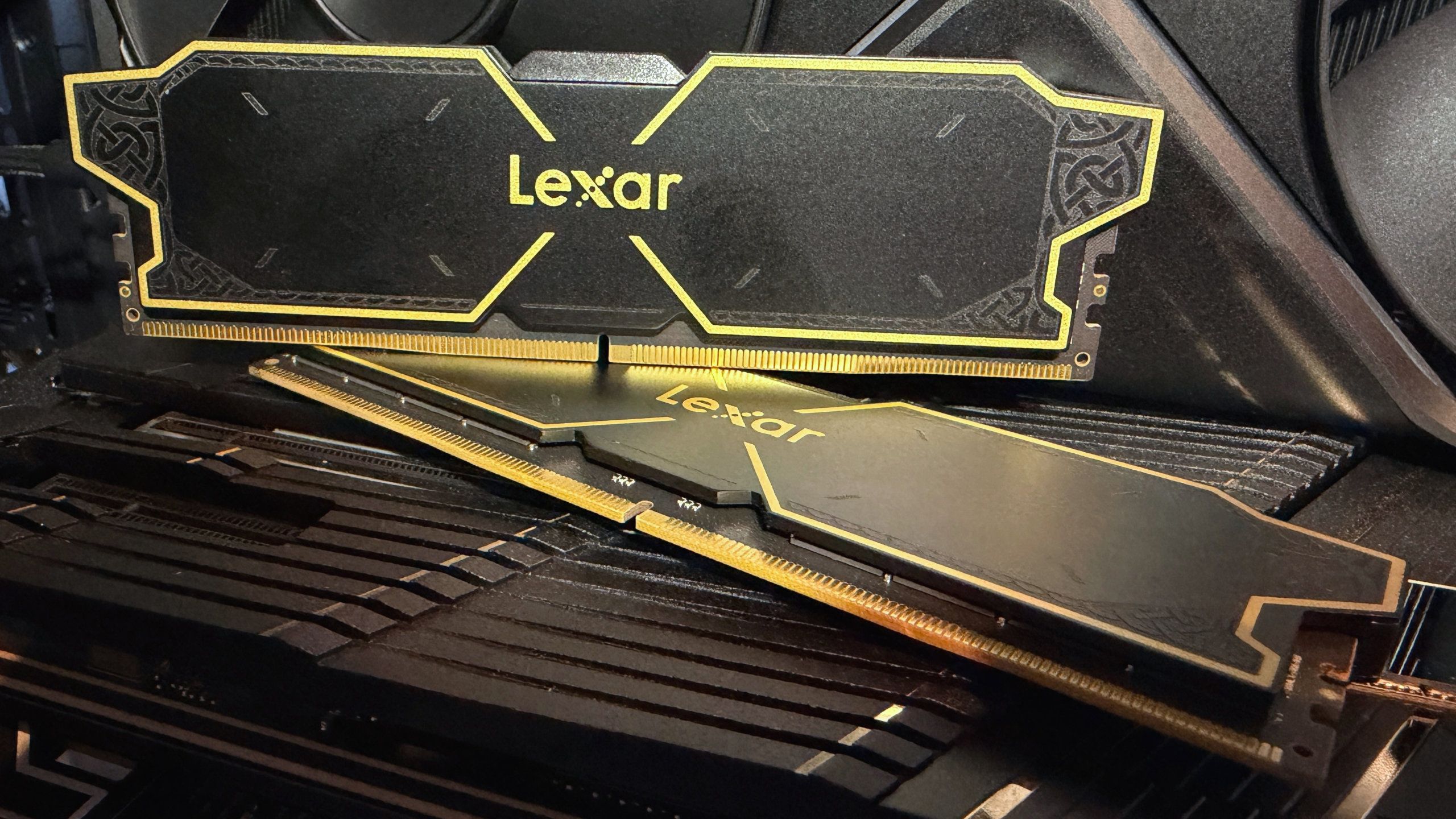
To answer that, we tested a system equipped with an AMD Ryzen 9 9900X, an Nvidia GeForce RTX 5090, and a 2TB Samsung 990 Evo Plus SSD—paired with a Lexar Thor OC DDR5-6000 kit running at DDR5-4800 (CL40) when EXPO was disabled. The results challenge the assumption that slower RAM is a dealbreaker, but with caveats.
Performance in the Real World
The test setup was pushed through seven games, recording average and 1% low frame rates at 1080p, 1440p, and 4K—all at maximum settings without DLSS or frame generation. The goal was to isolate CPU and memory bottlenecks rather than offload work to the GPU.
In most titles, the difference between DDR5-6000 and DDR5-4800 was negligible. Games like Cyberpunk 2077 and Star Citizen showed virtually no frame rate drop, as their performance is dominated by GPU workloads. Even in CPU-heavy scenarios, the impact was modest—typically under 5% in average FPS, with 1% lows occasionally dipping by 8-10% in demanding scenes. Only in a handful of cases did slower RAM create noticeable stuttering, and even then, it was confined to specific sequences rather than systemic lag.
That said, the tradeoff isn’t without consequences. DDR5-4800 kits often sacrifice single-channel performance, meaning dual-channel configurations are critical for maintaining stability. Additionally, latency spikes can cause micro-stutter in fast-paced games where the CPU must constantly fetch data—something less noticeable in slower-paced titles.
Who Should (and Shouldn’t) Buy Slow DDR5?
For most gamers, DDR5-4800 is a viable stopgap—especially if paired with a high-end CPU like the Ryzen 9 9900X, which mitigates memory bottlenecks. Budget builds targeting 1080p or even 1440p can stretch further without sacrificing playability, though 4K users may notice slight frame rate drops in CPU-bound scenes.
However, enthusiasts chasing maximum performance—or those running multi-core workloads like streaming—should still prioritize faster RAM. The $180 premium for DDR5-6000 over DDR5-4800 isn’t trivial, but in high-refresh competitive games or content creation, the stability and bandwidth gains justify the cost.
Key Specs: The Test Rig
- CPU: AMD Ryzen 9 9900X
- Cooling: Asus ROG Strix LC III 360 AIO
- GPU: Nvidia GeForce RTX 5090 Founders Edition
- Storage: Samsung 990 Evo Plus 2TB NVMe SSD
- PSU: Thermaltake ToughPower PF3 1050W
- Case: Thermal Grizzly Der8enchtable
- Display: Acer XB280KH (1440p)
- OS: Windows 11 25H2
- RAM Tested: Lexar Thor OC DDR5-6000 (CL32) @ DDR5-4800 (CL40)
The bottom line? DDR5-4800 isn’t ideal, but it’s far from a dealbreaker—especially in GPU-limited scenarios. For those waiting for prices to drop, it’s a pragmatic compromise. For the rest, the choice comes down to budget versus future-proofing.