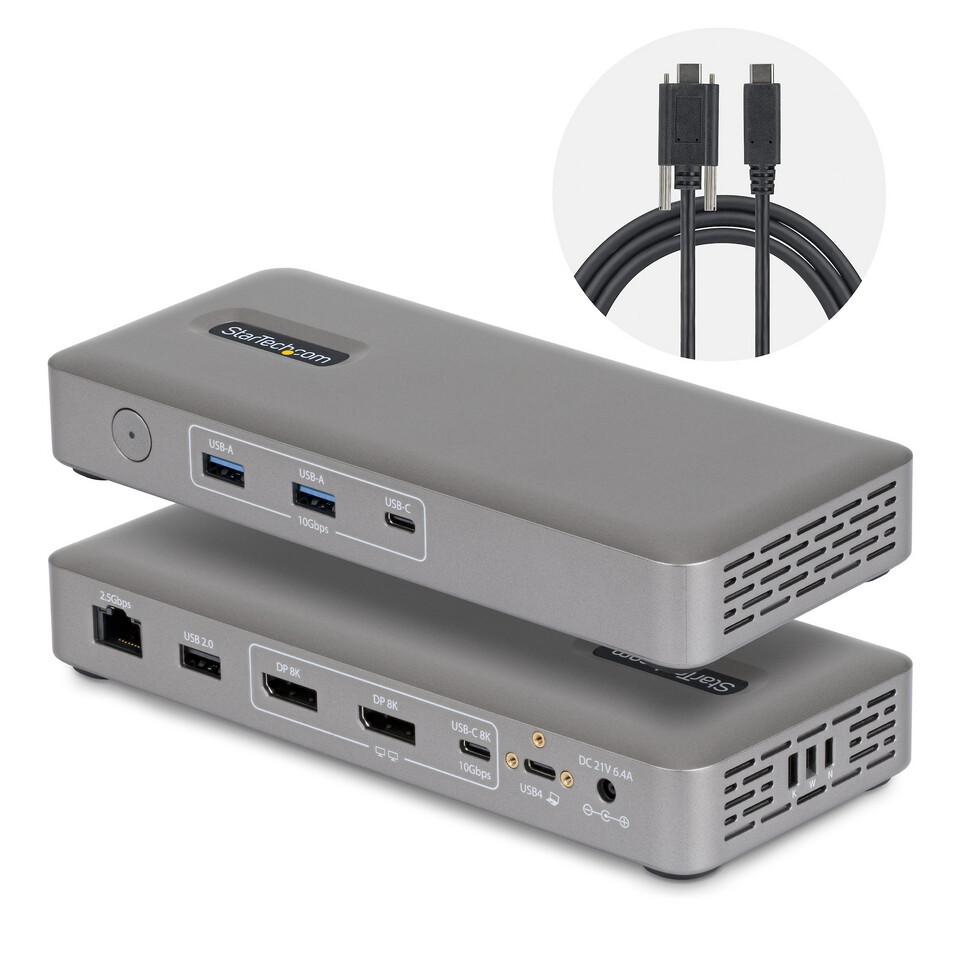
StarTech has unveiled a USB4 dock that claims to eliminate driver hassles for Mac, Windows, and Linux systems. The tradeoff? A price tag that may leave some wondering whether the convenience is worth it.
The device, designed to handle two 5K displays simultaneously, arrives at a time when USB-C connectivity has become standard, yet its performance hinges on a balance between software flexibility and hardware constraints. Whether this dock delivers on its promises—or if its limitations will overshadow its advantages—remains an open question.
At first glance, the dock’s ability to work across operating systems without manual driver installation is a standout feature. However, the underlying tradeoff lies in power delivery and bandwidth sharing. While USB4 theoretically supports up to 80W of power and 40Gbps data transfer, real-world performance depends on how well the dock manages these resources under load.
Power users will want to pay close attention to latency and thermal behavior. Early impressions suggest that while the dock excels in low-stress scenarios—such as office work or light media consumption—it may struggle when pushed to its limits, particularly with high-resolution displays running at maximum refresh rates. The question isn’t just whether it can handle these workloads, but how gracefully it does so.
Another consideration is the ecosystem’s long-term roadmap. USB4 docks are still a niche product, and their future depends on both hardware evolution and software support. If StarTech can maintain compatibility as operating systems update and display technologies advance, this dock could carve out a lasting place in professional workflows. But if it becomes quickly outdated—or if its current limitations prove too restrictive—it may fade as quickly as it arrived.
For now, the dock’s availability is tied to pre-order listings, with full production expected by mid-year. Whether it justifies its premium positioning remains to be seen, but for those who prioritize seamless setup over raw performance, it could offer a compelling solution—provided they’re willing to accept some compromises along the way.