Data centers are evolving beyond copper cables, and a new facility in Texas is leading the charge with silicon photonics—an innovation that promises faster, more efficient data transmission. This transition isn’t just technical; it’s foundational for next-generation AI workloads, particularly those demanding massive GPU clusters like NVIDIA’s Vera Rubin supercomputing project.
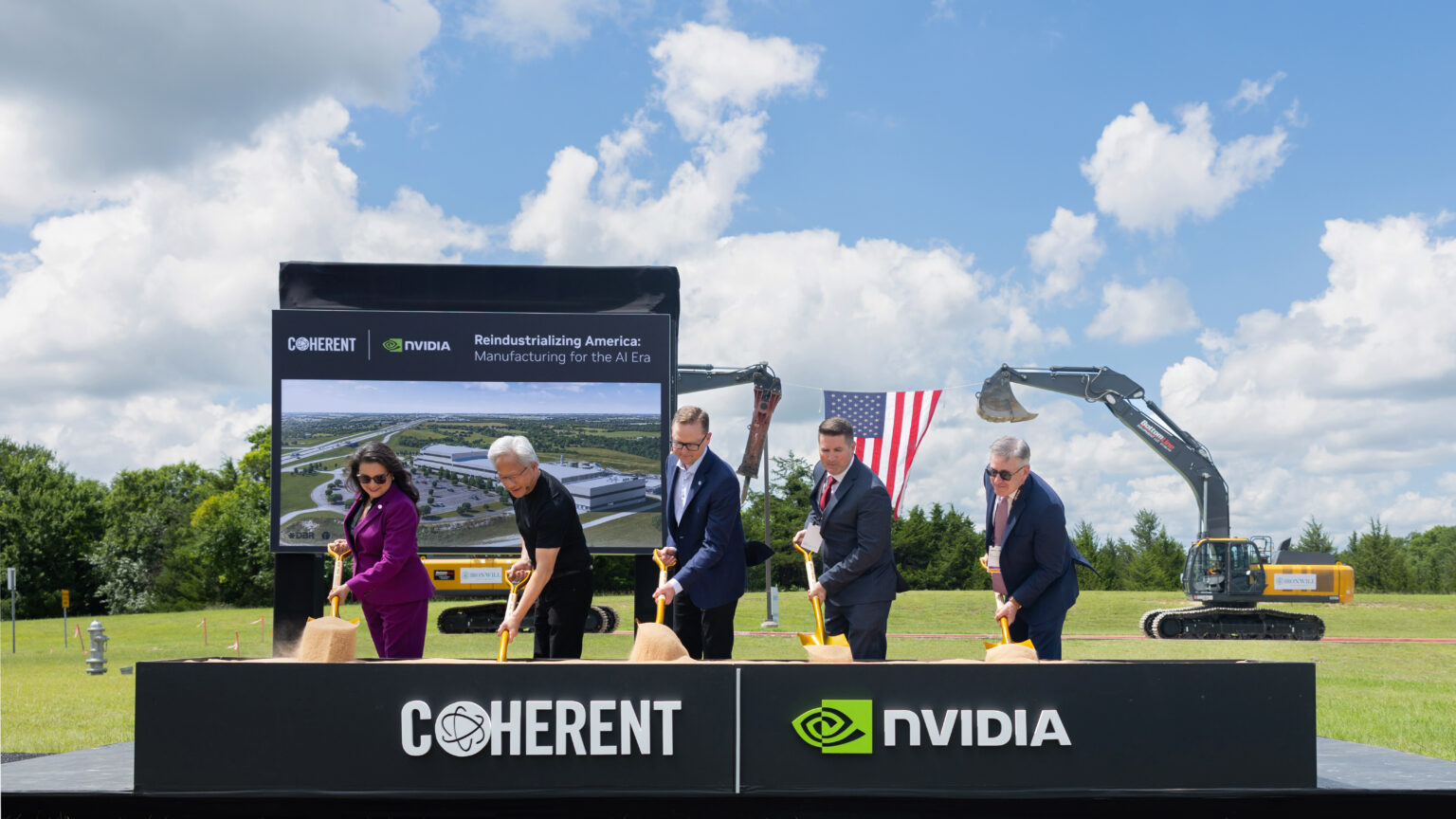
At the heart of this shift is Coherent’s expanded manufacturing plant in Plano, Texas. The facility will produce silicon photonics components, replacing traditional copper-based interconnects with optical solutions that support higher bandwidth and lower latency. This isn’t just about speed; it’s about reimagining how data moves within data centers, especially as AI models grow in complexity and demand.
From Copper to Light: The Silicon Photonics Revolution
The traditional reliance on copper cables has been a bottleneck for high-performance computing. Copper can handle significant bandwidth but struggles with the demands of modern AI workloads, where data flows between GPUs at unprecedented speeds. Silicon photonics addresses this by using light to transmit data, eliminating electrical resistance and enabling much higher throughput.
Coherent’s new plant will manufacture these components at scale, supporting NVIDIA’s Vera Rubin initiative—a project that combines 576 NVIDIA GPUs with advanced networking to deliver exascale AI performance. The shift to silicon photonics isn’t just for NVIDIA; it’s a broader industry movement toward optical interconnects, which are already being adopted in high-performance computing and enterprise data centers.
Key Specifications: What This Means for Data Centers
- Silicon Photonics: Replaces copper with optical interconnects, enabling higher bandwidth (up to 112 Gbps per channel) and lower latency.
- NVIDIA Vera Rubin: Features 576 GPUs with advanced networking capabilities, designed for exascale AI workloads.
- Manufacturing Scale: Coherent’s Texas plant will produce silicon photonics components at industrial scale, supporting the growing demand for optical interconnects.
The implications of this shift are significant. For data center operators, silicon photonics reduces power consumption and heat generation while increasing bandwidth capacity. For AI researchers and enterprises, it means faster training times and more efficient data processing. The Vera Rubin project, in particular, will benefit from this infrastructure, as its massive GPU cluster requires ultra-low-latency interconnects to function optimally.
A New Era for Data Center Connectivity
This isn’t just a technical upgrade; it’s a paradigm shift in how data centers are built and operated. The move away from copper reflects the industry’s need for solutions that can handle the exponential growth of AI and high-performance computing. Coherent’s plant is a critical step in this direction, providing the components needed to support these demands.
While silicon photonics isn’t yet mainstream, its adoption is accelerating. Major tech companies are investing heavily in optical interconnects, recognizing their potential to future-proof data center infrastructure. For buyers and operators, this means preparing for a transition that will redefine performance benchmarks and efficiency metrics. The question now isn’t whether silicon photonics will dominate, but when—and how quickly—it will replace copper as the standard.
The real-world impact is already visible in early adopters. Enterprises running AI workloads are seeing measurable improvements in training times and throughput, while data center operators report reduced power costs. This shift is not just about performance; it’s about sustainability and scalability—a critical combination for the future of computing.