The Peerless Assassin SE series marks a significant shift in CPU cooling technology by challenging the long-held assumption that liquid cooling is necessary to match the thermal demands of modern processors. While air coolers have traditionally been seen as a compromise—offering decent performance without the complexity or failure risks of liquid systems—the SE series closes that gap with a level of sophistication that rivals even the most advanced closed-loop designs.
At the heart of this redesign is the dual-fin-stack architecture, which replaces the conventional single-fin approach with two parallel heat sinks. This isn't merely an aesthetic choice; it fundamentally alters how heat is distributed and dissipated. The Peerless Assassin 120 SE V3, for example, employs six 6 mm-thick nickel-plated copper heatpipes arranged in this dual configuration. Nickel plating extends the lifespan of the heatpipes by preventing oxidation, a common issue that degrades performance over time in traditional copper-only designs. The base, crafted from C1100 copper, provides both thermal conductivity and structural integrity, while the TL-P12 fans—featuring fluid dynamic bearings—spin up to 2,000 RPM to deliver 70.84 CFM of airflow without excessive noise (29.8 dBA).
The larger Peerless Assassin 140 SE V3 scales this approach upward with a 140 mm conveyor fan and a 120 mm intake, achieving an impressive 88.89 CFM of airflow while maintaining a low noise floor (25.6 dBA). This model addresses the needs of users who prioritize maximum heat dissipation without sacrificing acoustic performance—a balance that has historically been elusive in air cooling. The dual-fin-stack design ensures that heat isn't concentrated in one area, reducing hotspots and improving sustained performance under heavy loads.
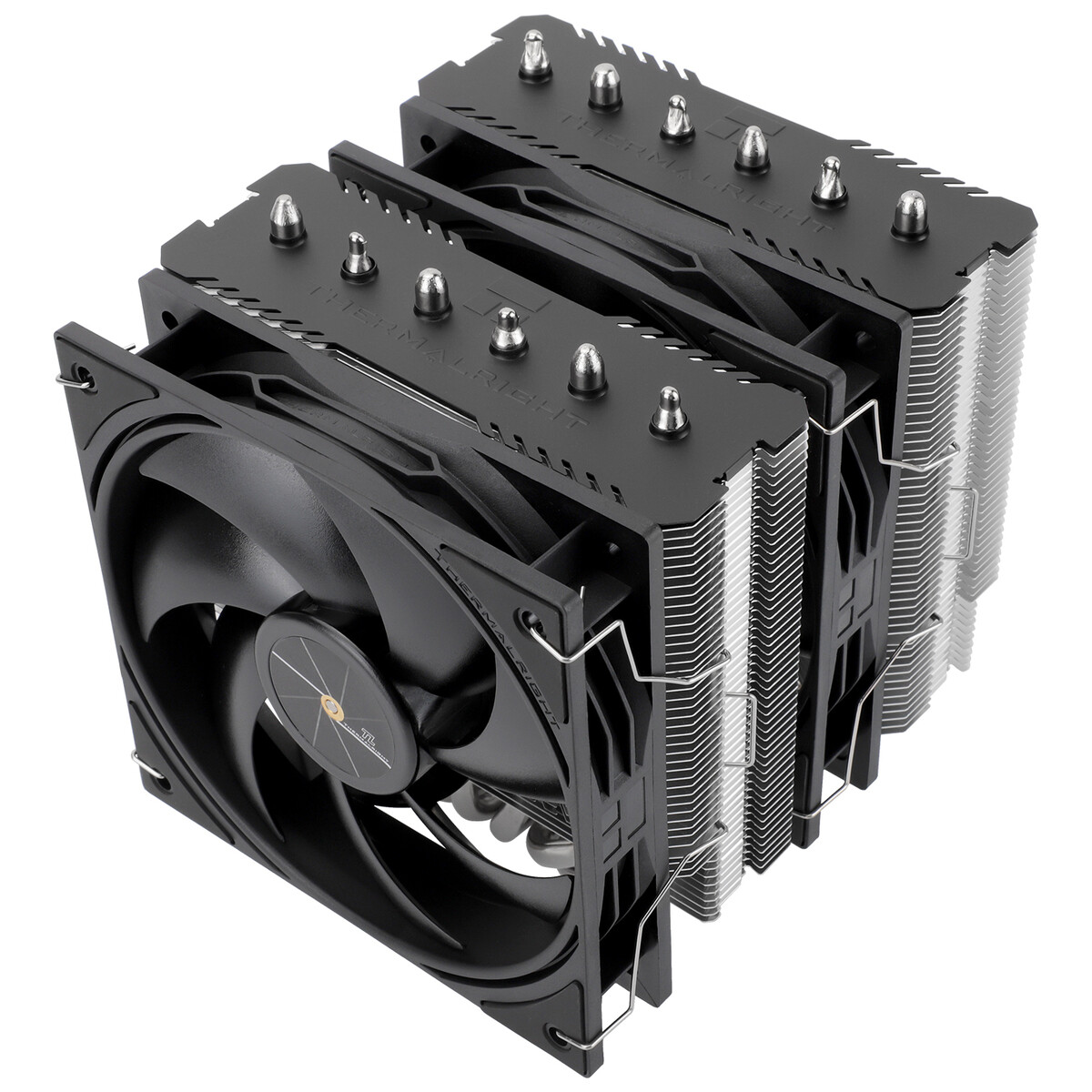
- Heatpipe Design: Six 6 mm-thick nickel-plated copper heatpipes (120 SE V3); dual-fin-stack architecture for optimized airflow distribution.
- Fan Specifications (TL-P12): 2,000 RPM max, 70.84 CFM airflow, 29.8 dBA noise (120 SE V3).
- Fan Specifications (140 SE V3): 120 mm intake: 1,850 RPM max, 88.89 CFM airflow, 29.5 dBA noise; 140 mm conveyor fan: 1,500 RPM max, 77.84 CFM airflow, 25.6 dBA noise.
- Base Material: C1100 copper (120 SE V3); extended base for the 140 SE V3 to accommodate larger heat sinks.
- Compatibility: Supports AM5, LGA1851, LGA1700, AM4, and LGA1200/115x sockets, ensuring broad platform support.
The practical implications of this design are substantial. For data center workloads, rendering tasks, or gaming sessions that push CPUs to their limits, the SE series offers a plug-and-play solution that eliminates the need for complex liquid cooling setups. Without pumps or loops, it avoids the risk of leaks or pump failure while delivering performance that was once exclusive to liquid-cooled systems. The dual-fin-stack design ensures that heat is distributed more evenly across the heatsink, reducing thermal throttling—a critical factor in applications where sustained performance is non-negotiable.
However, no solution is without tradeoffs. The 140 SE V3, while superior in airflow and cooling capacity, may not fit in all case configurations, particularly those with limited clearance or non-standard layouts. Pricing is expected to reflect the premium materials and engineering behind the SE series, positioning it at a higher tier than previous generations. Whether this premium is justified will depend on the user's specific needs—those prioritizing performance and reliability may find it worth the investment, while budget-conscious builders might still opt for more traditional air coolers.
The SE series arrives at a pivotal moment in computing. As CPU power draw continues to rise with increasing core counts and clock speeds, the demand for efficient thermal solutions has never been greater. This iteration proves that air cooling isn't just about playing catch-up; it's about redefining what's possible within its constraints. If proven in real-world benchmarks, the SE series could shift the paradigm once again, demonstrating that innovation in air cooling doesn't require liquid intervention—it just requires a willingness to break from tradition.