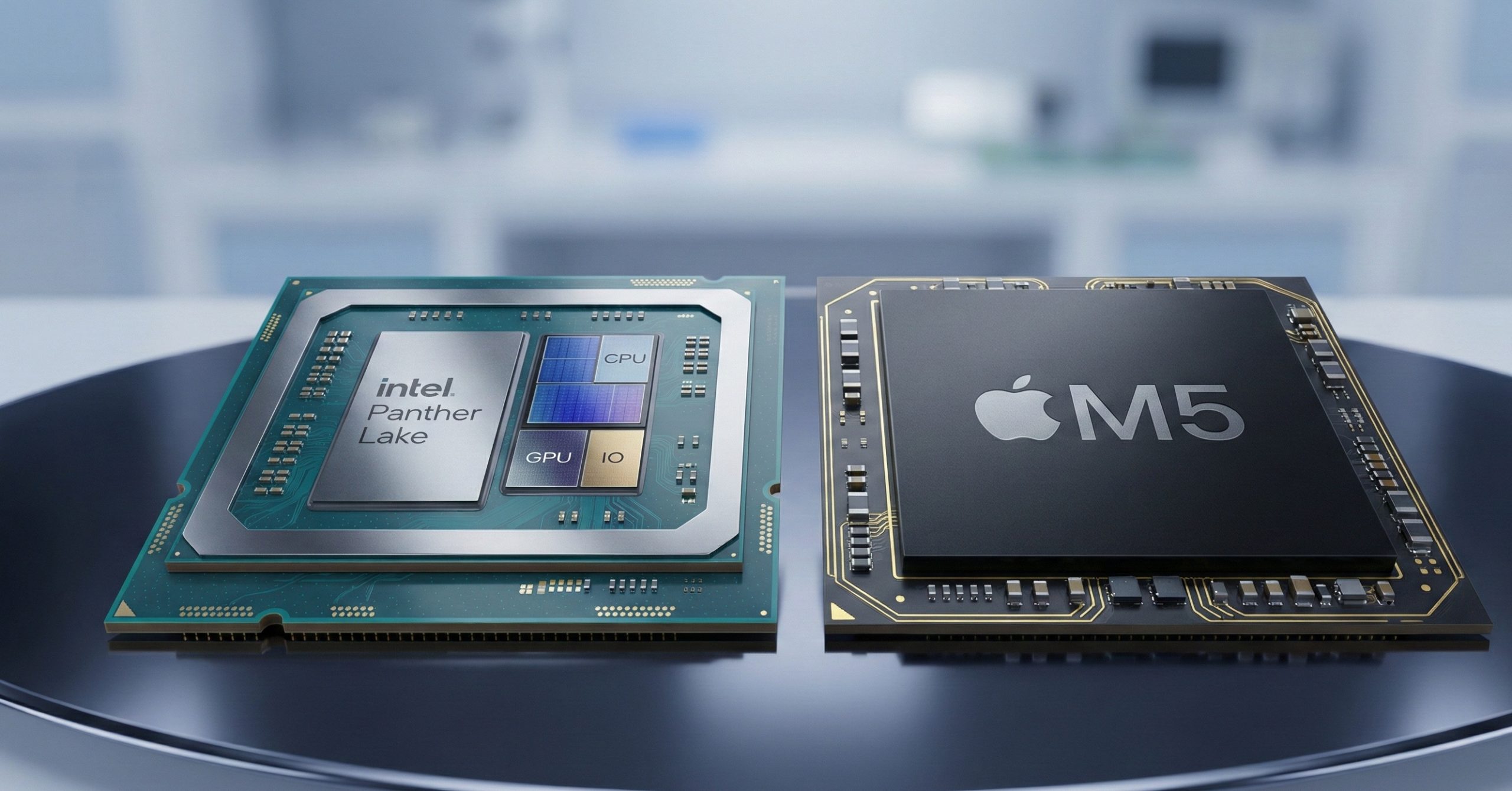
Intel’s new Panther Lake chip, designed for high-efficiency laptops and mobile devices, has delivered a surprising performance in a head-to-head battery test against Apple’s M5 processor. While the comparison pitted Intel’s best current mobile solution against Apple’s lowest-end chip—a far from even matchup—the results highlight just how narrow the efficiency gap has become.
The test, conducted on the Asus 14-inch ExpertBook Ultra (powered by Panther Lake) against the 14-inch MacBook Pro (with the M5), revealed that after 2.5 hours of heavy benchmarking at maximum brightness, both devices retained nearly identical battery levels: 40% for the MacBook Pro and 38% for the Intel-powered laptop. That’s a remarkable feat for a Windows machine, which traditionally lags behind Apple’s optimized hardware-software integration.
Where Intel’s Panther Lake Stands Up
The Asus ExpertBook Ultra doesn’t just compete in battery life—it also outclasses the MacBook Pro in raw storage and memory capacity. With 32GB of RAM and a 1TB SSD (delivering read speeds of 13,980MB/s), it dwarfs the M5 MacBook Pro’s 16GB RAM and 512GB SSD (6,797MB/s). Yet, in pure processing power, Apple’s M5 still holds a clear lead: its Geekbench 6 scores (4,328 single-core, 17,987 multi-core) outpace Intel’s Panther Lake (2,823 single-core, 15,449 multi-core). The integrated GPU in the M5 MacBook Pro also pulls ahead, with an OpenCL score of 76,601 compared to Intel’s Arc B390’s 50,072.
What This Means for Buyers
For power users who demand both performance and endurance, the choice between Intel’s Panther Lake and Apple’s M5 now hinges on more than just battery life. The Asus ExpertBook Ultra’s generous RAM and storage make it a stronger candidate for tasks like video editing or running multiple virtual machines, while the M5 MacBook Pro retains an edge in raw processing speed and graphics performance. The near-equal battery results, however, suggest Intel has closed a critical gap—one that could redefine expectations for Windows laptops in the coming year.
Who Should Care?
This benchmark matters most to professionals and creators who rely on laptops for demanding workloads but still need long battery life. While Apple’s M5 remains the more balanced choice for general productivity, Intel’s Panther Lake offers a compelling alternative for those who prioritize expandable storage and memory over pure computational efficiency. The fact that a Windows laptop can now nearly match an Apple device in endurance is a testament to Intel’s progress—and a sign that the gap between platforms may be shrinking faster than expected.
Key Specs Compared
- Processor: Intel 18A Panther Lake (Asus ExpertBook Ultra) vs. Apple M5 (MacBook Pro)
- RAM: 32GB (Intel) | 16GB (Apple)
- Storage: 1TB SSD (Intel) | 512GB SSD (Apple)
- SSD Read Speed: 13,980MB/s (Intel) | 6,797MB/s (Apple)
- Geekbench 6 (Single-Core): 2,823 (Intel) | 4,328 (Apple)
- Geekbench 6 (Multi-Core): 15,449 (Intel) | 17,987 (Apple)
- GPU (OpenCL): Arc B390 (50,072) | Apple M5 GPU (76,601)
- Battery After 2.5 Hours: 38% (Intel) | 40% (Apple)
The Asus ExpertBook Ultra starts at an estimated price point that positions it as a premium Windows alternative, though exact pricing hasn’t been confirmed. For those willing to compromise on raw processing power for flexibility and endurance, Panther Lake’s performance is a strong indicator of where Intel is headed—especially as the company refines its efficiency improvements.