The Dell PowerEdge XE7740 is positioned as the go-to platform for enterprise AI inference, offering a deliberate balance between flexibility and scalability. Unlike systems built solely for training or single-accelerator ecosystems, this server is designed to accommodate real-world deployment scenarios where organizations may need to mix accelerators—whether due to availability, cost constraints, or future-proofing considerations.
At the heart of its design is a dual-zone architecture that segregates thermal and power demands. This separation ensures that high-TDP accelerators like NVIDIA’s H100 or Intel’s Gaudi 3 do not impact cooling efficiency for other components, such as CPUs or lower-power GPUs. The result is a system that maintains stable performance under load while minimizing acoustic output and energy waste.
Networking is another critical aspect of the XE7740’s architecture. It includes eight dedicated rear Gen5 x16 slots for scale-out inference, enabling distributed deployment across racks without sacrificing bandwidth. This setup supports both NVIDIA GPUs (including RTX PRO 6000, H100/200, L40S, and A16) and Intel’s Gaudi 3 accelerator, which integrates RDMA over Converged Ethernet (RoCEv2) for accelerated communication between nodes.
Key Features and Considerations
- Accelerator Flexibility: Supports PCIe Gen5 accelerators from NVIDIA (H100, L40S, etc.) and Intel (Gaudi 3), allowing organizations to adapt to market availability.
- Dual-Zone Thermal/Power Management: Isolates high-power components to prevent thermal interference with other system elements.
- Scalable Networking: Eight rear Gen5 x16 slots enable distributed inference without bandwidth bottlenecks.
- Cable Management: Optimized for airflow, reducing noise and power consumption while maintaining cooling efficiency.
The XE7740 is powered by Intel’s Xeon 6 series processors (6700P or 6787P), built on a 3 nm process. These CPUs deliver up to 86 cores per socket, with clock speeds ranging from 1 GHz to 3.8 GHz, depending on the model. They are paired with support for up to 4 TB of DDR5 memory (or 2 TB of DDR4), providing ample bandwidth for AI workloads that rely on KV cache offloading.
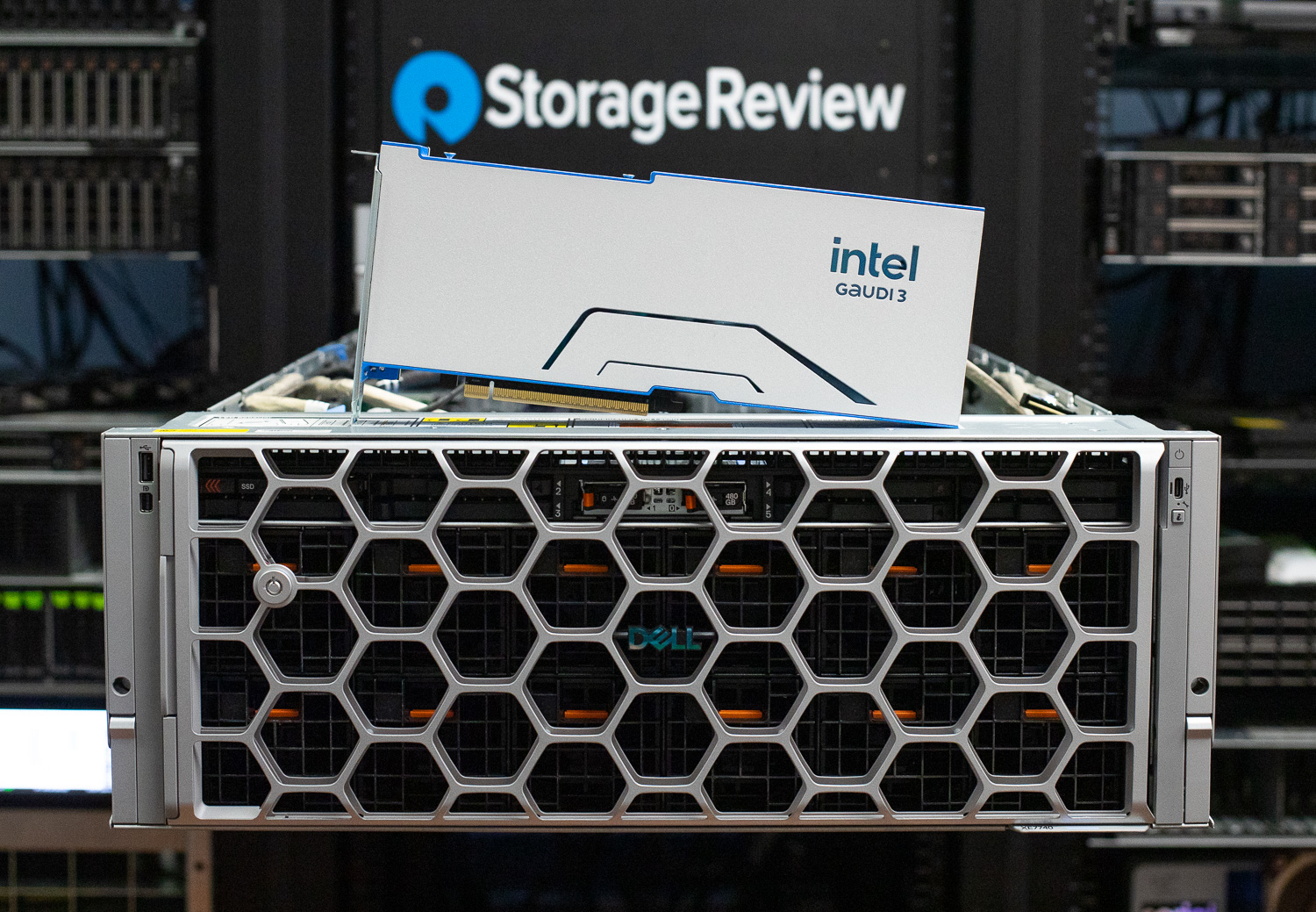
Intel’s Gaudi 3 accelerator is a standout component, offering 128 GB of HBM2e with 3.7 TB/s of memory bandwidth—ideal for memory-bound inference tasks. The system can also be configured with up to 8 TB or 4 TB of DDR5 memory, depending on the use case, ensuring headroom for schedulers, tokenization, and preprocessing.
Performance and Management
- AI Workload Support: Handles mid-size language models, retrieval-augmented generation, and computer vision tasks with high throughput and low latency.
- Memory Bandwidth: DDR5 configurations (up to 4 TB) or HBM2e (128 GB on Gaudi 3) optimize performance for memory-intensive inference.
- Advanced Management: iDRAC 10 provides SHA-384/SHA-512 authentication and quantum-safe AES-256 encryption, while OpenManage Enterprise offers centralized monitoring for large-scale deployments.
The XE7740 is not limited to a single workload profile. It can serve as the foundation for enterprise AI inference clusters, whether deployed in data centers or edge environments. Its ability to scale from partial GPU population in a single chassis to distributed racks ensures organizations can grow their deployments without overhauling infrastructure.
For administrators, the system’s design simplifies maintenance with optimized cable management and thermal zoning. Power consumption is also carefully managed, with configurations ranging from 600 W for standard setups to 3200 W for high-density GPU deployments (e.g., four H100 GPUs). This flexibility ensures that organizations can tailor power draw to their specific needs while adhering to data center constraints.
In summary, the Dell PowerEdge XE7740 is a pragmatic choice for enterprise AI inference. It balances accelerator flexibility, thermal efficiency, and scalable networking—all without sacrificing performance or security. For IT teams prioritizing adaptability and long-term scalability, this platform delivers on its promise of being a future-proof solution for production-grade AI workloads.