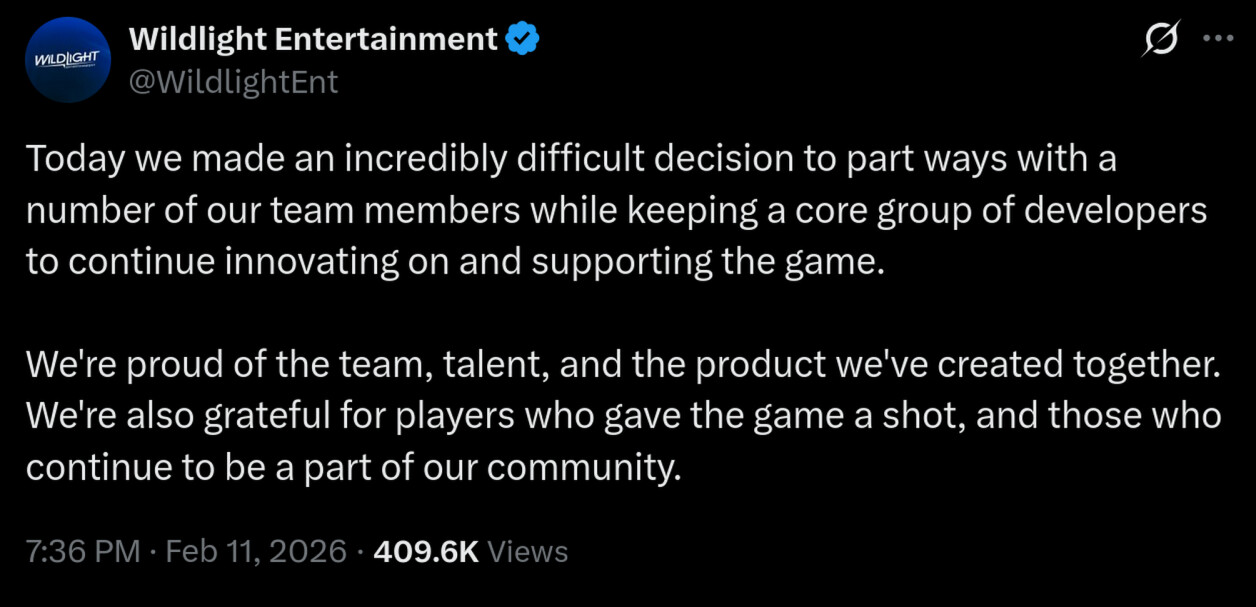
Wildlight Entertainment, the developer behind the newly released Highguard, has begun a sweeping round of layoffs, cutting most of its development team in the wake of the game’s sharp decline in player numbers. The studio, which had positioned Highguard* as a high-stakes, team-based shooter with unique mechanics, now faces an uncertain future after its launch in late January failed to sustain momentum.
Daily player counts on Steam plummeted from an initial peak of nearly 98,000 concurrent users to a steady 2,000–3,000—hardly enough to justify the resources poured into its development. The game’s reception was further dampened by technical hiccups, oversized maps that felt empty, and a lack of meaningful content for its 10v10 structure, which made matches drag. While a subsequent 5v5 mode update improved pacing, it arrived too late to reverse the damage.
Wildlight’s announcement confirmed that only a small core team will remain to support Highguard, with no clear roadmap for future content. The studio’s abrupt shift suggests a broader failure in execution: a rushed launch without adequate playtesting, a disconnect between design ambitions and player expectations, and a lack of flexibility to adapt quickly. For a free-to-play title, even a modest player base should have been sustainable—but Highguard’s steep drop-off indicates deeper systemic issues.
Former employees, including level designers, have described the layoffs as sudden and demoralizing. Reports indicate that months of unreleased content—potentially intended as post-launch updates—were left unfinished, further complicating the studio’s ability to recover. The situation underscores a growing trend in game development: even promising projects can collapse under the weight of untested mechanics, poor iteration cycles, and a failure to engage players early.
- Player retention: Peak concurrency of 97,249 dropped to 2,000–3,000 within weeks.
- Design flaws: Oversized maps and lack of content led to criticized pacing.
- Layoffs: Majority of developers cut; only a core team remains for support.
- Unfinished work: Months of unreleased content abandoned post-launch.
- Future uncertain: No confirmed plans for new features or major updates.
The studio’s downfall serves as a cautionary tale for indie and mid-sized developers: even innovative concepts can falter without rigorous pre-launch validation, adaptable design, and a clear understanding of player behavior. For Highguard*, the writing was on the wall from the start—but the scale of the collapse suggests deeper structural problems at Wildlight itself.