Networking hardware is evolving beyond raw speed metrics, and the latest dual-band Wi-Fi 7 access point from a leading provider demonstrates this shift with a focus on in-room deployments. Unlike previous generations that prioritized peak throughput, this device emphasizes stable performance at the room level—where real-world usage patterns matter most.
Designed for environments like multi-dwelling units (MDUs), hotels, and shared office spaces, the access point combines Wi-Fi 7’s dual-band capabilities with integrated IoT radios. The result is a compact wall-plate form factor that supports both high-density connectivity and smart room management without requiring separate gateways.
Key Specifications
- Wi-Fi 7 (802.11be): Dual-band operation across 2.4 GHz and 5 GHz with 2×2:2 MU-MIMO, delivering up to 3.6 Gbps aggregated throughput.
- IoT Integration: Built-in Bluetooth Low Energy (BLE) and Zigbee radios for Matter-compatible smart room control, energy management, and asset tracking.
- Physical Design: Wall-plate form factor (110 × 88 × 39.9 mm), compatible with standard in-wall installation standards and concealed uplink cabling.
- Power & Connectivity: Operates on 802.3af Power over Ethernet (PoE), eliminating the need for higher power requirements while maintaining compatibility with existing switching infrastructure.
- Management Flexibility: Supports Edgecore ecCLOUD, OpenWiFi CloudSDK-based controllers, and Zero Touch Provisioning (ZTP) for scalable deployments from single sites to multi-site networks.
The device’s 2.5 GbE uplink and PoE support simplify large-scale installations while keeping power consumption in check—a critical factor for IT teams managing energy costs without sacrificing performance.
Beyond Wi-Fi: A Gateway for Smart Environments
While Wi-Fi 7 access points often focus on bandwidth, this model takes a different approach by embedding BLE and Zigbee radios. The combination allows it to function as both a connectivity hub and an IoT gateway, supporting Matter protocols today with plans to expand into Wi-Fi HaLow for low-power wide-area applications in the future.
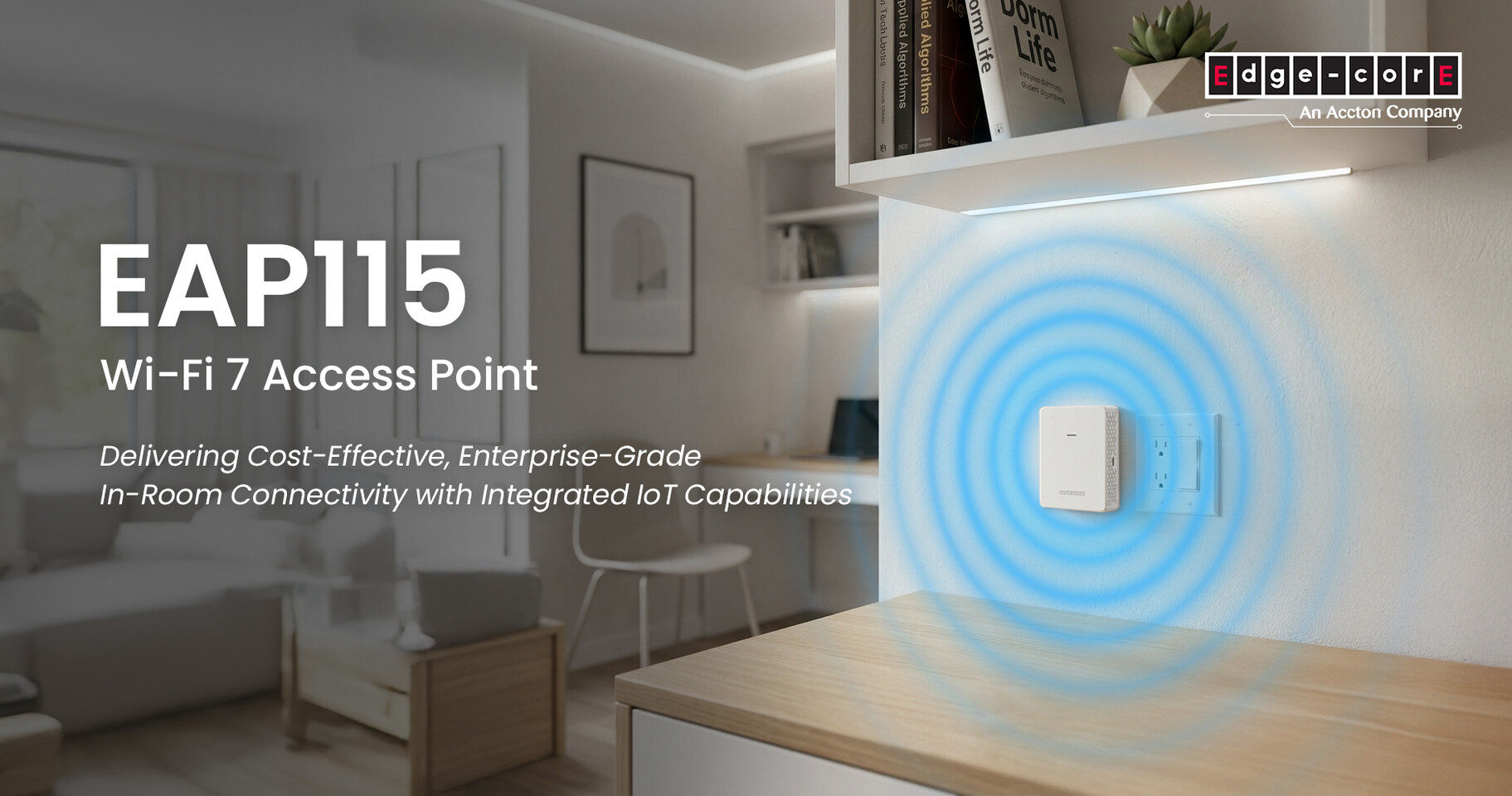
For IT managers in hospitality or residential settings, this means fewer devices to install and manage. A single access point can handle not only guest Wi-Fi but also smart lighting, occupancy sensors, and energy monitoring—all without requiring additional hardware. The tradeoff is that it adds complexity to firmware updates and security policies, but the long-term operational savings could justify the integration.
Who It’s For—and What Remains Unclear
- Ideal Use Cases:
- Multi-dwelling units (MDUs) where per-room connectivity is essential but space is limited.
- Hospitality environments (hotels, dormitories) needing both high-speed Wi-Fi and IoT-enabled room control.
- Managed service providers (MSPs) and ISPs looking for a unified platform to bundle Wi-Fi and IoT services.
The device’s compact size and PoE compatibility reduce physical footprint and power overhead, but its real-world performance in high-density scenarios—where multiple devices compete for bandwidth—has yet to be independently verified. Early benchmarks suggest stability under load, but long-term reliability in mixed IoT/Wi-Fi traffic remains an unknown.
Pricing has not been confirmed, but the focus on cost efficiency in the press materials suggests it aims to compete with mid-range Wi-Fi 6E access points while offering future-proof IoT capabilities. If that holds true, it could redefine what IT teams expect from in-room networking hardware: no longer just a conduit for data, but an active participant in smart environment management.
For now, the most significant change is clear: this access point blurs the line between Wi-Fi and IoT at the edge. Whether that translates to smoother deployments or more complex networks remains to be seen.