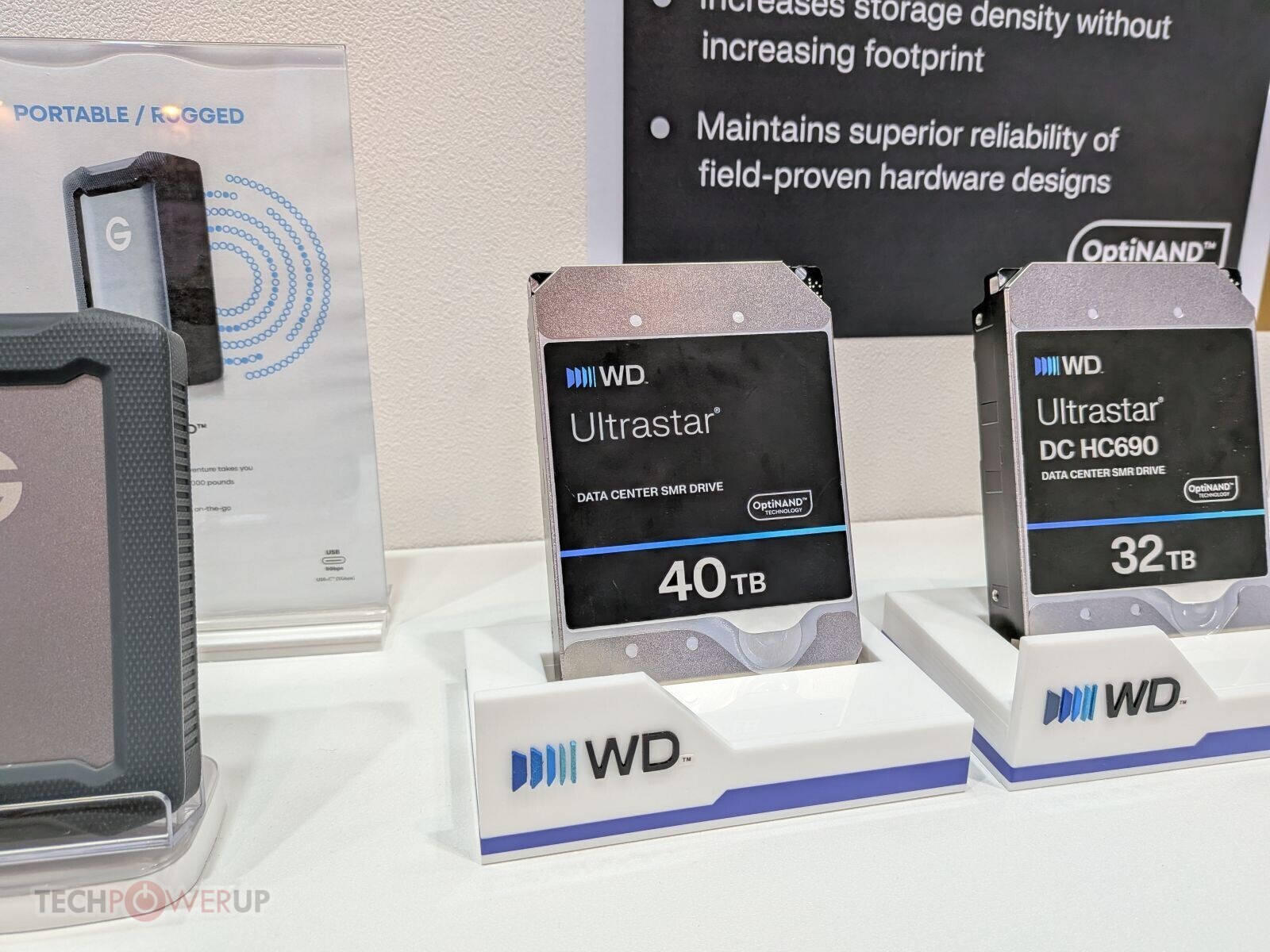
Enterprise storage is evolving beyond raw capacity, and Western Digital’s latest Ultrastar hard drive advancements are leading the charge. At an industry showcase, the company unveiled next-generation recording technologies designed to tackle the dual challenges of AI-driven data growth and thermal efficiency—two factors that could determine the economic viability of large-scale deployments.
workloads, from initial model training to active agentic systems, generate compounding volumes of data. Managing this explosion while maintaining cost-effective performance is becoming the defining challenge for enterprise environments. Western Digital’s approach treats AI primarily as a data system rather than just compute, emphasizing storage as the foundation for long-term operational success.
The core of this push lies in advancements like UltraSMR, ePMR, and HAMR recording technologies, which are being integrated into the Ultrastar portfolio. These drives promise massive capacities while addressing the physical constraints that have historically limited scalability in high-density deployments.
To support these drives, Western Digital has expanded its platform solutions with the Ultrastar Data 3000 series JBODs. The new enclosures feature twelve ports of 24 Gb/s SAS-4 connectivity, a significant leap from previous generations. This bandwidth boost is critical for AI workloads that demand faster data ingress and egress.
But the most notable innovation may be in thermal management. The Data 3000 series introduces ArcticFlow multizone cooling and IsoVibe vibration isolation technologies. These engineering tweaks are designed to reduce drive return rates by up to sixty-two percent, ensuring stable operation even in high-density, high-temperature environments where traditional HDDs often falter.
The implications for enterprise storage are substantial. By improving power efficiency and reducing thermal stress, Western Digital is addressing two of the most pressing pain points in data center design: cost per watt and reliability. For PC builders and system integrators, this means more stable performance from storage solutions that can handle sustained workloads without degradation.
What remains to be seen is how these advancements will integrate with emerging standards like DDR5 memory modules and the potential N1X platform, which could further push the boundaries of what’s possible in high-performance computing. If adopted widely, this generation of Ultrastar drives could set a new benchmark for enterprise storage efficiency.