What starts as a joke can end as a revolution. That’s the lesson from cursed, a programming language that doesn’t just mimic Gen Z internet culture—it is Gen Z internet culture. Every keyword, every syntax rule, has been rewritten in the shorthand of TikTok , meme culture, and online slang. Yet beneath its playful facade lies a technique that could redefine how software is built, tested, and deployed. The implications are already playing out in real-world contracts, where the same method behind cursed has slashed development costs by as much as 99%.
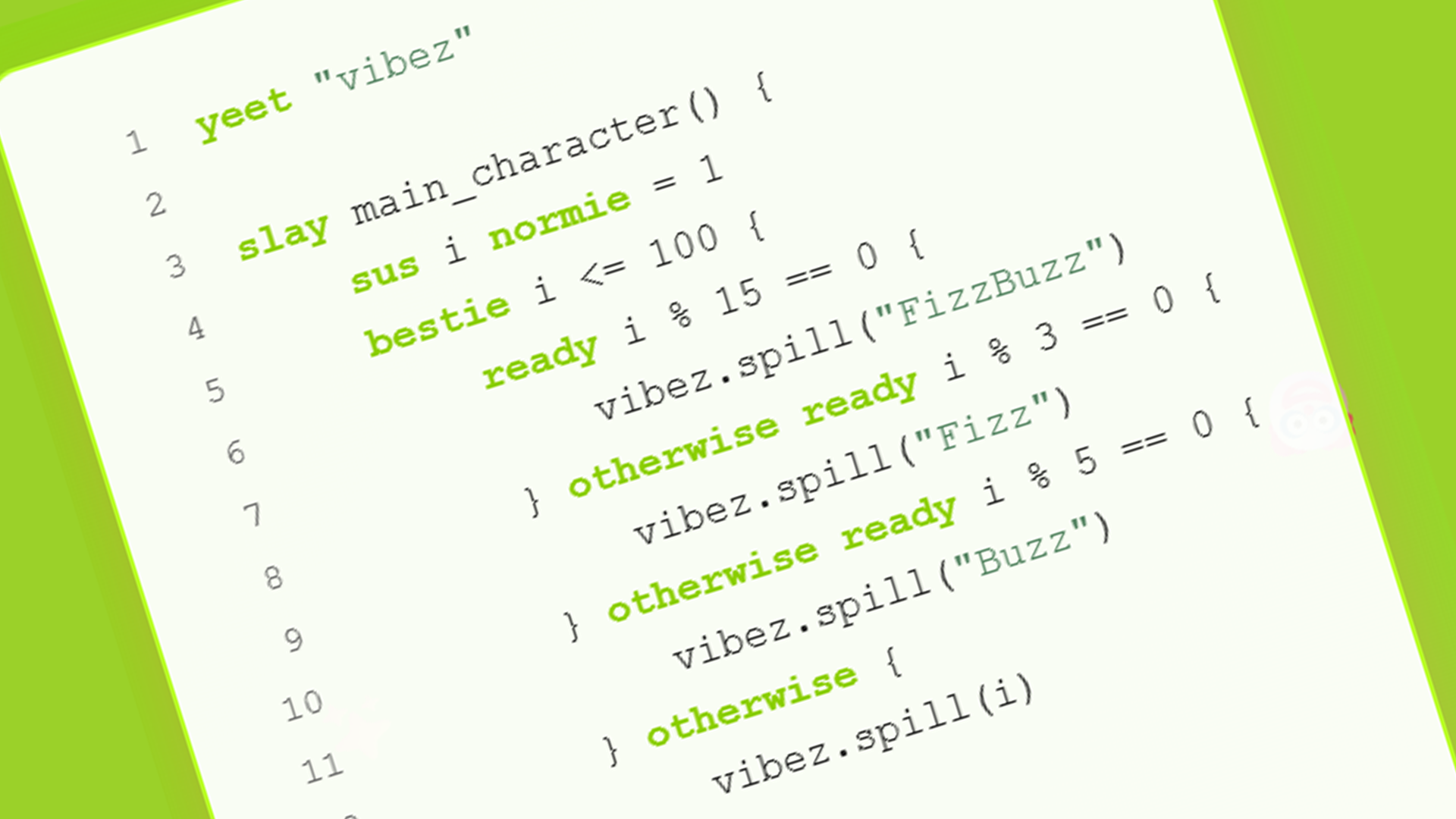
The language’s creation wasn’t the result of careful planning. Instead, it emerged from what its creator calls a Ralph Wiggum loop—a reference to the perpetually failing character from *The Simpsons*—where an AI was fed its own outputs, including errors, over and over again. The goal was simple: take a language like Go, strip away its traditional keywords, and replace them with terms like bestie (for loops), ghosted (break statements), and yeet (imports). What followed was three months of unsupervised refinement, where the AI gradually corrected its own mistakes until cursed became not just readable, but functional.
The language’s syntax is a direct translation of internet vernacular into code
- A bestie loop replaces the standard for loop.
- Slay defines a function, while sus declares a variable.
- Cringe stands in for false, and nah is nil.
- Even complex concepts like pointers are represented by ඞT, a doge meme face pointing to type T.
The result is code that looks like it was written by a teenager in a Discord server—yet it compiles and runs. The website for cursed leans into the absurdity, with its creator admitting he doesn’t even know why he built it. Success, he jokes, would be if the language either becomes the most beloved or the most hated in Stack Overflow’s annual survey. But the real test isn’t popularity—it’s whether the technique behind it can be scaled.
The method isn’t just about slang. It’s about autonomous refinement. By feeding AI-generated code back into itself—including failures—the system learns to self-correct, producing outputs that approach human-level accuracy without human intervention. The economic implications are immediate. Huntley’s experiments suggest that open-source software can now be cloned at rates as low as $10 per hour, a fraction of traditional development costs. More strikingly, a developer recently delivered the equivalent of a $50,000 contract’s worth of work for just $297 using the same approach.
This isn’t just a cost reduction—it’s a disruption. Traditional outsourcing models, which rely on labor arbitrage, now face competition from an AI that can generate functional code at near-zero marginal cost. The Ralph Wiggum plugin, integrated into Anthropic’s Claude Code tool, further democratizes the technique, embedding it into everyday development workflows. The question isn’t whether this will happen—it’s how quickly.
Yet the risks are just as clear. Huntley has expressed unease about the concentration of such power in individual hands. If AI can replicate entire codebases with minimal oversight, what becomes of the economic incentives that sustain software ecosystems? Will open-source projects still thrive when their work can be mirrored overnight? And who bears responsibility when an AI-generated system fails—not because of incompetence, but because it was never truly understood?
The cursed language itself may never gain mainstream adoption. But the technique that birthed it is already reshaping how code is written. The boundaries between human and machine authorship are blurring, and the tools being built today may redefine what’s possible—and what’s ethical—tomorrow. For now, cursed remains a curiosity, a meme given form. But the lesson it carries is serious: the future of software isn’t just about what we write. It’s about what the machines learn to write for us—and whether we’re ready for the consequences.