Mid-tower cases have evolved significantly over the past decade, shifting from basic steel cages to complex systems that balance aesthetics, cooling, and cable organization. SAMA’s latest S50 series continues this trend, but with a focus on practical improvements rather than radical innovation.
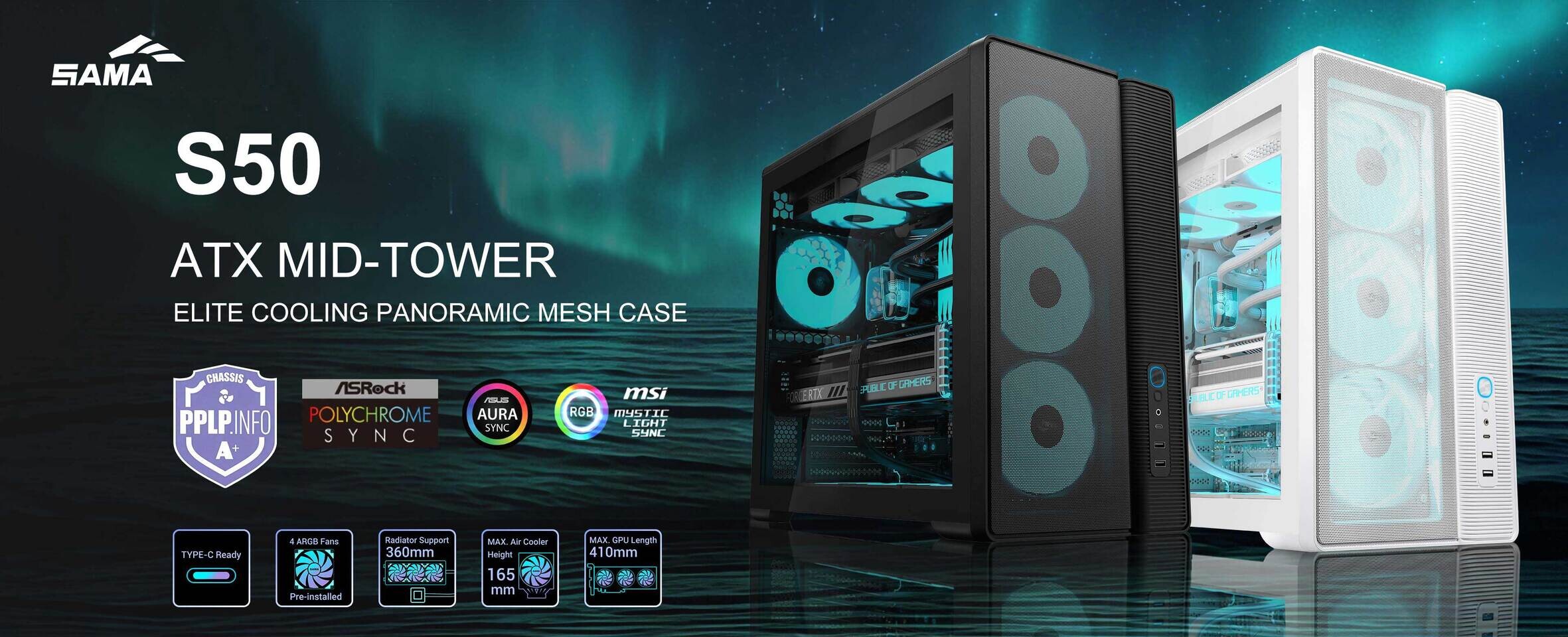
The S50 is built around a standard ATX form factor, maintaining compatibility with most modern builds while introducing subtle refinements. Its front panel features a mesh design that enhances airflow without sacrificing structural integrity, a common challenge in mid-tower cases where balance between cooling and build flexibility is critical. The series includes multiple variants—black, white, and silver—each tailored to different aesthetic preferences while retaining the same functional core.
Key Details
The S50 stands out with its improved cable management system, which SAMA claims reduces clutter by up to 30% compared to previous generations. This is a notable claim, as cable management has long been an area where mid-tower cases lag behind larger full-tower or smaller micro-ATX designs. The case also supports both front and top I/O configurations, giving builders more flexibility in routing power and data cables without compromising on airflow.
Under the hood, the S50 maintains a robust steel frame with reinforced corners to prevent flexing during heavy builds. Its support for up to 3x 140mm or 2x 120mm + 1x 140mm fans ensures compatibility with high-performance cooling setups, though it does not include built-in RGB lighting—a choice that aligns with SAMA’s focus on functionality over flashy aesthetics.
Why It Matters
The mid-tower market has seen a surge in competition, with manufacturers racing to offer more for less. The S50 enters this space with practical improvements rather than gimmicks, which could appeal to IT teams and enthusiasts prioritizing reliability over novelty. However, its success will depend on two critical factors: availability and pricing.
SAMA has not yet confirmed a global release date or pricing structure, leaving room for uncertainty. If the S50 follows past trends, it may face supply constraints due to high demand, which could limit its immediate impact. Additionally, while the case’s design is competitive, it does not introduce breakthrough features that would set a new benchmark in the category.
What to Watch Next
The S50 series will be judged not only on its technical merits but also on how well SAMA executes its supply chain. Mid-tower cases are a staple for many builds, and any delays or shortages could overshadow even the most refined design. For now, IT teams should monitor updates closely, as the S50’s performance in real-world testing will reveal whether it lives up to its marketing promises.
One area where the S50 does not make significant strides is in modularity. Unlike some competitors that offer removable panels or adjustable side walls, the S50 sticks to a traditional mid-tower layout. This could limit its appeal for builders who prioritize customization over out-of-the-box functionality.
Despite these caveats, the S50 represents a step forward in mid-tower design. It avoids the pitfalls of over-engineering while addressing practical pain points like cable management and airflow. Whether it becomes a staple in IT builds remains to be seen, but its focus on substance over spectacle is a refreshing shift in a market often dominated by flash.