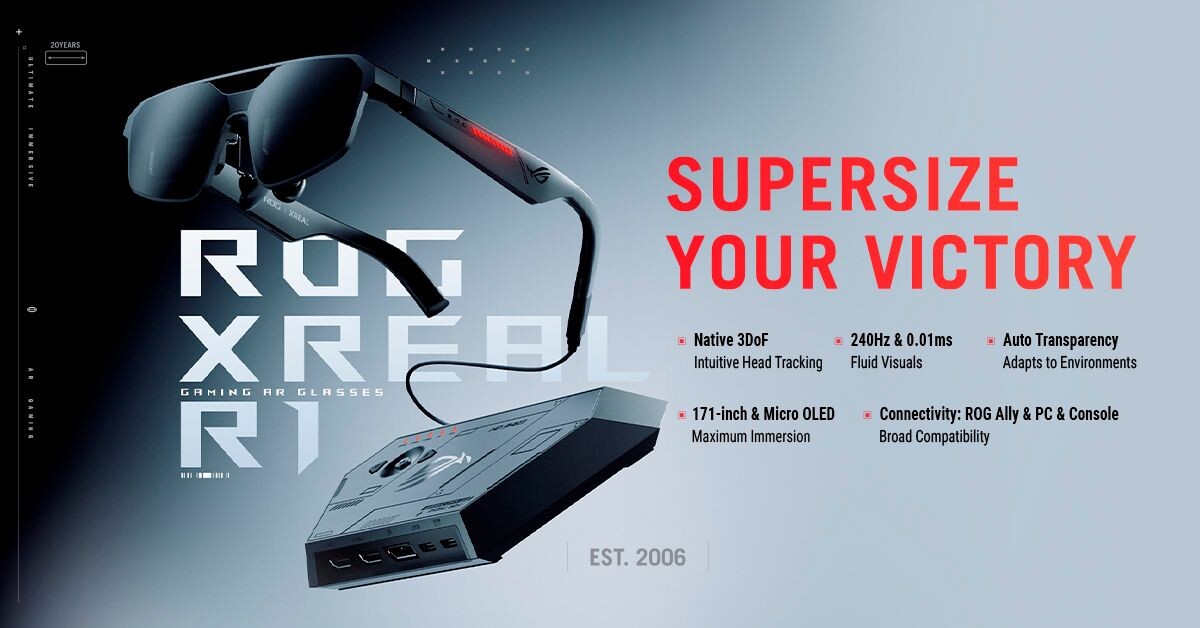
The ROG XREAL R1 is not just another gaming accessory—it’s the first consumer-grade AR glasses to combine a 240 Hz micro-OLED panel with electroceramic lens technology, creating a visual experience that feels like stepping into a live-action game. For users who demand both performance and adaptability, it represents a significant shift in how immersive displays can be integrated across platforms.
At its core, the R1 is built around a 171-inch virtual screen delivered through micro-OLED, paired with near-instant 0.01 ms response time and a 57° field of view that covers up to 95% of focused vision. This level of clarity is matched by intelligent lens control: the glasses automatically tint or clear based on gaze direction, ensuring readability in any lighting without manual adjustments. The system also supports native Three Degrees of Freedom (3DoF) interaction, allowing users to anchor the display in space or have it follow their movement seamlessly.
Key specs and platform integration
- Display: 171-inch virtual screen, micro-OLED, 240 Hz refresh rate, 3 ms motion-to-photon latency, 57° field of view (95% coverage), Anchor/Follow modes.
- Lens tech: Electroceramic dimming with three manual tint levels and one-click transparency, adaptive head-tracking for automatic adjustments.
- Audio: Bose 3D soundstage with spatial accuracy for immersive audio cues.
- Hardware/software: Compatible with ROG Ally (dual-screen sync), ROG Control Dock, ASUS DisplayWidget Center, Armoury Crate SE app for in-game tweaks.
The R1 is engineered to work as a standalone peripheral across mobile and handheld devices, but it reaches its peak when paired with the ROG Ally. In this setup, the glasses project a massive virtual display while the Ally’s built-in screen remains active, allowing real-time adjustments to brightness, aspect ratio, or visual effects without breaking immersion. The Armoury Crate SE app extends this control, letting users tweak spatial layouts, activate GamePlus enhancements (like AI crosshairs), and manage 3D mode—all while maintaining uninterrupted gameplay.
For PC builders, the ROG Control Dock acts as a command center, enabling keyboard-and-mouse customization of virtual screens and system-wide settings. This level of precision is designed to give competitive gamers an edge, with tools co-developed with pro players for skill refinement. However, while the hardware integration is seamless within the ROG ecosystem, its broader compatibility outside this platform remains unconfirmed—a potential limitation for users who rely on non-ASUS devices.
Who benefits and where it falls short
The R1’s 240 Hz refresh rate and 3 ms latency are tailored for fast-paced games, eliminating motion blur or jitter that can disrupt competitive play. The adaptive lens technology ensures comfort in bright or dim environments, while the Bose audio system adds spatial depth to sound cues—critical for immersion in titles where situational awareness matters. These features make it a compelling choice for hardcore gamers who prioritize performance and responsiveness.
Yet, the R1 is not a one-size-fits-all solution. Its ecosystem-driven design means it shines brightest within ASUS’s own hardware lineup, particularly when paired with ROG Ally or compatible PCs. Users outside this ecosystem may find limited functionality, and while the glasses are marketed as plug-and-play, long-term durability in mixed-use scenarios (e.g., gaming and non-gaming tasks) has not been independently verified. For those who value platform flexibility, the trade-off between cutting-edge performance and vendor lock-in is worth careful consideration.
Ultimately, the ROG XREAL R1 pushes the boundaries of what’s possible in portable gaming displays today. It confirms that 240 Hz micro-OLED with adaptive lens tech can deliver theater-sized immersion without compromising responsiveness. What remains unconfirmed is how this experience scales beyond ASUS’s ecosystem—and whether competitors will soon match or exceed its performance-per-watt efficiency.