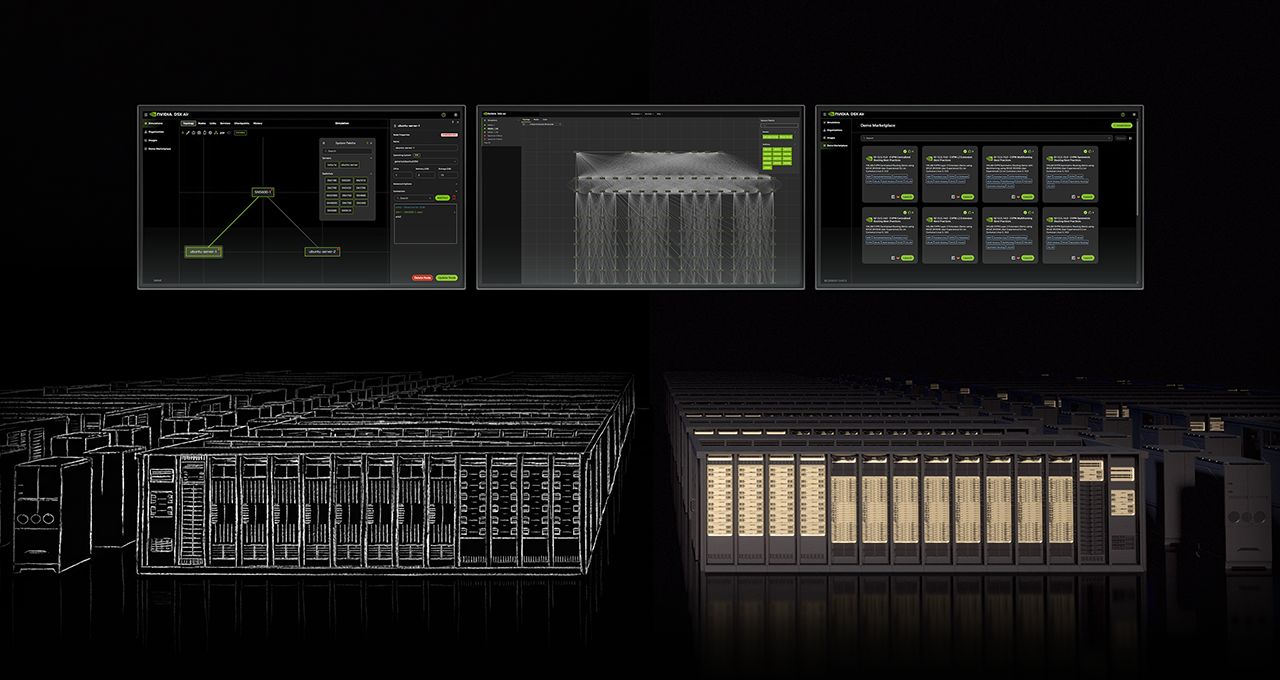
infrastructure is being reimagined—no longer a matter of trial and error with physical hardware. NVIDIA’s DSX Air, part of the company’s DSX Sim platform, allows organizations to create high-fidelity digital twins of their AI factories, complete with GPUs, networking, storage, orchestration, and security layers.
This shift mirrors a long-standing IT practice—testing configurations on a virtual replica before deployment—but scales it to hyperscale AI environments. The result? Organizations that once spent weeks or months integrating complex systems can now validate their setups in days, slashing time-to-token and reducing the risk of costly misconfigurations.
DSX Air isn’t just about speed; it’s about building an ecosystem. Server manufacturers, orchestration vendors, storage providers, and security partners can all test their solutions alongside NVIDIA’s hardware in a single simulated environment. This collaborative validation ensures that components work seamlessly together before any physical deployment.
Why Simulation is Becoming Non-Negotiable
The demand for AI infrastructure has outpaced traditional development cycles. Custom configurations, multi-tenant security requirements, and the complexity of modern AI workloads make physical prototyping impractical. DSX Air addresses this by providing a scalable, cost-effective way to simulate entire AI factories—compute, networking, storage, and more—without needing to unbox a single server.
For example, at NVIDIA’s GTC 2026 event, partners demonstrated how DSX Air could validate everything from GPU allocation (using NVIDIA Run:ai) to network orchestration (with Netris) and threat detection (via Check Point). Security vendors, in particular, benefit by testing multi-tenant policies and DPU-accelerated isolation in a realistic environment—long before production systems go live.
A New Operational Model for AI Factories
DSX Air introduces a simulation-first approach that changes how AI infrastructure is deployed and maintained. Teams no longer wait for hardware to arrive; instead, they build their intended production environment entirely in software first. This digital twin is then used to
- Validate networking, compute, storage, and security configurations before deployment.
- Test upgrades, patches, or maintenance changes in a safe, isolated environment.
- Predict operational impacts without risking live systems.
This lifecycle model reduces downtime and ensures that AI factories operate smoothly from day one. It also allows for continuous refinement—organizations can rehearse changes in simulation before applying them to production, minimizing disruptions.
Who Stands to Gain the Most?
The immediate beneficiaries are organizations racing to deploy large-scale AI infrastructure, including
- AI Cloud Providers: Companies like Siam.AI, Thailand’s largest AI cloud provider, use DSX Air to validate architectures in simulation before physical hardware arrives. This ensures day-one operational expertise and reduces deployment risks.
- Server Manufacturers: They can model and test reference architectures tailored to specific customer needs without building expensive physical labs. This accelerates solution validation and delivery.
- Orchestration and Security Vendors: Partners like Rafay (host orchestration) and Check Point (security) can validate complex workflows at scale, ensuring their solutions integrate seamlessly with NVIDIA’s infrastructure.
For these stakeholders, DSX Air is more than a tool—it’s a competitive advantage. The ability to simulate full-stack environments before deployment allows them to ship validated infrastructure faster while minimizing risk as global AI demand grows.
A Glimpse into the Future of AI Deployment
Simulation has long been a staple in industries like automotive and aerospace, where testing prototypes is costly and time-consuming. DSX Air brings that same rigor to AI infrastructure—a domain where complexity and scale have made physical validation impractical.
The platform’s success hinges on its openness: it integrates with leading partner solutions via open, API-based connectivity, ensuring interoperability across the ecosystem. This collaborative approach is already reshaping workflows, from server manufacturers testing bespoke configurations to security vendors refining multi-tenant policies in a realistic environment.
As AI factories expand in size and complexity, the ability to validate entire environments before hardware arrives will define the pace of innovation. DSX Air delivers that capability today, offering organizations the fastest path to first token while ensuring reliability over time.
The question isn’t whether simulation will become standard—it’s how quickly others will follow NVIDIA’s lead and adopt this new operational model.