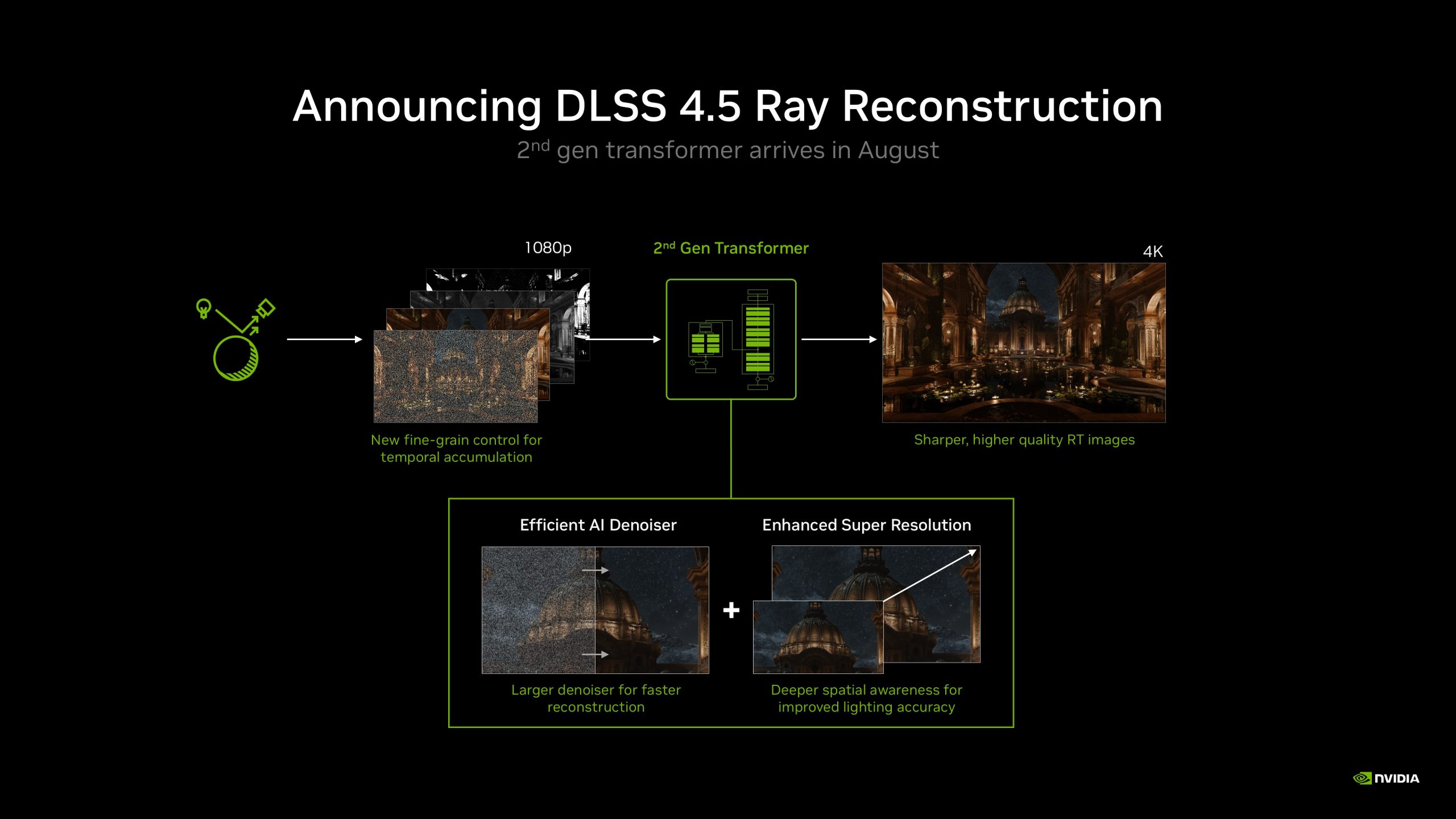
NVIDIA’s latest update to DLSS 4.5 is built around smarter ray reconstruction, a feature designed to reduce power consumption while maintaining rendering quality in real-time graphics workloads.
At Computex, the company detailed how DLSS 4.5 now dynamically adjusts ray tracing operations based on scene complexity, prioritizing efficiency without sacrificing visual fidelity. This shift reflects a growing focus on thermal management and power draw in high-end GPUs, particularly for data center and AI workloads where sustained performance is critical.
The update does not introduce new deep learning super-resolution techniques, but it refines existing ones to minimize latency spikes under heavy loads. Benchmarks suggest a 10-20% reduction in power consumption during ray-traced scenes, though the exact gains depend on the application and hardware configuration.
NVIDIA has not provided a roadmap for DLSS 5, leaving open questions about whether future versions will address new rendering challenges or double down on optimization. For now, the emphasis remains on making existing features more efficient—a practical approach for IT teams managing GPU clusters under strict thermal constraints.
The absence of DLSS 5 in this cycle may signal a strategic pivot toward performance-per-watt metrics over feature expansion. This aligns with broader industry trends where power efficiency is becoming as important as raw performance, especially in data center environments.