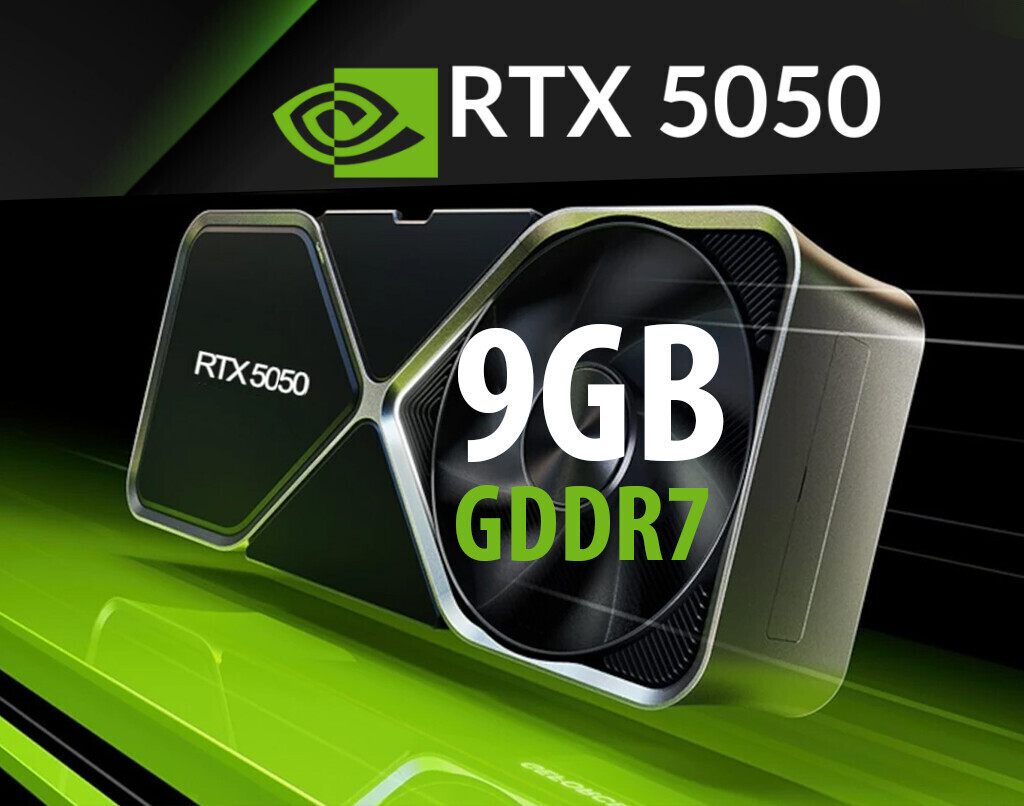
NVIDIA’s GeForce RTX 5050 is evolving in response to memory shortages that have reshaped how GPUs are designed. A new variant, expected to appear during Computex 2026, will swap the current 8 GB GDDR6 for 9 GB of GDDR7—achieved by using three 3 GB modules instead of four 2 GB ones. This shift maintains the same 128-bit bus width but boosts bandwidth from 320 GB/s to 336 GB/s, a modest improvement that nevertheless delivers more VRAM without increasing power draw.
The RTX 5050 remains one of NVIDIA’s most power-efficient GPUs, with the new variant retaining its 130 W TDP. However, the move to GDDR7 is not purely technical; it reflects a broader industry shift where memory manufacturers are prioritizing production of 3 GB modules over smaller GDDR6 variants. This has made it easier for NVIDIA to procure enough VRAM for the RTX 5050 while reducing the number of modules per card—an important consideration as supply constraints tighten.
Key specs
- Memory: 9 GB GDDR7 (3 modules × 3 GB) vs. 8 GB GDDR6 (4 modules × 2 GB)
- Bus width: 128-bit → 96-bit
- Bandwidth: 320 GB/s → 336 GB/s (+5%)
- TDP: 130 W (unchanged)
- GPU core: GB206 with 2,560 CUDA cores
The reduction in bus width from 128-bit to 96-bit is the most noticeable change for performance. While bandwidth increases slightly, memory latency and overall throughput could see a mild degradation compared to the current model. However, for entry-level gaming or workloads that don’t push VRAM limits, the difference will likely be negligible.
Why it matters
This variant marks NVIDIA’s first major adaptation to GDDR7, which is becoming the default memory standard as GDDR6 faces tighter supply. The shift also reduces the number of modules per GPU, simplifying production and potentially lowering costs—a critical factor in an environment where component availability is unpredictable.
For IT teams evaluating GPUs for entry-level workstations or budget-conscious deployments, this variant offers a small performance uplift without requiring additional power infrastructure. However, those relying on high-bandwidth memory operations may find the 96-bit bus a limitation compared to the current 128-bit configuration.
What’s next
The RTX 5050 with GDDR7 is expected to arrive alongside other Blackwell-based GPUs during Computex 2026. While NVIDIA has not confirmed pricing or exact release dates, the shift suggests a continued focus on efficiency and supply-chain resilience as demand for discrete GPUs remains volatile.
One unknown is whether this variant will extend to higher-tier RTX 50-series models, such as the RTX 5070 or 5090. If so, it could signal a broader industry move toward GDDR7 across the board—though whether performance losses in bus width will be mitigated by other architectural improvements remains to be seen.