The flight simulation market is at a crossroads. For years, enthusiasts have accepted a trade-off: either settle for generic, budget-friendly controls that lack realism or invest in boutique hardware that mimics professional flight decks—at a premium. Moza Racing’s new lineup disrupts this dynamic by offering near-professional force feedback and customization without the exorbitant price tag. But whether this shift will broaden the appeal of flight simulation or remain confined to a dedicated niche remains an open question.
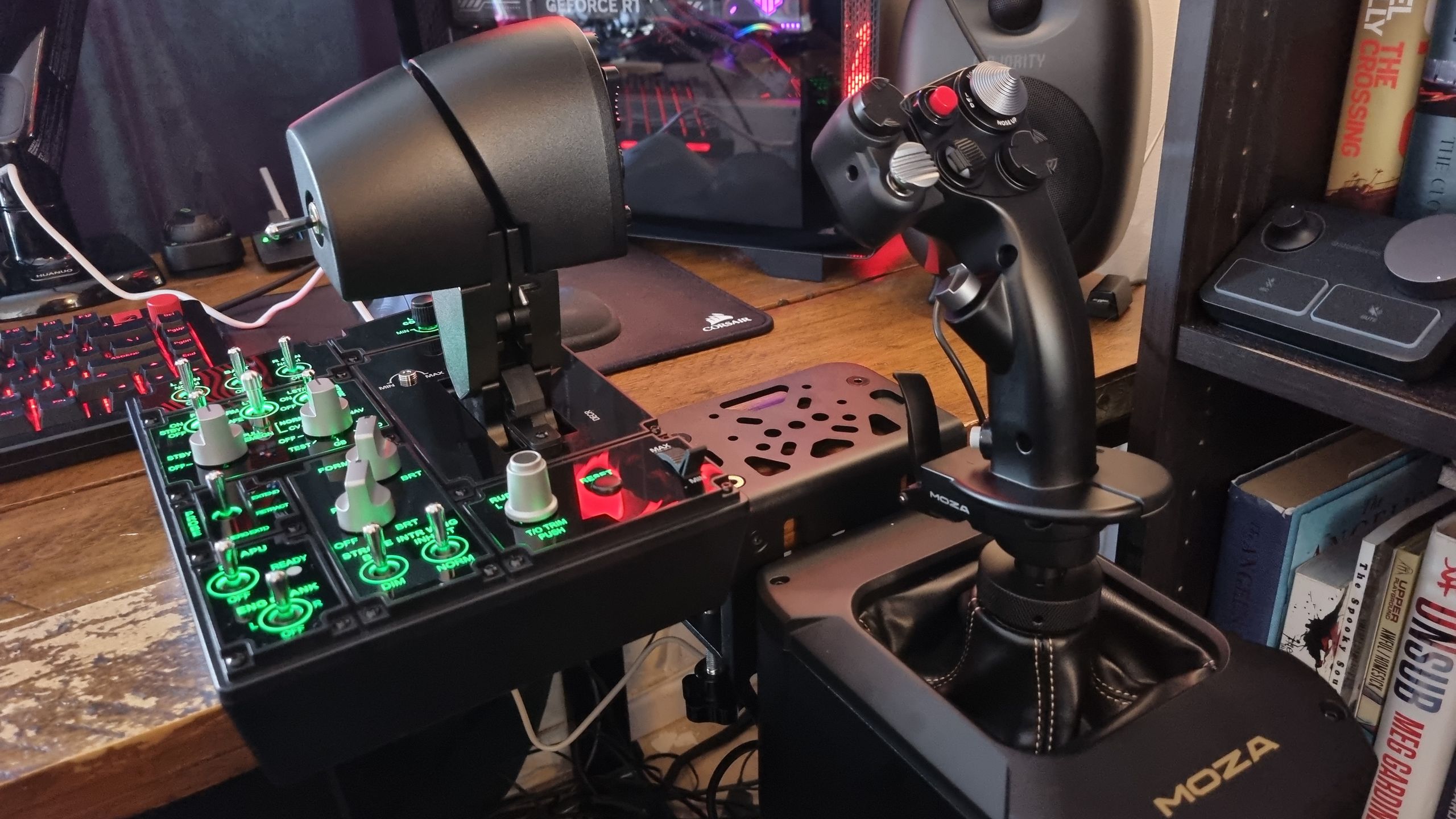
The AB9 FFB Base is the backbone of Moza’s system, delivering a peak torque of 12 Nm—enough to simulate the resistance of a real aircraft’s control column during high-G maneuvers. Unlike many consumer-grade bases that rely on single motors, Moza’s dual-servo design ensures smoother transitions between force feedback profiles, whether replicating the vibrations of a jet engine or the subtle drag of a propeller. The 5 mm steel clamp system allows for flexible mounting, accommodating both standalone setups and integration with existing rigs. This level of engineering is typically reserved for commercial-grade simulators, yet Moza achieves it in a package that weighs just 5.5 kg.
Where the MH16 Flightstick ($149) stands out is in its modularity. The stick itself is built from high-quality materials, with no compromises in ergonomics or responsiveness. The inclusion of an eight-way hat switch and a removable side panel with programmable buttons allows users to tailor the controls to specific aircraft types—a feature that most consumer flight sticks lack. While it may not boast the same level of tactile luxury as Thrustmaster’s premium offerings, the MH16’s precision and build quality make it a standout in its price category.
The MTP Throttle ($329) is where Moza’s design philosophy becomes most apparent. Packed with 27 programmable switches, split throttles, and a Hall effect joystick, it’s a control hub for serious simmers. The aluminum chassis ensures durability, though the absence of a built-in desk clamp is a minor oversight—addressed by Moza’s optional suction-mount adapter ($35). The throttle’s extensive configurability is both its greatest strength and potential weakness; while it offers unparalleled customization, it also demands a significant time investment to fine-tune. For those willing to put in the effort, however, the result is a level of control that rivals professional flight decks.
Moza’s modular approach extends to the optional Z-Axis module ($89), which adds vertical movement to the flightstick, enhancing the realism of pitch and roll dynamics. While not included in the base setup, this accessory underscores Moza’s commitment to letting users build their ideal rig—without unnecessary frills. The core setup, including the AB9 Base, MH16 Flightstick, MTP Throttle, and desk clamp, totals $977—a steep but justified investment for enthusiasts who prioritize immersion over budget constraints.
Yet price is only part of the equation. Compatibility remains a hurdle, particularly in games like Microsoft Flight Simulator 2024, where deep hardware integration is still evolving. While Moza’s Cockpit software supports DirectInput and telemetry modes for titles like DCS World and X-Plane, some games require manual adjustments to achieve optimal force feedback. This isn’t a flaw in Moza’s hardware but a reflection of the broader challenges facing flight simulation software developers. For now, users must balance patience with technical know-how to unlock the full potential of their rig.
The payoff, however, is undeniable. In DCS World, the force feedback delivered by Moza’s hardware is transformative. The stick’s resistance shifts dynamically with throttle changes, and even minor control inputs produce tactile feedback that trains pilots to rely on instinct rather than instruments. It’s an experience that blurs the line between gaming and professional training—a testament to Moza’s engineering prowess.
But this level of realism isn’t without trade-offs. The learning curve for Moza’s hardware is steep, with configuration options that can overwhelm newcomers. Moza’s software mitigates some of this complexity with features like auto-calibration, but mastering the system still requires time and experimentation. For casual users, the investment in both money and effort may not be justified. Yet for hardcore enthusiasts, the trade-off is worth it—offering a flight experience that few desktop rigs can match.
The broader implications for the flight simulation industry are significant. Moza Racing’s hardware proves that high-end force feedback doesn’t require boutique pricing. By democratizing professional-grade controls, the company has lowered the barrier to entry for enthusiasts who previously had to choose between budget-friendly but limited hardware or commercial-grade simulators with six-figure price tags. This shift could accelerate innovation in the space, encouraging other manufacturers to refine their offerings and expand the market beyond its current niche.
At the same time, the industry must address lingering challenges, particularly in software compatibility and user accessibility. For flight simulation to evolve beyond its enthusiast roots, developers and hardware manufacturers must work together to streamline setup processes and improve integration with mainstream games. Until then, Moza’s hardware remains a beacon for those willing to embrace the complexity—and cost—in pursuit of unparalleled realism.
The future of flight simulation may not be defined by Moza Racing alone, but the company’s latest lineup signals a turning point. It’s a reminder that the most compelling advancements in gaming hardware often come from those who refuse to compromise on quality—even if it means catering to a niche audience first. For serious simmers, Moza’s hardware is a game-changer. For the industry, it’s a call to push further, toward a future where flying feels as real as possible—without the prohibitive costs of yesterday.