Microsoft has announced a substantial update to its Agility SDK, version 1.619, introducing Shader Model 6.9 and DXR 1.2 alongside several DirectX 12 Ultimate enhancements. These updates aim to push the boundaries of GPU performance, offering developers new tools to optimize their applications.
The latest SDK brings four key additions to Shader Model 6.9: Long Vector support, which allows HLSL to handle vectors longer than four elements and up to 1024 elements; 16-bit float Specials for enhanced precision in shader operations; 16-bit and 64-bit shader ops and wave ops as required features; and HLSL exposure for DXR 1.2, enabling developers to leverage these advanced capabilities more effectively.
On the ray tracing front, DXR 1.2 introduces Opacity Micromaps (OMMs) and Shader Execution Reordering (SER). OMMs are designed to improve the handling of alpha-tested geometry, potentially offering up to a 60% performance boost in path-traced titles when used effectively. SER allows application shader code to inform hardware on how to find coherency across rays, optimizing parallel execution and further enhancing performance.
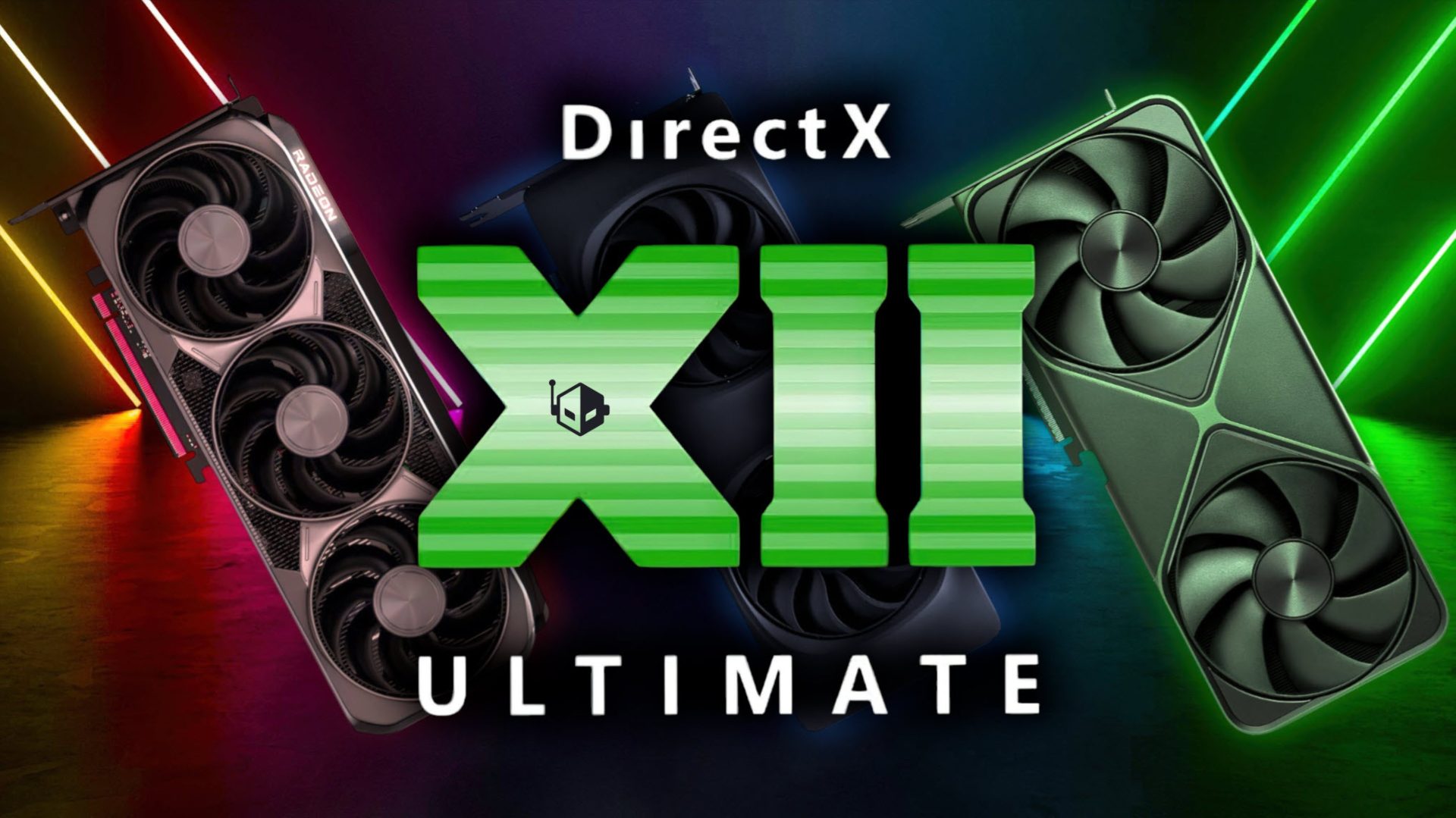
Key DirectX 12 Ultimate Enhancements
- Opacity Micromaps (OMMs): Enables more efficient handling of alpha-tested geometry, reducing reliance on costly AnyHit shader invocations. Hardware-accelerated on NVIDIA RTX 40 GPUs and above, with software emulation available on older hardware.
- Shader Execution Reordering (SER): Allows applications to inform hardware on how to sort rays for better parallel execution. Supported on NVIDIA RTX 40 GPUs and Intel Arc B-Series Graphics, but not on AMD Radeon RX 9000 GPUs.
- Revised Resource View Creation APIs: Modernizes buffer view creation, addressing limitations in the original D3D12 model. Supported across all major GPU vendors.
- Periodic Trim Notifications: Enables applications to receive notifications when the system should trim residency, improving memory management without requiring new driver support.
- Increased 1D Dispatch Limit: Raises the maximum 1-Dimensional Dispatch/DispatchMesh size from 65535 to a device-specific value, accommodating larger compute workloads.
- CPU Timeline Query Resolves: Introduces a new kind of Query Heap that can be resolved on the CPU timeline, reducing unnecessary GPU work and overhead.
The latest Agility SDK also includes several other enhancements, such as Fence Barriers in preview for AMD Radeon RX 7000 and Intel Arc B-Series Graphics, and VPblit 3DLUT support for AMD Radeon RX 7000 series graphics cards and Ryzen AI 300/400 series processors.
Hardware Support
- NVIDIA RTX GPUs: All RTX GPUs support the latest features, with hardware-accelerated OMMs on RTX 40 GPUs and above. SER is supported on RTX 40 GPUs and above.
- AMD Radeon RX GPUs: Support for RX 7000 and RX 9000 series, with full DXR 1.2 and Shader Model 6.9 features limited to RDNA 4 (Radeon RX 9000) GPUs.
- Intel Arc Graphics: Support for Arc B-Series (Battlemage) GPUs, with certain D3D features applicable to Lunar Lake CPUs as well. OMMs are supported but do not feature reordering on RX 9000 GPUs.
These updates underscore Microsoft's commitment to advancing GPU performance and providing developers with the tools they need to create more efficient and powerful applications. The latest Agility SDK is a significant step forward, offering new capabilities that promise to enhance both gaming and professional workloads.