Micron has officially launched the industry’s first PCIe Gen6 SSD—the 9650—marking a leap forward in storage speeds that could redefine how data centers handle AI and high-performance computing. With sequential read speeds hitting 28GB/s—nearly double the 14GB/s of PCIe Gen5—this drive isn’t just an upgrade; it’s a fundamental shift in how data moves between storage and accelerators like GPUs.
This isn’t just about raw speed, though. The 9650 also introduces a critical efficiency breakthrough: at the same power draw as Gen5 drives, it delivers twice the performance per watt, addressing a long-standing tradeoff in high-performance storage. For AI workloads—where data bottlenecks can stall training or inference—this means faster processing without proportionally higher energy costs.
Why PCIe Gen6 Matters Beyond the Numbers
PCIe Gen6’s doubling of bandwidth isn’t just incremental progress. It enables architectures where data can flow directly between storage and GPUs with minimal CPU intervention—a necessity for next-gen AI systems. For example
- Sequential read: 28GB/s (vs. 14GB/s Gen5)
- Sequential write: 14GB/s (vs. 10GB/s Gen5)
- Random read: 5.5M IOPS (vs. 3.3M IOPS Gen5)
- Random write: 900K IOPS (vs. 720K IOPS Gen5)
These gains aren’t just theoretical. In AI training, where models demand vast datasets, the 9650’s throughput could slash latency during data loading—critical for large language models or generative AI pipelines. Even in inference, where real-time data access is key, the drive’s speed helps sustain performance for applications like retrieval-augmented generation or extended-context processing.
Thermal and Practical Realities: Air vs. Liquid Cooling
With performance comes heat—and the 9650 acknowledges this by offering both air-cooled and liquid-cooled variants. As data centers push storage to its limits, passive cooling alone may no longer suffice. Micron’s dual approach reflects a broader industry trend: high-performance SSDs are no longer isolated components but integral parts of thermal management strategies.
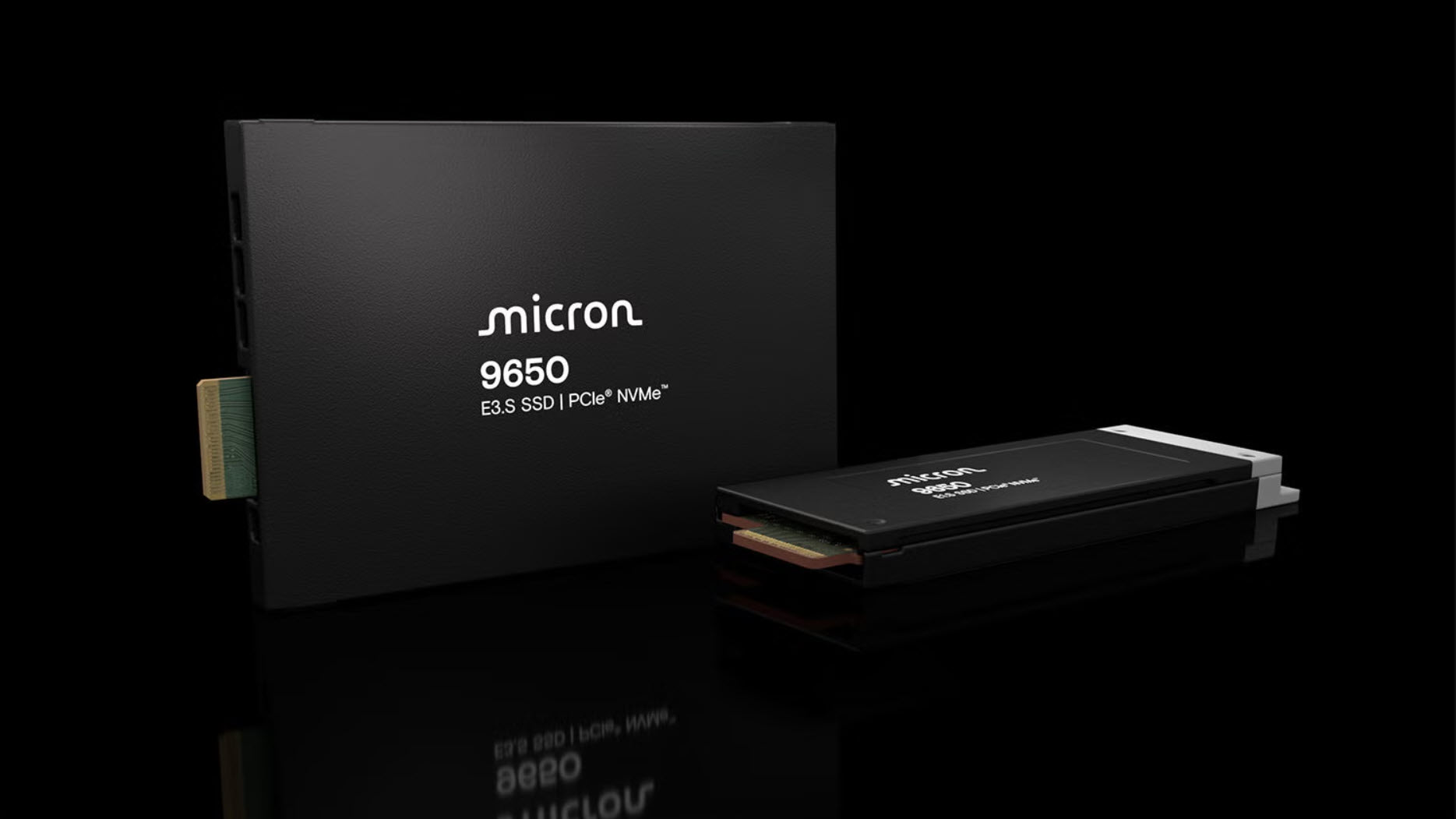
The drive’s efficiency gains are equally notable. Compared to Gen5 SSDs, the 9650 delivers
- 2x better MB/s per watt (read)
- 1.4x better MB/s per watt (write)
- 1.7x better KIOPS per watt (random read)
- 1.2x better KIOPS per watt (random write)
This efficiency isn’t just a technical detail. With AI infrastructure consuming an ever-larger share of global power, storage that delivers more performance per watt directly impacts a data center’s sustainability and operational costs.
Who Benefits—and When?
The 9650 isn’t a consumer upgrade; it’s a data center and AI-focused solution. Early adopters will likely include cloud providers, hyperscale operators, and enterprises running large-scale AI workloads. For these users, the drive’s speed and efficiency could mean faster model training, reduced energy costs, and the ability to handle larger datasets without upgrading entire infrastructure.
Yet, the broader impact may be architectural. By enabling direct data movement between storage and accelerators, PCIe Gen6 drives like the 9650 could accelerate the shift toward coherent memory architectures, where storage and compute resources operate as a unified system. This could be particularly transformative for AI, where data movement is often the bottleneck.
Micron’s move into mass production signals that this transition is underway. With the 9650 now qualified by major OEMs and AI data center customers, the industry is at a turning point: storage is no longer just a supporting component but a performance determinant in its own right.