Bungie’s Marathon is breaking new ground as an extraction shooter, prioritizing player-versus-player dynamics over cooperation—a sharp departure from its predecessor.
Recent server slam playtests revealed a game where conflict isn’t just allowed but actively encouraged. Even when mechanics suggested teamwork—such as shared objectives or squad-based missions—the systems consistently steered players toward confrontation. Offering help to a lone runner often met with hostility rather than gratitude, with most players focused on securing loot or eliminating rivals.
This shift represents a deliberate move away from Arc Raiders, where pacifist lobbies thrived even before the game’s reputation was solidified. Marathon appears set to double down on PvP, with multiple design choices reinforcing this direction.
Runner Classes Are Built for Combat
The Runner shells (classes) are a clear indicator of this focus. Abilities like wallhacking, cloaking, and rocket barrages aren’t just powerful—they’re designed to exploit opponents’ positions or movement patterns. A passive skill that reveals an enemy squad if one member is eliminated turns every encounter into a high-stakes gamble.
Some contracts further emphasize this PvP focus. An early mission from one of Marathon’s factions demands players kill or damage other runners, turning every extraction into a free-for-all. While Embark avoided making PvP mandatory for quests—opt instead for optional side challenges that encouraged conflict—Marathon seems to be taking that approach even further.
The UESC Faction Challenges the Default Narrative
Subjectively, the UESC faction doesn’t carry the same cooperative appeal as Arc Raiders’ Arc. The UESC’s bots are aggressive and best avoided, but their close-quarters combat style and proximity to cover make them feel like an individual burden rather than a shared enemy. Their humanoid design also blurs the line between player and NPC; without distinct squad markers, anyone shaped like a person is assumed hostile—a subtle psychological nudge toward aggression.
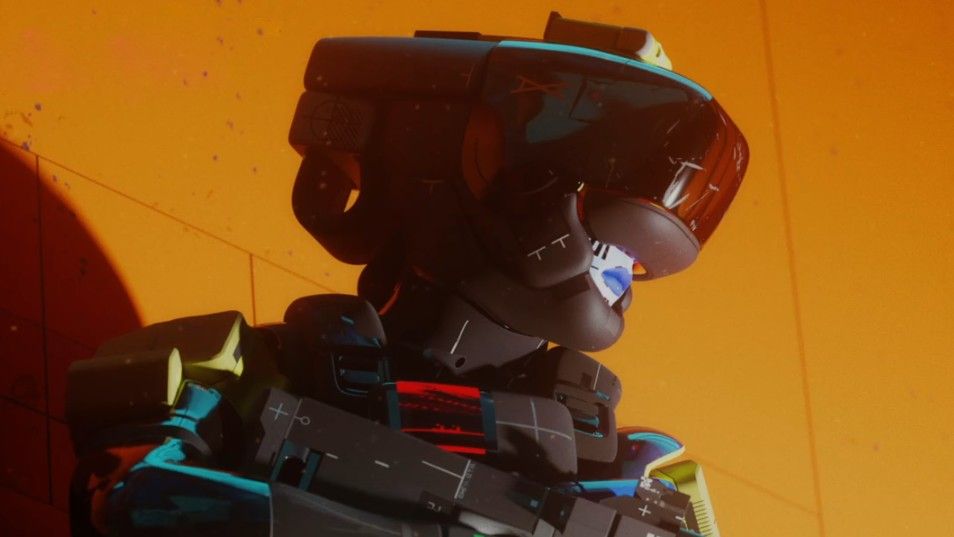
Visual cues reinforce this hostility. Players emit a bright red glow intermittently, their reticle turns red when targeting others, and even microphone symbols are stained with the same color—universal signals that cooperation is an exception, not the rule.
- Players glow bright red intermittently
- The reticle becomes red when aiming at others
- Microphone symbols are red for strangers
A Gun Always in Hand
One of the most striking differences from Arc Raiders is the absence of a holster button. In that game, players could tuck away their weapons, creating moments of tension and release. Here, the gun is always in hand—both literally and metaphorically.
This isn’t just a mechanical choice; it’s a psychological one. Marathon is an FPS through and through, with Bungie’s signature techy guns feeling incredible to fire. The weapon dominates the screen, reinforcing that shooting is the primary action. Even when not engaged in combat, the player’s identity is tied to their ability to pull the trigger.
This contrasts sharply with Arc Raiders, where players were full-bodied avatars capable of non-violent actions—ducking behind cover, dodging detection beams, or rummaging through drawers. Those moments of stealth and exploration gave the game a broader definition of action. In Marathon, if you’re not shooting, it often feels like you’re not fully engaged.
Whether this shift will resonate with players remains an open question. The community could surprise developers just as it did in Arc Raiders, where pacifism became a cultural norm despite the game’s systems. But if Marathon leans into its PvP roots, it may carve out a niche akin to Escape from Tarkov—a game where tension and conflict are the default, not the exception.