The transition from discrete laser modules to Lightmatter’s integrated VLSP platform carries immediate consequences for data center design. Current AI workloads—particularly those leveraging distributed training or large language model inference—require photonic links capable of sustaining terabits of throughput without latency spikes. The **Guide light engine** achieves this by embedding lasers directly into silicon photonics, eliminating the need for epoxy bonds and manual assembly that historically limited optical output to sub-100 milliwatt levels.
This architectural shift directly addresses three critical pain points
- Thermal constraints: Traditional ELSFP modules generate heat at the interface between InP lasers and silicon photonics, requiring active cooling and limiting integration density. VLSP’s monolithic design distributes heat more evenly, allowing for **100 mW per fiber**—a tenfold improvement over legacy solutions.
- Scalability bottlenecks: Adding bandwidth in conventional systems demands more modules, each with its own power and thermal overhead. VLSP scales horizontally by stacking wavelengths within a single package, supporting up to **64 channels** without proportional increases in footprint or energy use.
- Wavelength precision: AI networks demand **±20 GHz** channel spacing with sub-decibel uniformity—a tolerance that discrete lasers struggle to maintain over time. Lightmatter’s closed-loop control system locks wavelengths to within **0.1 dB**, ensuring stable DWDM performance even as traffic patterns fluctuate.
The **400 GHz-spaced grids** at **200 GHz offsets** enable a level of spectral efficiency that conventional systems cannot match. This isn’t merely incremental improvement; it’s a redefinition of what’s possible in photonic interconnects. For example, a single VLSP module can deliver **51.2 Tbps**—equivalent to the combined output of eight high-end ELSFP modules—while occupying less than one-tenth the space.
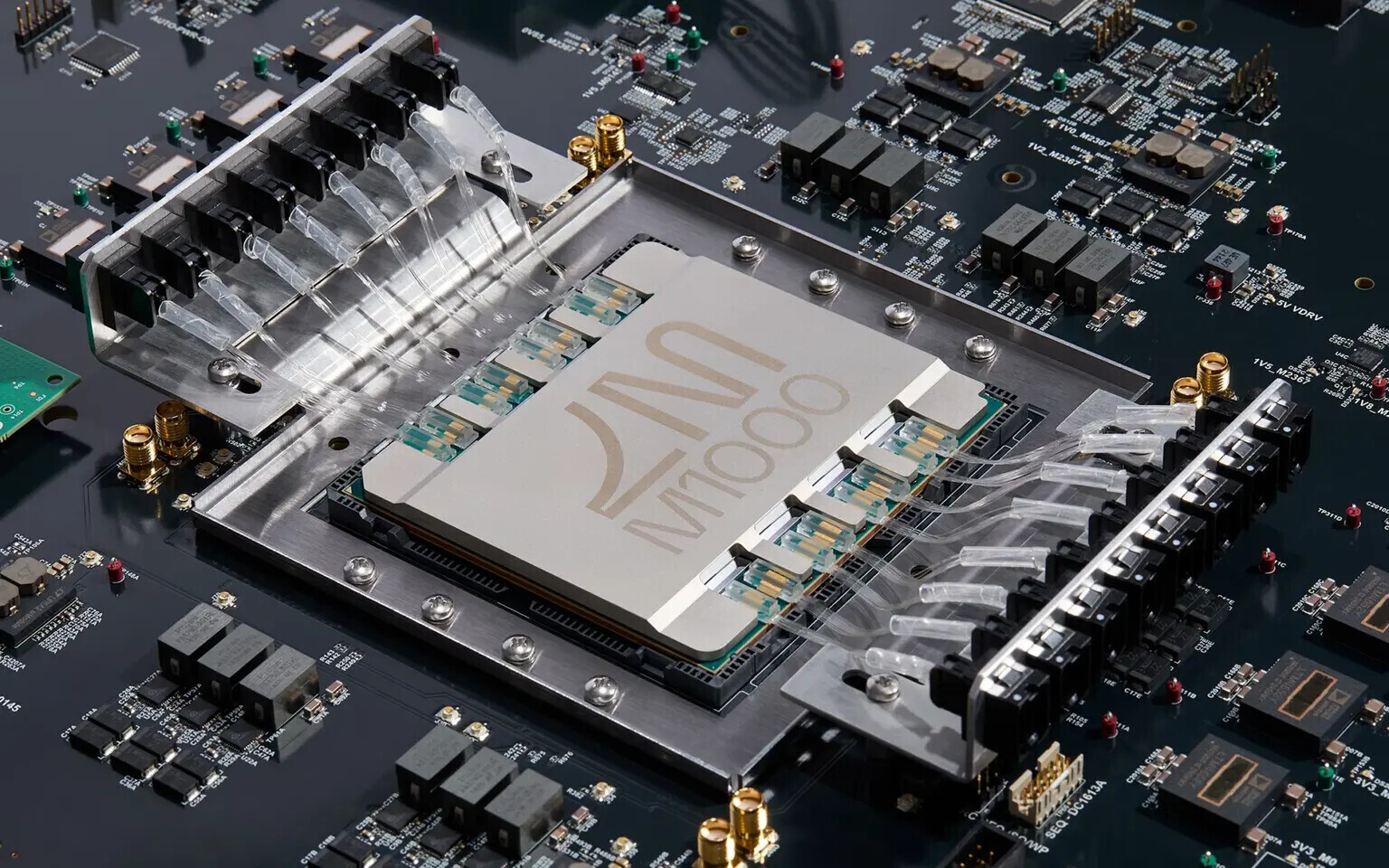
The broader impact on AI infrastructure is twofold. First, it accelerates the adoption of **co-packaged optics (CPO)**, where photonic components are integrated directly onto the CPU or GPU die. Lightmatter’s platform provides the necessary light sources to make CPO viable at scale, reducing latency and power consumption in high-performance computing clusters. Second, it lowers the barrier to deploying **full-duplex optical links**, where data travels simultaneously in both directions over the same fiber. This capability is essential for next-generation AI networks, where bidirectional communication can cut training times by half.
Industry adoption will depend on two key factors: cost and compatibility. Lightmatter’s foundry approach suggests long-term price reductions as production scales, though initial deployment costs may remain elevated compared to discrete lasers. Compatibility with existing data center architectures is less of an issue, as VLSP modules are designed to interface with standard optical transceivers and switching fabrics. The real challenge lies in convincing hyperscale operators to transition from proven—but limited—ELSFP solutions to a new paradigm.
Looking ahead, Lightmatter’s **Passage M-Series and L-Series switches** will serve as the first commercial applications of the VLSP platform. These systems are positioned to dominate the **100 Tbps to 1 Pbps** switching market, where traditional architectures would require impractical rack space and cooling infrastructure. The technology’s ability to scale from near-package optics to long-reach DWDM suggests it could underpin not just AI data centers, but also next-generation telecom and supercomputing networks.
The long-term question is whether Lightmatter’s innovation will spark a broader shift in photonic manufacturing. If foundry-scale production of lasers becomes the industry standard, the implications for cost, performance, and scalability could rival the semiconductor industry’s own transitions from discrete transistors to integrated circuits. For now, the **Guide light engine** stands as a proof point: a demonstration that photonic interconnects can evolve beyond their historical limitations—if the right architecture is in place.