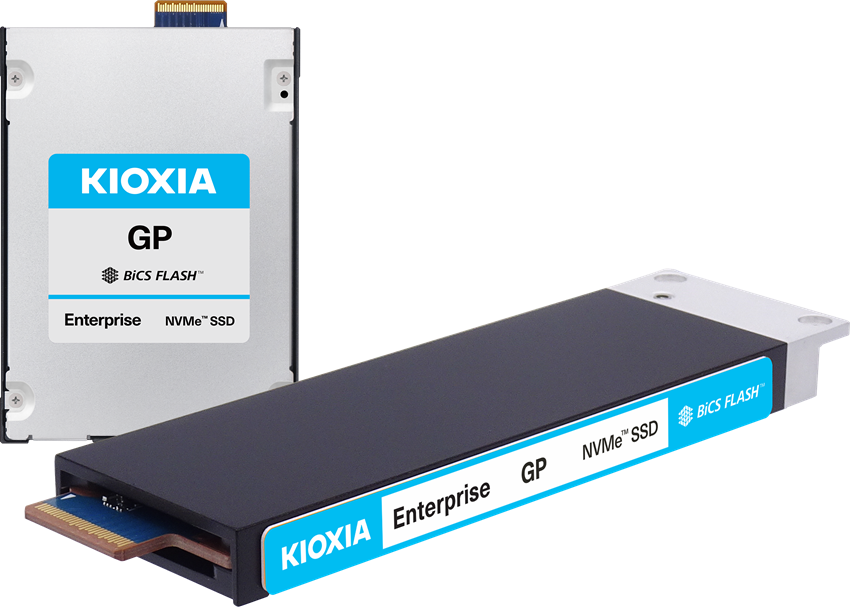
workloads are pushing storage solutions to their limits. KIOXIA’s GP Series SSD aims to address this challenge by integrating directly with NVIDIA’s platform, extending GPU memory and improving performance in high-demand environments.
The GP Series is built around XL-FLASH technology, which KIOXIA claims delivers faster data transfer speeds and lower latency compared to traditional SSDs. This is particularly relevant for AI training and inference tasks, where rapid access to large datasets can significantly impact operational efficiency.
Key Specifications
- Capacity: 1TB, 2TB, 4TB (confirmed models)
- Interface: PCIe 5.0 x4
- Form Factor: M.2 2280
- Endurance: Up to 1,000 TBW (terabytes written)
- Performance: Sequential read/write speeds up to 14,000 MB/s and 12,000 MB/s respectively
- Power Consumption: Designed for low-power operation, suitable for data centers
The drive’s PCIe 5.0 interface ensures compatibility with next-generation GPUs, making it a strong candidate for AI workloads that require both speed and scalability. Its endurance rating suggests it’s built to handle the rigorous demands of continuous AI training sessions without significant performance degradation.
Why It Matters
For IT teams managing AI infrastructure, the GP Series SSD could offer a tangible reduction in operational costs. By extending GPU memory, the drive allows for more efficient data processing, potentially reducing the need for additional GPU resources or cooling solutions. This is especially valuable in large-scale deployments where every performance gain translates to cost savings.
However, the real-world impact will depend on how well KIOXIA can integrate this technology into existing AI workflows. While the specs are impressive, adoption will hinge on seamless compatibility with NVIDIA’s ecosystem and the ability to deliver consistent performance under varying workload conditions.
The GP Series SSD is positioned as a tool for those at the forefront of AI development—researchers, data centers, and enterprises running demanding models. If it lives up to its promises, it could become a critical component in the push toward more efficient and scalable AI systems.