Memory technology is about to get a major upgrade, and Kioxia is leading the charge. The company has begun sampling its latest embedded flash memory, built around the emerging UFS 5.0 standard—a specification still under development by JEDEC but already poised to become the backbone of next-gen mobile devices.
The push for UFS 5.0 isn’t just about incremental improvements. It’s about meeting the explosive demands of smartphones that increasingly rely on on-device AI, high-resolution video, and seamless multitasking. Kioxia’s new chips leverage MIPI M-PHY version 6.0 and UniPro version 3.0, with a new HS-GEAR6 mode that theoretically maxes out at 46.6 Gbps per lane. When paired with dual lanes, that translates to roughly 10.8 GB/s of effective read/write performance—nearly double what UFS 4.1 offers today.
But speed isn’t the only innovation here. Kioxia has also engineered a compact 7.5 x 13 mm package for its evaluation samples, ensuring that device manufacturers won’t sacrifice board space for performance. The samples come in 512 GB and 1 TB capacities, using the company’s 8th-generation BiCS FLASH architecture alongside a custom UFS 5.0 controller.
Why This Matters for Mobile Tech
For developers and OEMs, this move is a critical step toward building devices that can handle the future workloads of mobile AI. The samples are already in the hands of select partners working on UFS 5.0-compatible systems, allowing them to test performance and interoperability before mass production.
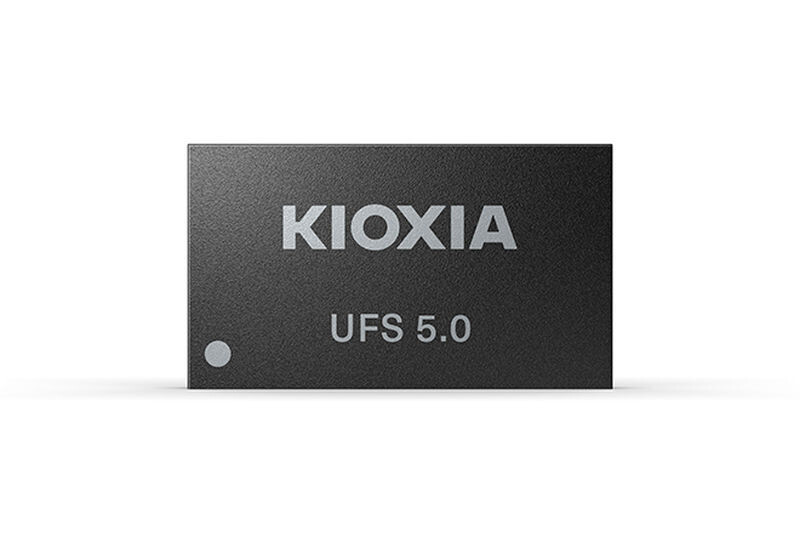
- Performance: Up to 10.8 GB/s with dual-lane HS-GEAR6 mode, a near-2x boost over UFS 4.1.
- Capacity: Available in 512 GB and 1 TB configurations, catering to high-end storage needs.
- Form Factor: A 7.5 x 13 mm package for efficient board integration.
- AI-Ready: Designed to support the bandwidth demands of on-device AI and 8K video.
- Timing: Samples are now available, with full standardization expected as UFS 5.0 matures.
The announcement comes as Kioxia continues to expand its footprint in both consumer and enterprise storage. Just last year, the company introduced QLC UFS 4.1 devices for high-capacity mobile storage and previewed PCIe 5.0 M.2 SSDs at CES 2026. With UFS 5.0 now in the hands of early adopters, the stage is set for a new era of mobile performance—one where flagship smartphones can keep up with the most demanding applications.
For now, the focus remains on evaluation and refinement. But if the past is any indication, Kioxia’s UFS 5.0 chips could become a cornerstone for the smartphones of 2027 and beyond.