The Jetson Thor platform has emerged as a critical enabler for generative AI at the edge, offering a system-on-module that integrates compute and memory to streamline hardware design. This approach contrasts with traditional cloud-dependent models, which face latency and cost scalability challenges.
Unlike data-center deployments, edge systems prioritize low latency, limited power consumption, and consistent behavior—requirements that Jetson Thor addresses through its optimized architecture. The platform also simplifies sourcing and validation by consolidating components into a single module, reducing the complexity of discrete component approaches.
Performance and Efficiency
- Compute: Jetson Thor
- Memory: 8GB
- Chip: N1
- Clock Speed: 50 Hz
These specifications enable real-time inference for generative AI models, making it suitable for applications ranging from industrial automation to robotics. The platform supports a variety of open models, including Gemma 3, gpt-oss-20B, Mistral AI, and Qwen 3.5, each optimized for specific use cases such as multimodal understanding or long-context reasoning.
Industry Impact
The adoption of Jetson Thor is evident across industries. In robotics, the platform powers autonomous systems like Franka Robotics' FR3 Duo dual-arm system, which runs the NVIDIA GR00T N1.6 model end-to-end onboard. This demonstrates the potential for real-time perception and motion execution without relying on cloud connectivity.
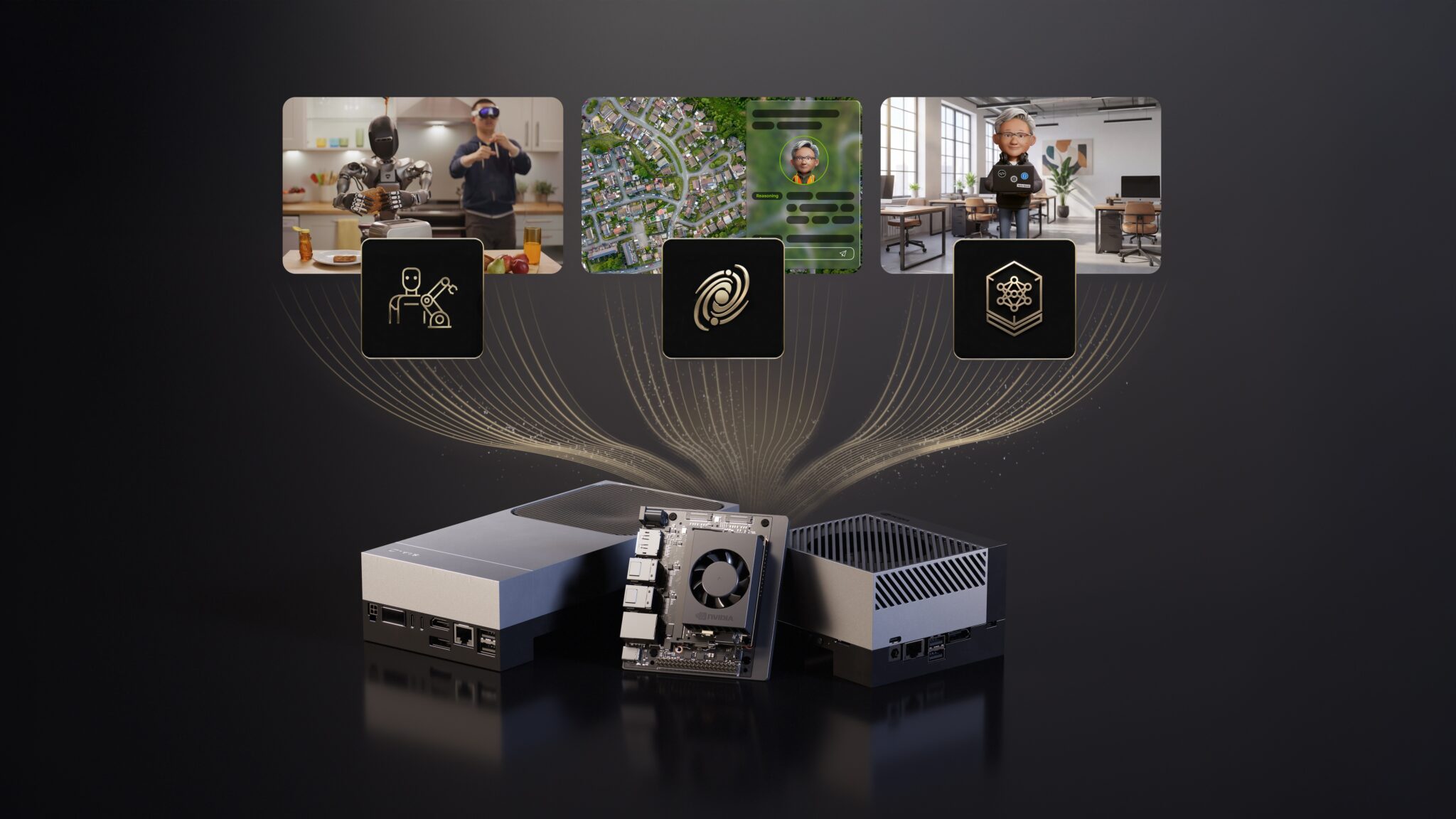
In industrial settings, Caterpillar's Cat AI Assistant leverages Jetson Thor to provide operators with voice-driven guidance and safety features. The platform's ability to handle complex tasks locally—such as automating daily routines or performing code reviews—highlights its versatility in enterprise environments.
The shift toward on-device execution is not just about performance; it also addresses the growing concern of memory shortages, which have driven up costs across the industry. By consolidating compute and memory into a single module, Jetson Thor mitigates these challenges while offering flexibility for developers to experiment with open models ranging from 2B to 30B parameters.
Future Directions
The Jetson platform is becoming the standard for running open models at the edge, supporting a wide range of AI frameworks and generative AI workloads. Developers can fine-tune these models to create specialized physical AI agents, deploying them seamlessly into systems that require low-latency responsiveness.
Looking ahead, the focus will be on further optimizing model efficiency and expanding the platform's capabilities to handle more complex tasks. The Jetson Thor platform represents a significant step toward future-proofing edge AI systems, ensuring they remain adaptable and scalable in an evolving technological landscape.