Intel’s stock price has climbed back to levels last seen in early 2022, marking a dramatic reversal from the company’s low point in April 2025 when it hit $17.63 per share. The recent surge, which has pushed the stock to $54.16—a 44.8% increase over just 13 trading days—reflects broader shifts in investor sentiment toward the semiconductor giant.
This resurgence comes against a backdrop of significant challenges for Intel, including executive restructuring, delayed foundry projects, and financial pressures that eroded market confidence. Yet, the company’s trajectory appears to be changing under CEO Lip-Bu Tan, whose leadership has introduced cost-saving measures—projected at $10 billion in operating expense reductions—and a more aggressive roadmap for its foundry business.
One of the key catalysts for Intel’s recovery is its role in supporting U.S. semiconductor independence, a priority that gained momentum under both Democratic and Republican administrations. The U.S. government’s $8.9 billion investment in Intel, made when the stock was trading at $20.47 per share, secured a 9.9% stake in the company. This support, combined with Intel’s recent product launches—such as the Core Ultra 300 series—has reignited investor faith, pushing the market capitalization back toward $254 billion.
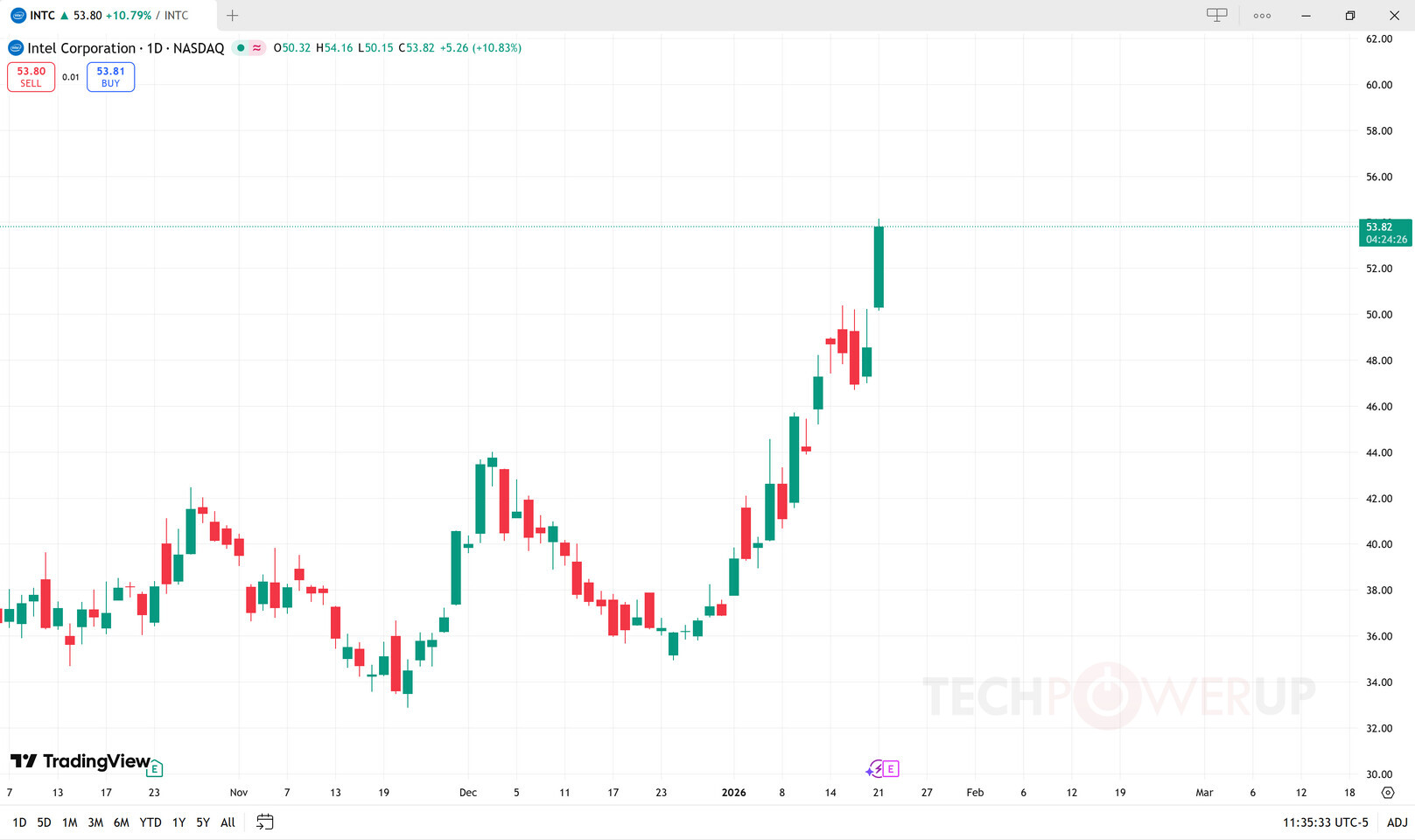
However, questions remain about whether this momentum is sustainable. While Intel has made strides in regaining its footing in the competitive semiconductor landscape, competitors like NVIDIA and AMD continue to push boundaries with their own innovations. The company’s ability to maintain this upward trajectory will hinge on its execution of new technologies, including advanced packaging solutions that could position it as a leader in the next generation of silicon manufacturing.
Intel is set to report its Q4 2025 earnings and full-year outlook on January 22, offering further insight into its financial health and strategic direction. For now, the stock’s performance suggests a turning point for Intel—but whether this marks the beginning of a lasting recovery or another temporary spike remains to be seen.