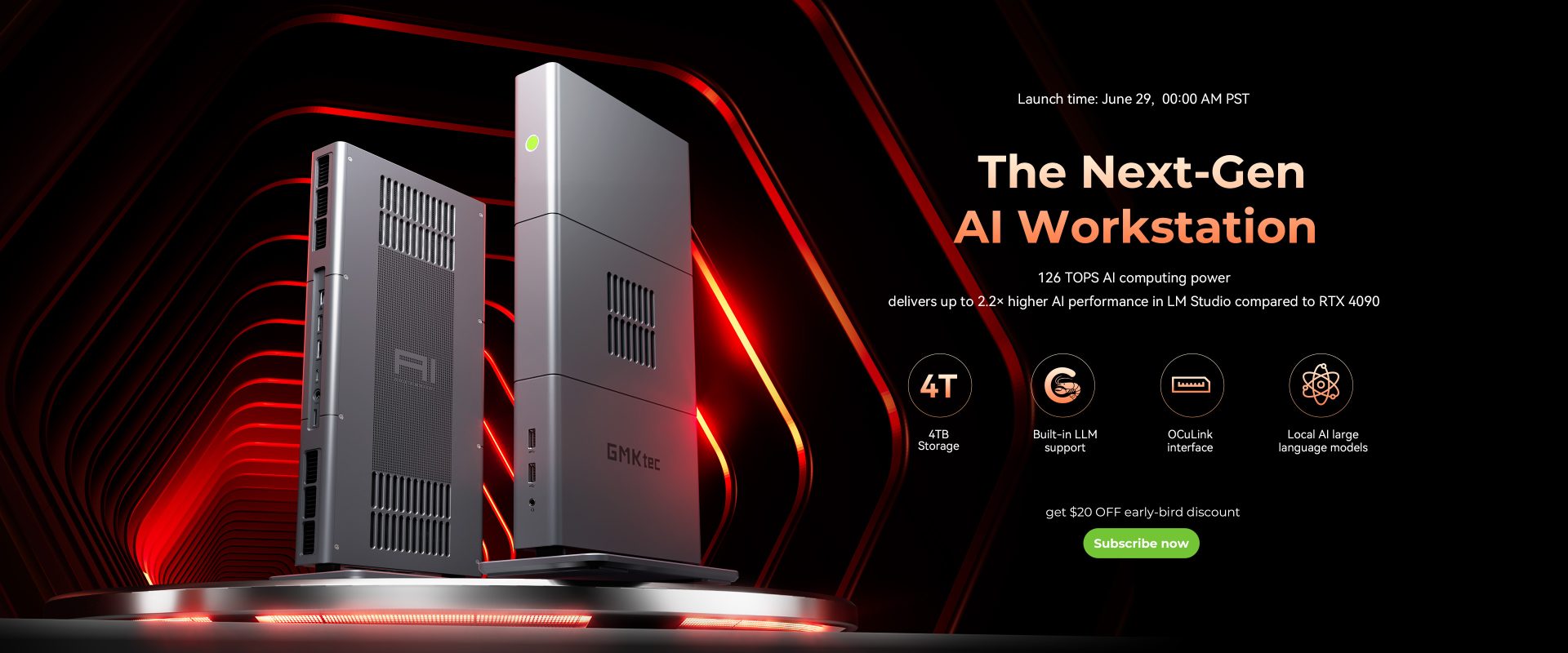
The EVO-X3 is a workstation that redefines what can fit inside a PS4-sized chassis. It doesn't just cram more power into a small box—it delivers real-world performance that rivals enterprise-grade systems, all while staying within the footprint of a gaming console.
At its core, the EVO-X3 features 128 GB of DDR5 memory paired with an AMD Ryzen AI MAX+ 395 processor. This combination is designed to handle heavy workloads, from AI development to high-end graphics rendering, without sacrificing space efficiency. The system's compact design is a deliberate choice, blending the portability of consumer hardware with the raw power typically reserved for data center applications.
Key Specifications
- Processor: AMD Ryzen AI MAX+ 395 (16 cores, 32 threads)
- Memory: 128 GB DDR5 (up to 4800 MHz)
- Storage: Up to 8 TB NVMe SSD
- GPU: Optional NVIDIA RTX 4090 or AMD Radeon Pro W7900X
- Thermals & Power: Active cooling with a TDP of 125W for the CPU, scalable GPU options
The EVO-X3 isn't just about raw specs—it's about how those specs translate into real-world performance. For developers working on AI models or rendering complex scenes, the 128 GB of memory ensures that even the most demanding tasks run smoothly without hitting bottlenecks. The Ryzen AI MAX+ 395, with its integrated AI acceleration, is a notable addition, offering capabilities that were once exclusive to high-end workstations.
Performance in Practice
While the EVO-X3's performance is impressive on paper, its real strength lies in its balance of power and portability. The system can handle workloads that would typically require multiple machines, but it does so without sacrificing space or efficiency. However, this comes with tradeoffs—thermal management becomes a critical factor, especially when paired with high-end GPUs like the RTX 4090. Users will need to monitor temperatures closely to ensure sustained performance.
The EVO-X3 is positioned as a challenge to NVIDIA's DGX Spark, but it takes a different approach. Where the DGX Spark is optimized for data center workloads, the EVO-X3 is designed for developers and professionals who need that power on their desks or in compact spaces. It's not just about matching enterprise performance—it's about rethinking how workstations can be built without compromising on capability.
For enterprises looking to deploy high-performance systems without the footprint of traditional workstations, the EVO-X3 offers a compelling alternative. Its ability to pack 128 GB of memory and enterprise-grade processing into a PS4-sized chassis is a significant shift in how we think about compact computing. The question now isn't just whether it can match NVIDIA's offerings—it's whether it can redefine the expectations for what a workstation should be.