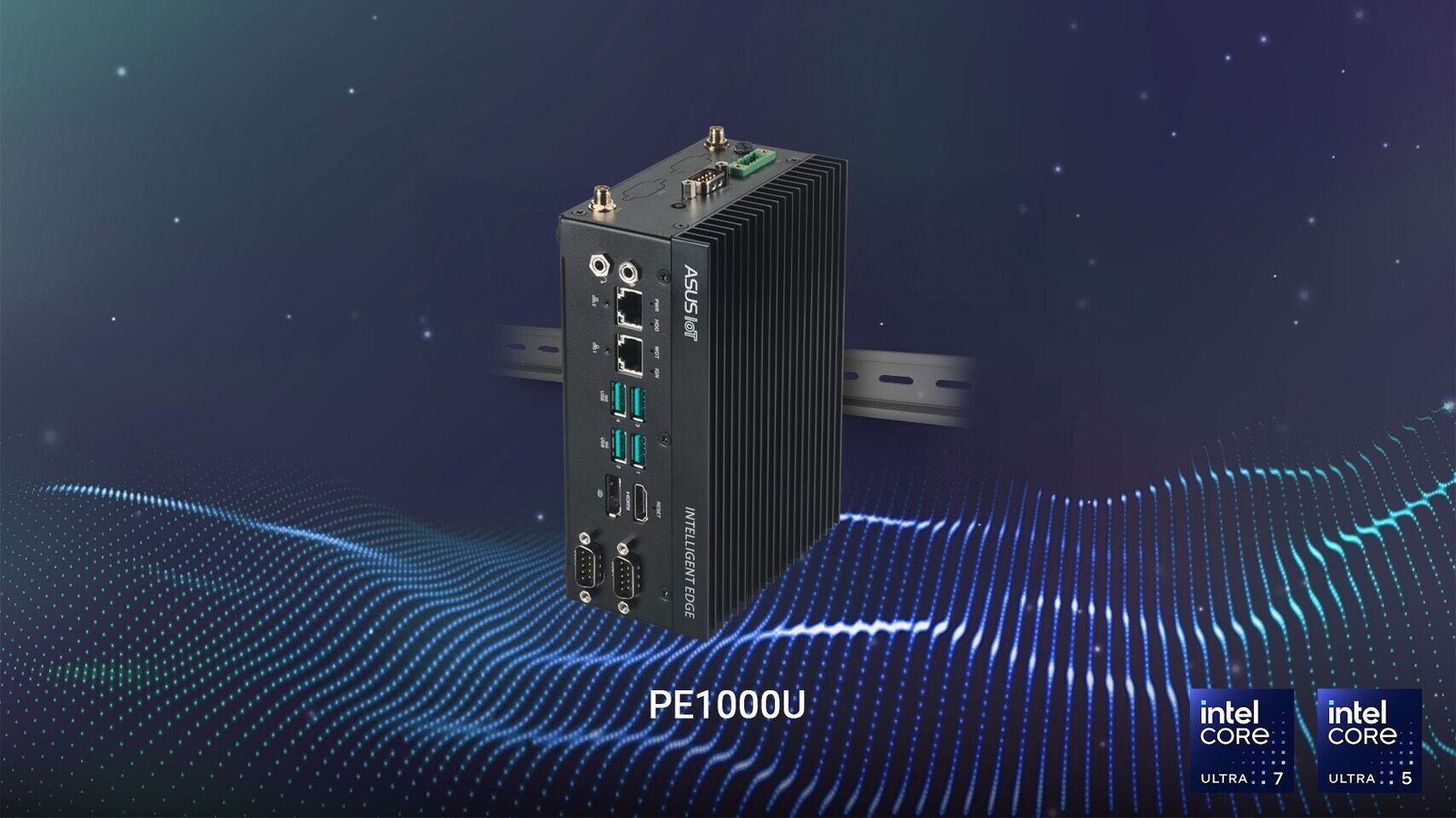
Industrial computing often demands ruggedness, precision, and silence—qualities that standard PCs struggle to deliver. ASUS IoT’s new PE1000U flips the script with a palm-sized edge computer that packs Intel’s latest Core Ultra 2 processors into a sealed, vibration-resistant chassis. Designed for deployment in factories, autonomous mobile robots (AMRs), and collaborative robotics, the PE1000U prioritizes durability over traditional cooling methods, eliminating fans entirely while maintaining performance in extreme temperatures.
Weighing in at just 63 x 110 x 160 mm, the PE1000U is small enough to mount on a DIN rail yet robust enough to withstand US MIL-STD-810H vibration testing (up to 5Grms) and operate reliably between -25°C and 70°C. Its wave-pattern aluminum heatsink dissipates heat passively, ensuring silent operation in environments where noise or dust would otherwise disrupt sensitive equipment.
A hybrid processor for edge intelligence
The heart of the PE1000U is Intel’s Core Ultra 2 series, specifically the 265U or 235U models. These chips combine CPU, GPU, and NPU acceleration, delivering both high single-thread responsiveness for motion control and AI inference capabilities for real-time decision-making. This hybrid approach is critical for applications like industrial vision systems or autonomous guided vehicles, where latency can mean the difference between efficiency and failure.
Connectivity is equally comprehensive. Front-access I/O includes four USB ports, up to four COM ports, and four Ethernet jacks (two defaulting to 2.5G speeds). Dual CAN Bus interfaces and an isolated DIO module ensure deterministic control for motor controllers and sensors, while DisplayPort and HDMI outputs support dual 4K displays—a must for human-machine interfaces (HMIs) or multi-camera machine vision setups.
Built for the edge, not the lab
The PE1000U’s DIN-rail form factor and fanless design make it ideal for space-constrained industrial deployments. Whether integrated into a collaborative robot’s arm, an AMR’s navigation system, or a laser processing station, its compact footprint and sealed enclosure reduce wiring complexity and eliminate maintenance headaches. The wide 9-36V DC power input and built-in ignition control further simplify integration into mobile or vehicle-based systems.
For applications requiring wireless connectivity, the PE1000U supports Wi-Fi 6E or 5G, enabling seamless communication with LiDAR, fleet management platforms, or cloud-based analytics. The combination of wired and wireless options ensures flexibility in both static and dynamic environments.
Who needs this?
The PE1000U isn’t a replacement for traditional workstations or gaming PCs—it’s a specialized tool for industries where uptime, precision, and environmental resilience are non-negotiable. Manufacturers deploying AMRs or cobots will appreciate its ability to handle vibrations without compromising performance. Computer vision engineers benefit from the isolated DIO and multi-Ethernet ports, which simplify the integration of high-speed cameras and strobe lighting. Even in semi-outdoor kiosks or semi-trucks, the PE1000U’s temperature range and passive cooling ensure reliability where traditional PCs would fail.
With no moving parts and a design tested for harsh conditions, the PE1000U redefines what’s possible in edge computing—proving that sometimes, the smallest solutions deliver the biggest impact.