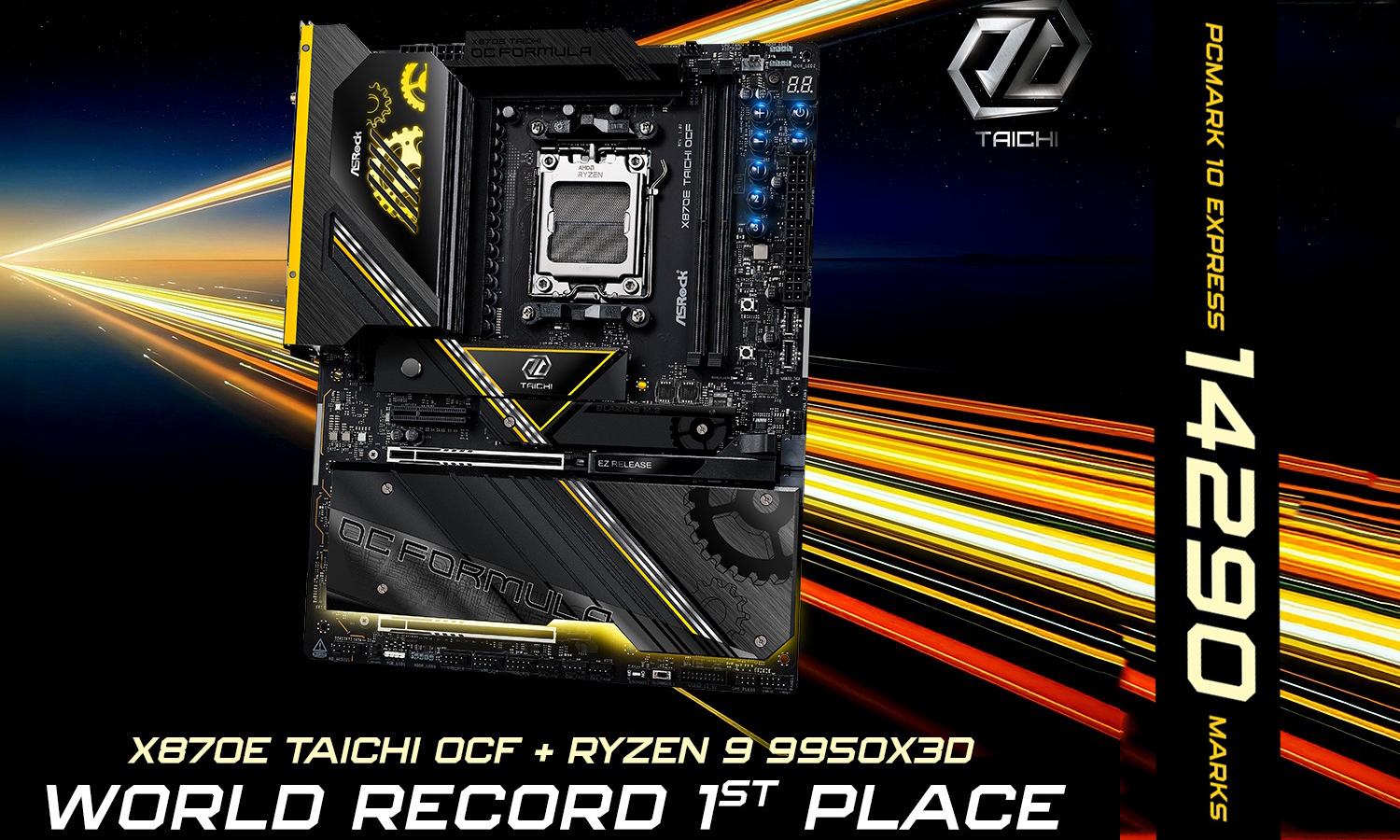
In a tightly contested benchmarking landscape, an overclocked system using AMD’s Ryzen 9 9950X3D has achieved a new world record in PCMark 10 Express. The result, which edges out the previous record held by an Intel Core i9 14900K setup, underscores how closely AMD is competing with Intel in both synthetic and real-world performance metrics.
The new record of 14,290 marks was set on an ASRock X870E Taichi OCF motherboard, a platform renowned for its overclocking capabilities. The CPU was pushed to 6.37 GHz using nitrogen cooling, demonstrating the potential of AMD’s latest processor when optimized for extreme performance.
Key Specifications
- CPU: Ryzen 9 9950X3D (overclocked to 6.37 GHz)
- Motherboard: ASRock X870E Taichi OCF
- Cooling: Nitrogen cooling solution
- Benchmark Score: 14,290 marks in PCMark 10 Express
The achievement is notable not only for the marginal improvement over Intel’s record but also because it represents a shift in how AMD’s processors perform in complex workloads. While Intel has long dominated synthetic benchmarks like Cinebench and 3DMark, real-world performance—particularly in productivity tasks—has seen AMD close the gap significantly.
Why This Matters
The Ryzen 9 9950X3D’s success in PCMark 10 Express suggests that its 3D V-Cache architecture is delivering tangible benefits in multi-threaded applications, a category where Intel has historically held an advantage. The fact that this record was set with overclocking—rather than stock speeds—also raises questions about whether AMD’s latest processors can maintain this lead without aggressive tuning.
That said, the 10-mark difference between this result and the previous Intel record is deceptively small. PCMark 10 Express is a rigorous test of system performance, and such close margins indicate that both platforms are now operating at the upper limits of what current hardware can achieve. For end users, this means that choosing between AMD and Intel may increasingly come down to factors beyond raw performance—such as power efficiency, thermal behavior, or software optimization.
What’s Next
The real test for AMD will be whether this record holds up in sustained workloads or if it’s an outlier driven by extreme overclocking. Intel’s dominance in CPU frequency records suggests that pushing clocks higher remains a viable path to performance gains, but it also comes with tradeoffs in stability and longevity. Observers will be watching how often new PCMark 10 Express records emerge, given the benchmark’s rarity compared to other synthetic tests. If AMD can replicate this result across more benchmarks without relying on extreme overclocking, it could signal a broader shift in the performance landscape.
For now, the record stands as a milestone, but whether it translates into real-world advantages for users remains an open question. The next few months will determine if this is the start of a new era or merely a brief blip in AMD’s journey toward parity with Intel.