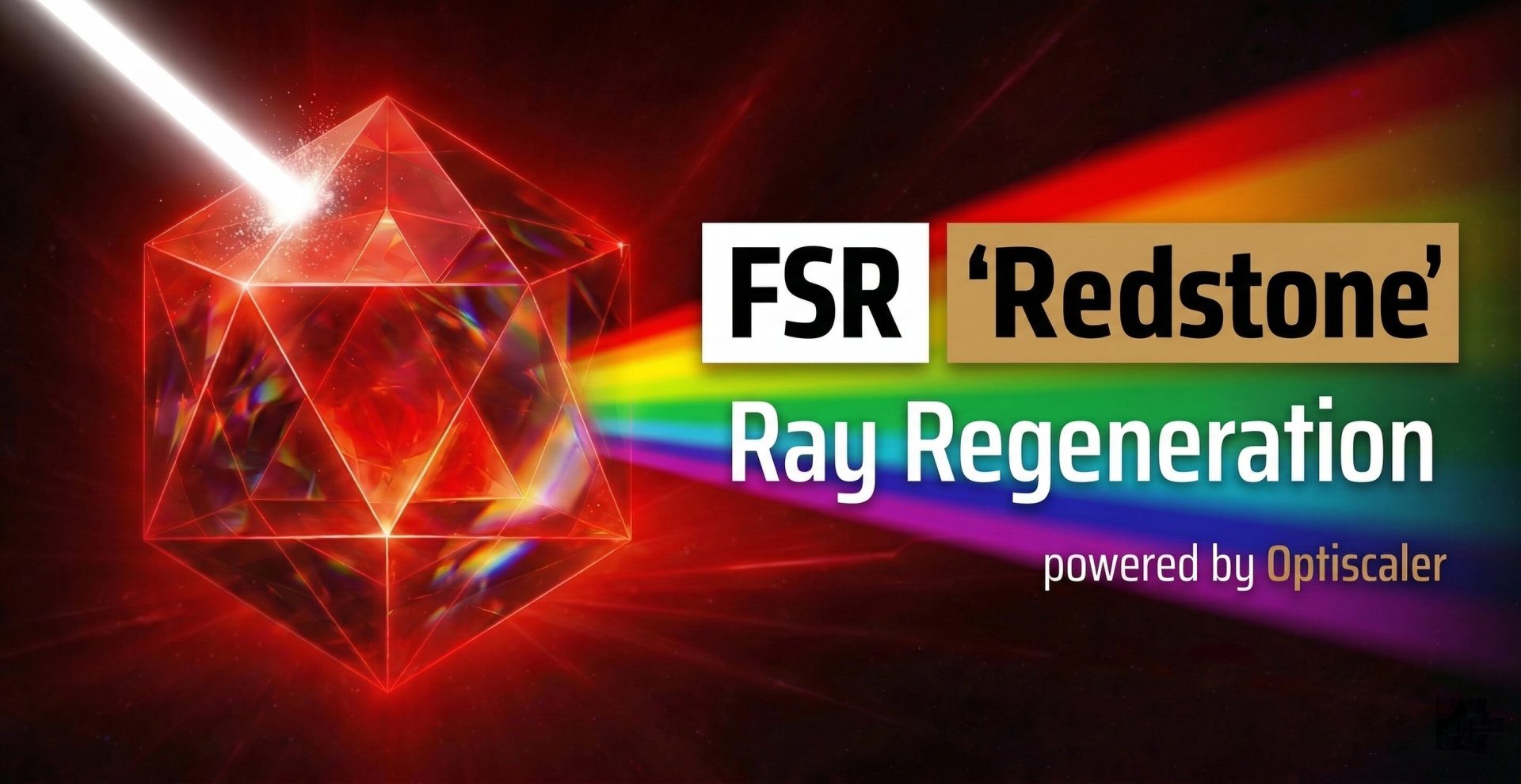
AMD's RX 9000 series graphics cards are now capable of running path tracing with usable performance, and a new development could significantly expand their compatibility with ray-traced games. A community-driven mod, built on the Optiscaler framework, has successfully integrated AMD's Ray Regeneration denoiser into Cyberpunk 2077, bypassing the need for official support.
This is not an official release but a technical preview that demonstrates what could be possible with future updates. The integration allows users to leverage AMD's RDNA 4-based GPUs for ray-traced rendering in games that currently rely on Nvidia's DLSS Ray Reconstruction. The mod works by translating the input data from Nvidia's pipeline into a format compatible with AMD's Ray Regeneration, effectively enabling cross-platform upscaling.
Key Technical Details
- Compatibility: Currently limited to RDNA 4 cards for both Ray Regeneration and FSR 4.1 support. RDNA 3 cards may work on Linux with additional modifications, but this is not yet confirmed.
- Performance Impact: The mod introduces a noticeable performance penalty due to the translation process required to adapt Nvidia's input data for AMD's pipeline. This is expected to improve in official implementations.
- Visual Improvements: Ray Regeneration provides richer global illumination, clearer reflections (particularly on metallic surfaces), and enhanced light interaction with volumetrics like fog, offering a more realistic rendering experience compared to the default denoiser.
The mod also introduces a visual artifact described as a 'wobbling' instability, which resembles shimmering or noise. While this is a regression from the default denoiser, it may be resolved in official implementations where the translation process is optimized. The performance impact is significant, with Ray Regeneration consuming more resources than Nvidia's equivalent.
Why This Matters
This development highlights the potential for AMD's RDNA 4 architecture to deliver high-quality ray-traced rendering in a broader range of games. While the mod is currently limited to Cyberpunk 2077, it serves as a proof-of-concept that could pave the way for official support in future titles. For IT teams and developers, this demonstrates the importance of cross-platform compatibility in upscaling technologies, particularly as ray tracing becomes more prevalent.
What to Watch Next
The next steps will likely involve official integration by AMD or the Optiscaler team, expanding compatibility beyond Cyberpunk 2077. Developers should monitor updates for potential performance optimizations and broader game support. For end-users, this could mean access to advanced denoising techniques in games that currently lack native support, but with the caveat of potential performance tradeoffs.
While the current implementation is not without its issues, it represents a significant step forward in AMD's ability to compete in the ray-traced upscaling space. The focus now shifts to refining the technology and expanding its reach across more titles, ensuring that users on RDNA 4 hardware can fully leverage the capabilities of their GPUs.